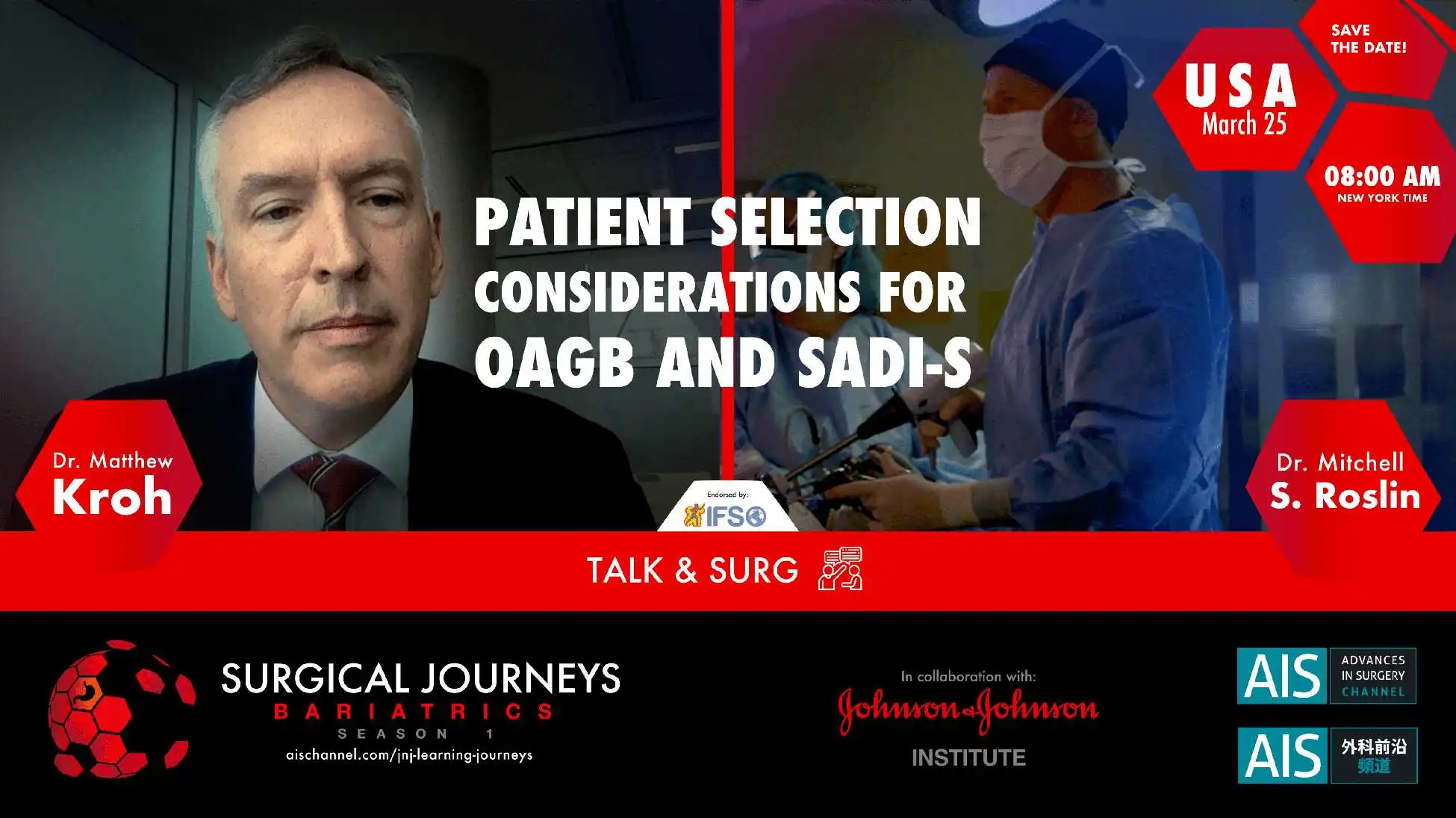
Dr. Matthew D. Kroh and Dr. Mitchell S. Roslin present Patient Selection Considerations for OAGB and SADI-S.
Case Record:
Single anastomosis duodenal switch: SADI SIPS
Clinical History:
34-year-old female with super morbid obesity, insulin resistance, gestational diabetes, with a BMI of 52.
Technique Description:
Clinical Background
Measure bowel (300cm) from terminal ileum rotating to right upper quadrant and mark: Omental division not necessary
Dissect all posterior gastric adhesions so blood supply is only on lesser curvature elevating pylorus
On greater curve, dissect past pylorus (bipolar radiofrequency helpful)
Dissect the greater curvature to base of left crus
Divide duodenum on top of gastroduodenal artery and take superior tissue to allow it to centralize and eliminate tensión from anastomosis (use buttress)
Sleeve over 42 bougie starting 5 cm from pylorus and make straight
Suture anastomosis
Technique Description
Procedure Steps:
Measure bowel and mark
Dissect greater curvature down past pylorus and up to base of left crus of diaphragm
Take all posterior adhesions
Divide duodenum with buttress
Sleeve over 42 bougie straight and around 5 cm from pylorus
Handsewn anastomosis using barbed suture. Place OG tube on top of posterior layer into efferent limb to test and make anterior layer simpler
Learning Points:
Measure appropriately and err on longer not shorter and why I use 300 cm
Take all the adhesions and this makes encircling duodenum simple
Buttress helpful when divide the duodenum
Don’t make the sleeve too small
Proper dissection allows for centralized anastomosis without tension


Share it with your network and help spread clinical knowledge.