with Dr. Vítor Cavadas, Dr. Daniel Pérez-Fentes
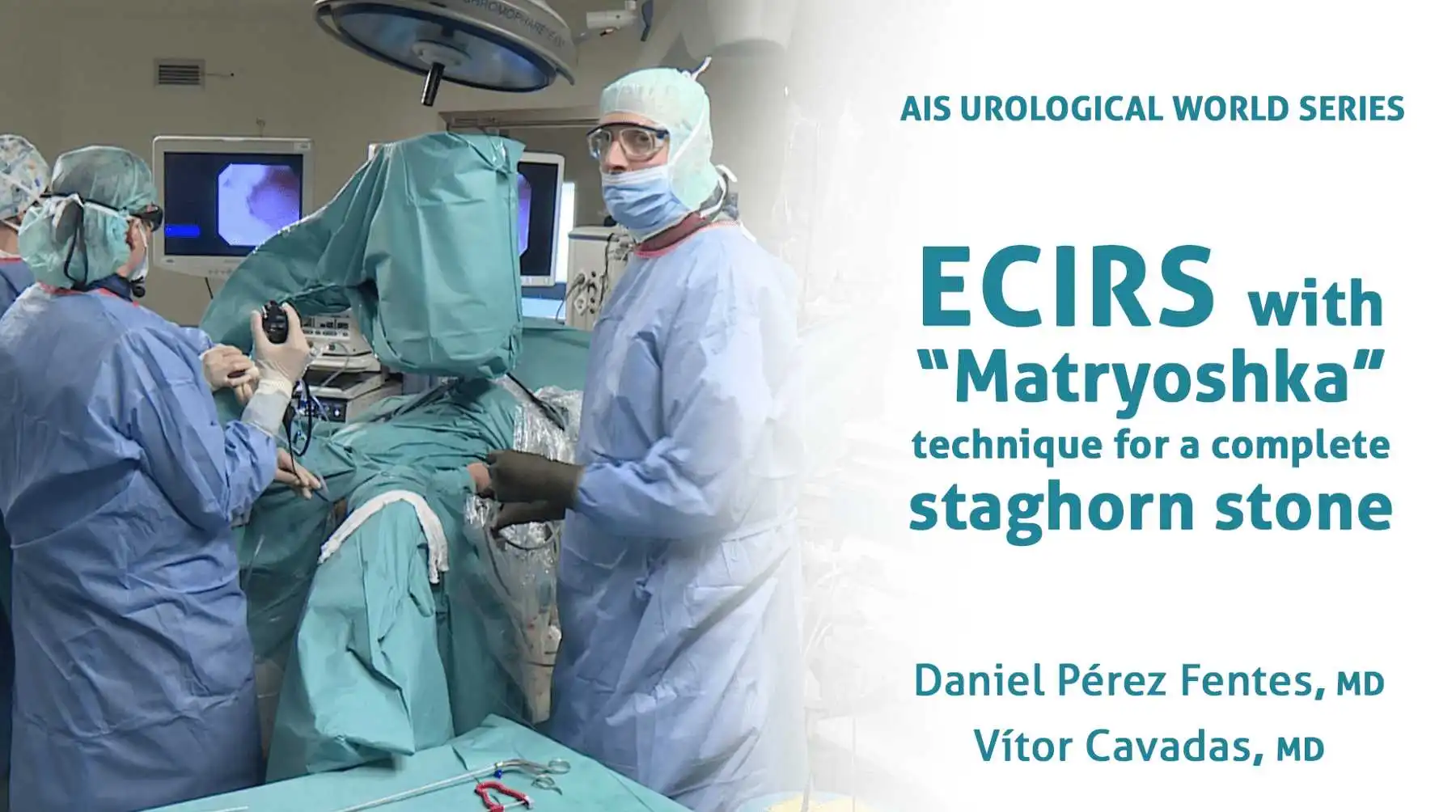
The patient was placed in the Galdakao-modified supine Valdivia position. A puncture was made under ultrasound and X-ray control in a posterior lower calyx, seeking a transpapillary puncture. The calyx entry was blocked, and the guidewire could not pass into the renal pelvis. An initial dilation of up to 16Ch was required to make room in this calyx access so to then place the guidewire in the ureter (“through and through” situation). A standard access (24Ch) was created using Amplatz serial dilators. A rigid nephroscope and lithotripsy using combined ultrasonic and ballistic energy with suction was used to remove the stone burden in the calyx access and renal pelvis. Flexible nephroscopy and laser were required to treat some fragments in the upper calyx and proximal ureter. Stones in the middle calyx were cleared out using a flexible ureteroscope inserted retrogradely (ECIRS) and extracted through the Amplatz sheath. A final endoscopic review did not reveal any residual fragments. At the end of the procedure a double J stent was placed without a nephrostomy tube, after having performed an endoscopic control of the percutaneous tract.
Clinical Background
Age: 50
Gender: female
Weight: 65 kg
Height: 1.68 m
BMI: 23 kg/m2
Diagnosis: Complete staghorn stone in the left kidney
Technique Description
Recurrent urinary tract infections and mild left loin pain
1. OR setup and patient positioning for ECIRS (Galdakao-modified supine Valdivia position)
2. Retrograde pyelography
3. US & X-ray guided puncture
4. Matryoshka technique: dilation up to 16Ch (mini PCNL) to then proceed to a dilation up to 24Ch (standard PCNL)
5. Ultrasonic and ballistic lithotripsy
6. Flexible nephroscopy
7. Flexible ureteroscopy (ECIRS)
8. Drainages
How to organize your OR for an ECIRS surgery in supine
Tips and tricks for a combined US & X-ray guided puncture in supine aiming at the tip of the papilla
Use of the sequential percutaneous tract dilation to overcome difficult situations in PCNL (Matryoshka technique)
Pros and cons of the different lithotripsy energies in percutaneous stone surgery
Rational use of flexible endoscopes in PCNL to minimize or avoid additional percutaneous accesses: the ECIRS concept
Drainage options: how and for whom?
No medical treatments
Previous surgeries: tonsillectomy, appendicectomy
ASA score: I
Preoperative urine culture: negative
Preoperative prophylaxis: amoxicillin + gentamicin
Dr. Pérez Fentes, Dr. Cavadas & Dr. Santamaría will show you all the steps and tricks!


Share it with your network and help spread clinical knowledge.