

Clinical Outcomes & Patient Safety, Market Access & Commercialization, Innovation & Emerging Technology
Mission
Our Mission is to enable healthcare providers around the world to deliver exceptional outcomes for patients, through accessible CONMED solutions.
CONMED is a global medical technology company that specializes in the development and sale of surgical and patient monitoring products and services that allow our physician customers to deliver high quality care and as a result, enhanced clinical outcomes for their patients.
Through its Advanced Endoscopic Technologies, Advanced Surgical, International, and Orthopedics units, CONMED serves the following medical specialties: orthopedic surgery, laparoscopic, robotic, and open surgery, gastroenterology, pulmonology and patient care.
Our broad portfolio focuses on the needs and wants of specific specialties while coming together at the point of care delivery to offer our customers the power of choice and the power of convenience.
Vision
Empower healthcare providers worldwide to deliver exceptional outcomes for patients. CONMED.... Imagine what we could do together.

Dr. Antonio M. de Lacy (Spain) and his team at the Hospital Clinic of Barcelona (Spain) will perform a totally robotic Roux-en-Y gastric bypass with the Da Vinci Xi platform and answer all your questions. Clinical History: A 46 years-old female with a history of obesity. Other History: Other comorbidities: mild non-alcoholic fatty liver disease. Technique description: Totally robotic Roux-en-Y gastric bypass (Da Vinci Xi platform). Procedure steps: Robotic docking. Performance of the gastric pouch. Division of the greater omentum. Measurement of the biliary limb. Performance of the gastro-jejunal anastomosis. Closure of Petersen defect. Measurement of the alimentary limb. Performance of the jejuno-jejunal anastomosis. Closure of the mesenteric defect. Final section to perform the Roux-en-Y. Trainings Objectives: Key-steps of Roux-en-Y gastric bypass. Robotic surgery, tips and tricks.
Published
Sep 2022

Dr. Antonio M. de Lacy (Spain) and his team at the Hospital Clinic of Barcelona will perform a Robotically assisted Ivor-Lewis esophagectomy and answer all your questions. Clinical History: A 79-year-old man diagnosed with a neoplasm of the distal third of the esophagus, stage uT2N1. He received neoadjuvant treatment with chemoradiation, with complete metabolic response in the restaging PET-CT scan. Histology: moderately differentiated ADK. Neoadjuvant treatment received: CROSS protocol (carboplatin/paclitaxel + 41.4Gy). Other History: Arterial hypertension Parkinson's disease Atrial fibrillation anticoagulated with acenocoumarol Benign prostatic hyperplasia Technique description: Robotically assisted Ivor-Lewis esophagectomy Procedure steps: This is a two-stage procedure: resection of both the distal part of the esophagus and the gastroesophageal junction + creation of a gastric conduit (abdominal part, performed via laparoscopy), ascension of the gastric conduit to the thorax and esophago-gastric hand-sewn anastomosis (thoracic part, robotically assisted). Abdominal part: Gastrolysis Abdominal lymphadenectomy Creation of the gastric tube/conduit Ascension of structures to the thorax Thoracic part: Robotic docking. Section of the azygos vein Distal esophageal dissection + mediastinal lymphadenectomy Distal esophageal resection Verification of correct vascularization with ICG green Totally hand-sewn end-to-end esophago-gastric anastomosis Training Objectives: Key-steps of Ivor-Lewis esophagectomy Robotic surgery, tips and tricks
Published
Sep 2022
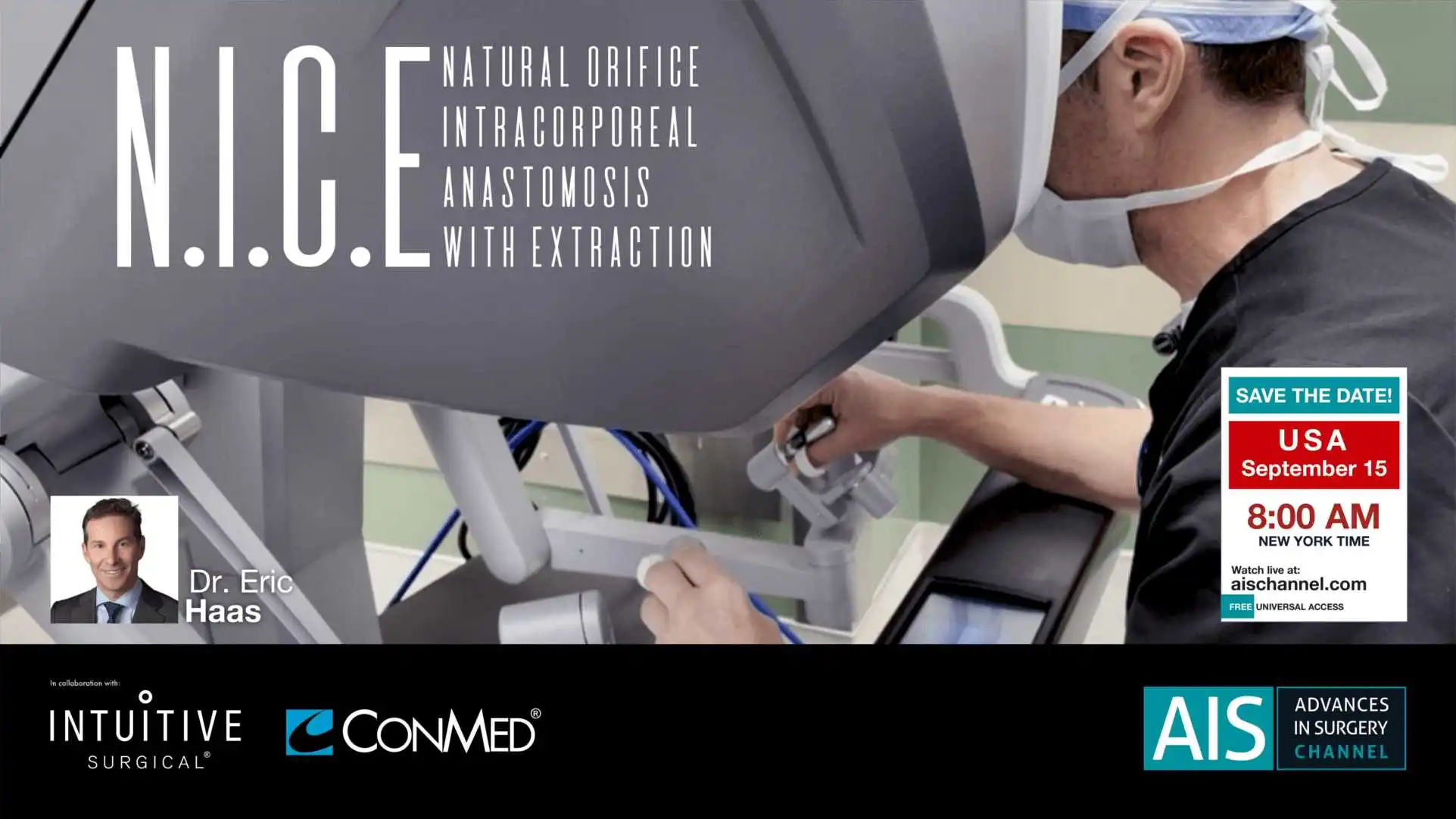
On September 15 at 8am (New York Time), AIS Channel will be broadcasting this procedure performed by Dr. Eric Haas (USA) and his team from the Texas Medical Center (USA) Clinical History: Patient presents for surgical resection for complicated diverticulitis following numerous prior episodes including hospital admission for microperforation Clinical evaluation including colonoscopy and CT scan confirms diverticulitis with no evidence of malignancy She was optimized in regards to nutrition and placed on antibiotics to bridge to elective planned resection Technique description: Robotic total intracorporeal surgery Robotic colorectal left-sided resection Natural orifice transrectal extraction of specimen Intracorporeal colorectal anastomosis without the use of linear staplers Procedure steps: Lateral to medial dissection with mobilization of splenic flexure Proximal division of the colon, mesenteric sparing dissection followed by distal transection of the rectum Natural orifice transrectal extraction of the specimen Intracorporeal colorectal anastomosis Trainings Objectives: Understand key concepts and considerations for robotic total intracorporeal surgery Gain exposure to left-sided colorectal resection using mesenteric sparing technique Learn techniques for safe and efficient natural orifice transrectal extraction of specimen Understand various tips and tricks for intracorporeal anastomosis without crossing staple lines
Published
Sep 2021
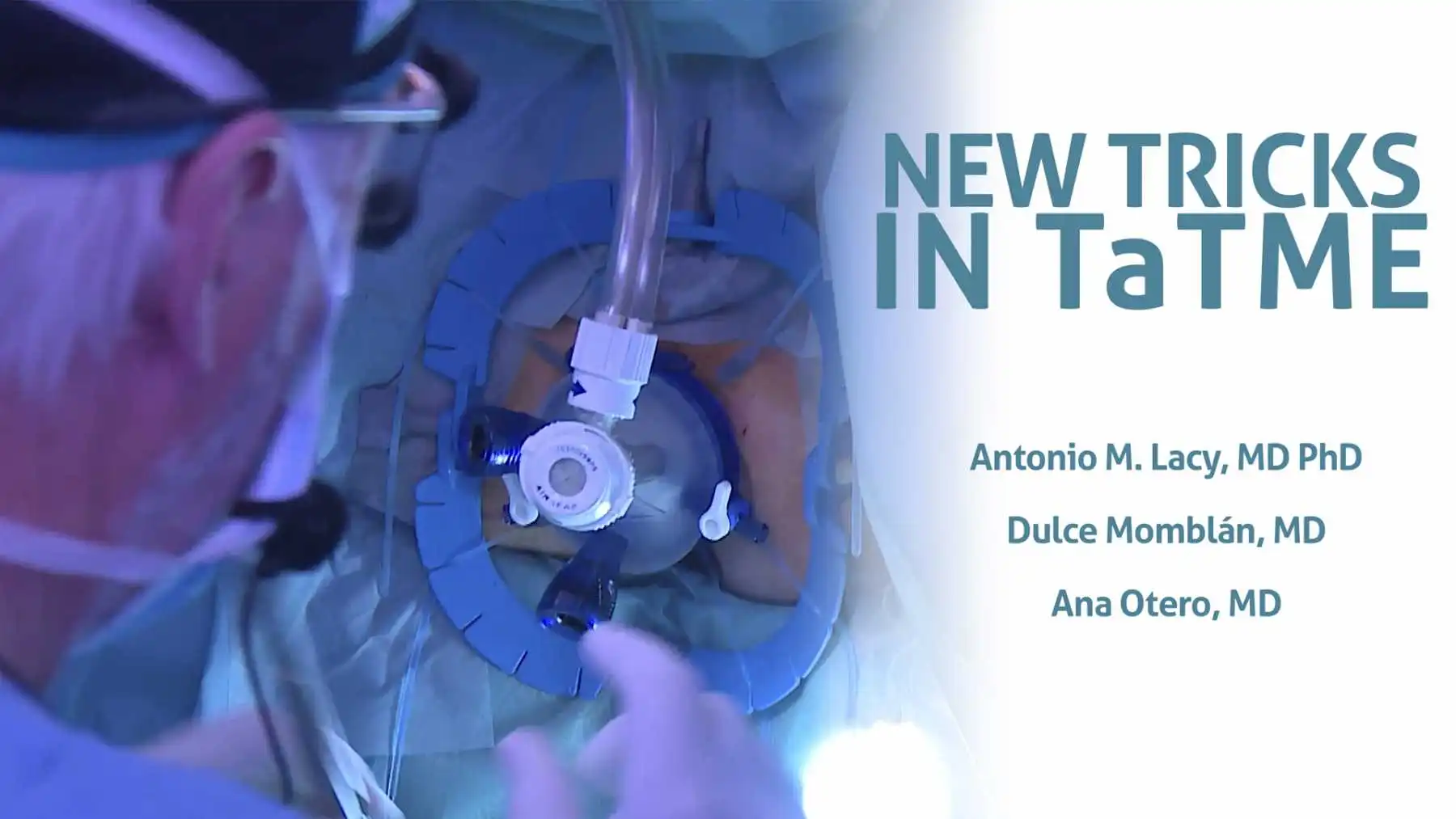
Minimal invasive surgery for locally advanced rectal cancer is challenging and requires advanced technological assistance to make the procedure feasible and safe. The Transanal Total Mesorectal Excision is an innovative approach for rectal cancer. It provides several advantages compared to the fully laparoscopic technique. Issues such as transection of the distal margin and difficult cases may have found a solution with this procedure. You have been able to see this procedure many times on AIS Channel. This time we want to show you transanal surgery from another point of view. This surgery will focus on the main steps for the combined transanal and transabdominal approach (Cecil approach) for rectal cancer, highlighting the most frequent mistakes and how to prevent them. Program: Minimal invasive surgery for locally advanced rectal cancer is challenging and requires advanced technological assistance to make the procedure feasible and safe. The Transanal Total Mesorectal Excision is an innovative approach for rectal cancer. It provides several advantages compared to the fully laparoscopic technique. Issues such as transection of the distal margin and difficult cases may have found a solution with this procedure. You have been able to see this procedure many times on AIS Channel. This time we want to show you transanal surgery from another point of view. This surgery will focus on the main steps for the combined transanal and transabdominal approach (Cecil approach) for rectal cancer, highlighting the most frequent mistakes and how to prevent them.
Published
Apr 2018
Share it with your network and help spread clinical knowledge.