
Dr. Ana María Otero Piñeiro is a highly specialized colorectal surgeon with extensive expertise in minimally invasive surgery, particularly robotic and laparoscopic techniques. She earned her medical degree from the University of Santiago de Compostela and completed her specialization in General and Digestive Surgery. She furthered her training as a Research Fellow in the Colorectal Surgery unit at the Cleveland Clinic (USA). Dr. Otero holds a PhD from the Autonomous University of Barcelona, with a thesis focused on the use of Indocyanine Green (ICG) angiography to prevent anastomotic leakage. She is an active researcher with over 40 scientific publications and a strong focus on advanced oncological techniques, including TaTME and robotic colorectal procedures.
Selected publications from PubMed
Influenza A virus infection during pregnancy increases transfer of maternal bloodborne molecules to fetal tissues.
Gonzalez-Ricon RJ, Otero AM, Chalen I, Savas JN, Adetunji S, Antonson AM
Brain Behav Immun. 2025 Nov;130:106069 doi: 10.1016/j.bbi.2025.106069.
Ontogeny and colonization of embryonic border-associated macrophages and their role in neurodevelopment.
Otero AM, Antonson AM
Front Cell Neurosci. 2025;19:1677414 doi: 10.3389/fncel.2025.1677414.
Influenza A virus during pregnancy disrupts maternal intestinal immunity and fetal cortical development in a dose- and time-dependent manner.
Otero AM, Connolly MG, Gonzalez-Ricon RJ, Wang SS, Allen JM, Antonson AM
Mol Psychiatry. 2025 Jan;30(1):13-28 doi: 10.1038/s41380-024-02648-9.
Cacao (Theobromacacao L.) climate zones and its associated agrobiodiversity in Arauca, Colombia.
Gonzalez-Orozco C, Porcel M, Escobar S, Bravo D, Gutierrez Lopez Y, Yockteng R, Vaillant F, Santander M, Llano S, Parra K, Briceño E, Carmona J, Torres S, Contreras R, Otero AM, Pesca A, Carrillo GA
Biodivers Data J. 2023;11:e112771 doi: 10.3897/BDJ.11.e112771.
At the crux of maternal immune activation: Viruses, microglia, microbes, and IL-17A.
Otero AM, Antonson AM
Immunol Rev. 2022 Oct;311(1):205-223 doi: 10.1111/imr.13125.
Clinical Case: This video presents a robotic-assisted surgical procedure for the treatment of rectal adenocarcinoma. The footage provides a systematic, step-by-step demonstration of the key surgical milestones, covering everything from port placement and robotic docking to the precise dissection of the mesorectum, structural preservation, and the final colorectal anastomosis. Key Highlights: Utilization of robotic technology for enhanced precision during pelvic dissection. Application of Indocyanine Green (ICG) for the assessment of tissue perfusion. Technical strategies for left colon mobilization and ensuring the safety of the colorectal anastomosis. This educational material aims to provide a clear visual guide on critical technical landmarks in robotic colorectal surgery, offering practical tips to optimize surgical outcomes.
Published
May 2026

It is a well-known fact that a healthy diet and physical activity play an important part in our well-being. Within a care team, the physician's role is a critical one. Consequently, their well-being can have a big impact not only on care practices but on patient experience as well. For example, many studies point out that physicians and trainees often do not get proper nourishment and hydration while on the job. Looking into this area could provide useful insights to those physicians looking to improve their overall well-being. It has also been shown that physically active physicians get sick less frequently, suffer less burnout, handle stress better, and are more likely to discuss physical activity with their patients. Given the commonplace occurrence of burnout in physicians, we believe that in addition to related issues like heavy workloads and length of shifts, the state of physicians' nutrition and how it affects their work performance and health should also be addressed. In this session, we will discuss the current evidence related to the potential effects of nutrition and physical activity on physicians' occupational well-being and performance, identify gaps, and discuss opportunities to address nutrition as one of the important means of improving physicians' welfare.
With Johnson & Johnson MedTech
Published
Jul 2022

PROGRAM 1. Circular Stapling - Pelvis - Dr. Manish Chand Anastomotic leaks are one of the main problems in colorectal surgery. Surgeons should keep in mind the different factors that this complication entails, as well as its treatment. A standardized procedure is preferable in any type of surgery. To achieve a good operative outcome, recommendations are given on the mistakes to avoid. A video of the procedure is played, and Dr. Manish Chand discusses how to avoid problems in anastomotic leak surgery. Dr. Chand also discusses circular staplers and their characteristics that help reduce anastomotic leaks. He comments on a video of an important part of the procedure, as well as on some data and visual information to encourage the use of this device. 2. General Considerations about mechanical staplers - Dr. Ana Otero In this video, Dr. Ana María Otero provides an introduction to the use of staplers in anastomotic procedures, the different types of endostaplers, and their specific features. Two videos of the most common procedures in which anastomosis is performed are displayed: side-to-side anastomosis and end-to-end anastomosis. Videos of mechanical stapling anastomosis are also played to discuss the best approach and how to perform the procedure. Finally, Dr. Otero gives advice on the principles to follow for good endostapler performance. 3. Laparoscopic Right Hemicolectomy - Dr. Matt Albert Although laparoscopic right colectomy is regarded as the simplest colon operation, this does not mean that it cannot lead to severe complications. The basic steps of intracorporeal anastomosis are described. Dr. Matthew Albert comments on videos of specific steps of this procedure, giving advice based on his experience. Pancreas head anatomy is also explained by means of surgical videos. Dr. Albert describes the benefits of intracorporeal anastomosis and gives recommendations on what the surgeon should pay attention to in a laparoscopic right colectomy.
With Johnson & Johnson MedTech
Published
Feb 2022
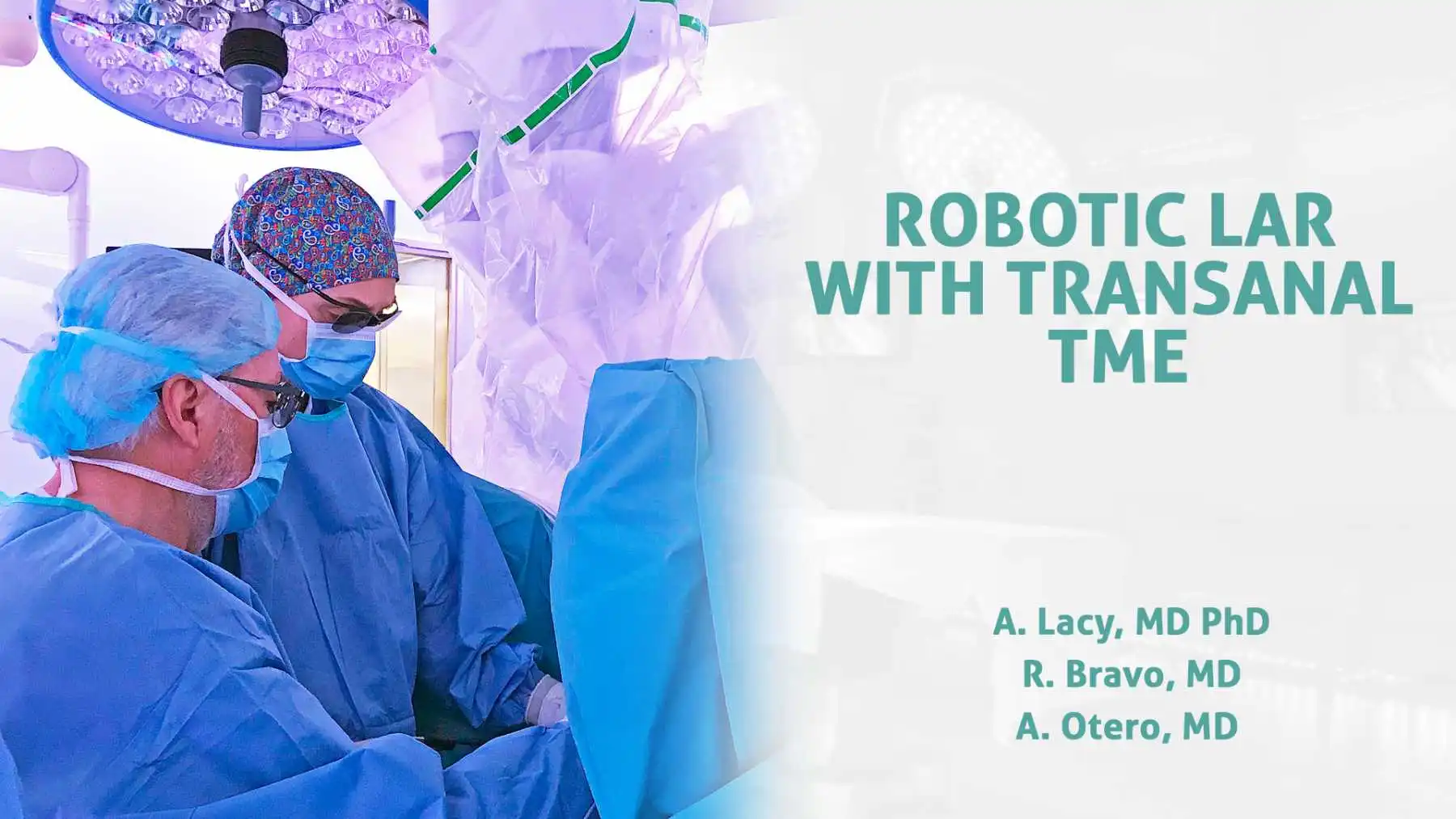
Learn how to perform a combined two-teams, Cecil approach with the robotic surgical system, the advantages of the robotic assistance during TaTME for rectal cancer, the tips and tricks to perform the low pelvis dissection and which are the new complications that may arise during TaTME
Published
Dec 2021

Splenic flexure neoplasms are a surgical challenge due to the proximity of other structures such as the spleen, stomach, pancreas, and vascularization of the colon. A minimally invasive approach avoids the large incision that is required for an open segmental colectomy. In these cases, the robotic approach is particularly useful because, thanks to its precision and better visualization, it facilitates the dissection of the different anatomical structures, offering great surgical safety and oncological results. In this video, we present the case of a 80-year-old, with a BMI of 26.84 kg/m2 and a diagnosis of occlusive splenic flexure neoplasm. After a colon stent was placed, a Robotic Splenic Flexure Resection with Intracorporeal Anastomosis was performed.
Published
Dec 2021

Anorectal suppurative disease may manifest itself in an acute or a chronic setting. Anal sepsis (abscess) represents the acute manifestation, and anal fistula represents the chronic form of the suppurative process. In its simplest form, an anal fistula is a communication between an internal opening in the anal canal and an external opening through which an abscess has drained. A fistula and abscess may coexist or be associated with atypical internal openings and multiple tracts that result in a complex suppurative process. Parks and Gordon classified fistulas into four main subgroups according to the course taken by the main tract: intersphincteric, transsphincteric, suprasphincteric, or extrasphincteric. Each category can be further subclassified based on associated secondary tracts and other anatomic details. Symptoms consist of pain, slight fever, and pain on defecation followed by mucopurulent drainage and abatement of the pain. Pruritic symptoms may be present because of skin irritation associated with the chronic discharge. A correct diagnosis is important, through physical examination and the different complementary examinations available (rectoscopy, anorectal ultrasonography, MRI…). Patients with anorectal fistulas should undergo surgical treatment because they rarely heal spontaneously. In the following presentation we will explain the surgical options that we currently have for this pathology.
Published
May 2021
Help your network discover Dr. Ana María Otero's clinical expertise.