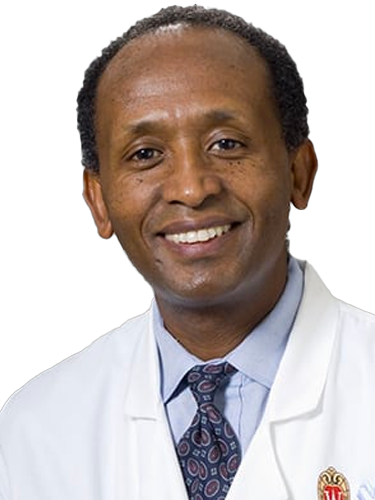
Dr. Tefera is a vascular surgeon at University of Wisconsin-Madison, Wisconsin. He is the Chair of the Division of Vascular Surgery. Dr. Tefera joined the American College of Surgeons, Division of Member Services, as the new Medical Director of the Operation Giving Back Program in February 2015. . His clinical research interests include abdominal aortic aneurysm treatment with endovascular stent graft and other complex aneurysmal diseases of the thoracic and abdominal aorta. Additionally, Dr. Tefera has led several global health funded initiatives in health care system strengthening and education in Ethiopia. He has lead the University of Wisconsin’s efforts in the development of Emergency medical services and vascular and endovascular surgery services in Ethiopia. His current global health outreach efforts through the ACS focusses on the development of Global Surgery Education Centers of Excellence in low and middle income countries. He is a devoted mentor to medical students, residents and vascular fellows.
Selected publications from PubMed
Protocolized management of acute type B aortic dissections reduces disease progression and need for surgery.
Gober LM, Telma K, Richmond E, Liu S, Bontekoe J, Sobol C, Tefera G, DiMusto P, Morgan C
J Vasc Surg. 2026 Apr;83(4):1070-1078.e2 doi: 10.1016/j.jvs.2025.11.023.
Decolonizing Global Surgery: Bethune Round Table, 2022 Conference on Global Surgery (virtual), June 16-18, 2022.
Botelho F, Gripp K, Yanchar N, Naus A, Poenaru D, Baird R, Reis E, Farias L, Silva AG, Viana F, Neto JAP, Silva S, Ribeiro K, Gatto L, Faleiro MD, Fernandez MG, Salgado LS, Sampaio NZ, Faleiro MD, Mendes AL, Ferreira RV, Marcião L, Canto G, Borges J, Araújo V, Andrade G, Braga J, Bentes L, Pinto L, Ndasi HT, Amlani LM, Aminake G, Penda X, Tima S, Lechtig A, Agarwal-Harding KJ, Whyte M, Fowler-Woods M, Fowler-Woods A, Shingoose G, Hatala A, Daeninck F, Vergis A, Clouston K, Hardy K, Djadje L, Djoutsop OM, Djabo AT, Kanmounye US, Youmbi VN, Kakobo P, Djoutsop OM, Djabo AT, Kanmounye US, Tafesse S, Tamene B, Chimdesa Z, Alemayehu E, Abera B, Yifru D, Belachew FK, Tirsit A, Deyassa N, Moen BE, Sundstrøm T, Lund-Johansen M, Abebe M, Khan R, Mekasha A, Soklaridis S, Haji F, Asingei J, O'Flynn EP, O'Donovan DT, Masuka SC, Mashava D, Akello FV, Ulisubisya MM, Franco H, Njai A, Simister S, Joseph M, Woolley P, James D, Evans FM, Rai E, Roy N, Bansal V, Kamble J, Aroke A, David S, Veetil D, Soni KD, Wärnberg MG, Zadey S, Vissoci JRN, Iyer H, Zadey S, Shetty R, Zadey S, Jindal A, Iyer H, Ouma G, Shah SSNH, Hinchman C, Rayel IM, Dworkin M, Agarwal-Harding KJ, Mlinde E, Amlani LM, May CJ, Banza LN, Chokotho L, Agarwal-Harding KJ, Dworkin M, Mbomuwa F, Chidothi P, Martin C Jr, Harrison WJ, Agarwal-Harding KJ, Chokotho L, Paek S, Amlani L, Mbomuwa F, Chidothi P, Martin C Jr, Harrison WJ, Agarwal-Harding KJ, Chokotho L, Adégné T, Abdoulmouinou P, Amadou T, Youssouf T, Madiassa K, Younoussa DM, Moussa S, Amadou B, Hawa T, Laurent A, Jesuyajolu DA, Okeke CA, Obuh O, Jesuyajolu DA, Ehizibue PE, Ikemefula NE, Ekennia-Ebeh JO, Ibraham AA, Ikegwuonu OE, Diehl TM, Bunogerane GJ, Neal D, Ndibanje AJ, Petroze RT, Ntaganda E, Milligan L, Cairncross L, Malherbe F, Roodt L, Kyengera DK, O'Hara NN, Stockton D, Bedada A, Hsiao M, Chilisa U, Yarranton B, Chinyepi N, Azzie G, Moon J, Rehany Z, Bakhshi M, Bergeron A, Boulanger N, Watt L, Wong EG, Pawlak N, Bierema C, Ameh E, Bekele A, Jimenez MF, Lakhoo K, Roy N, Sacato H, Tefera G, Ozgediz D, Jayaraman S, Peric I, Youngson G, Ameh E, Borgstein E, O'Flynn E, CROCODILE study group, Simoes J, Kingsley PA, Sasson L, Dekel H, Sternfeld AR, Assa S, Sarid RS, Mnong'one NJ, Sharau GG, Mongella SM, Caryl WG, Goldman B, Bola R, Ngonzi J, Ujoh F, Kihumuro RB, Lett R, Torquato A, Tavares C, Lech G, Džunic A, Ujoh F, Gusa V, Apeaii R, Noor R, Bola R, Guyan IO, Christilaw J, Hodgins S, Lett R, Binda C, Heo K, Cheng S, Foggin H, Hu G, Lam S, Feng L, Labinaz A, Adams J, Livergant R, Williams S, Vasanthakumaran T, Lounes Y, Mata J, Hache P, Schamberg-Bahadori C, Monytuil A, Mayom E, Joharifard S, Joos É, Paterson A, Maswime S, Hardy A, Pearse RM, Biccard BM, African Surgical Outcomes (ASOS) group and International Surgical Outcomes (ISOS) group, Salehi M, Zivkovic I, Jatana S, Joharifard S, Joos É, Flores MJ, Brown KE, Roberts HJ, Donnelley CA, von Kaeppler EP, Eliezer E, Haonga B, Morshed S, Shearer DW
Can J Surg. 2022 Jul-Aug;65(4 Suppl 1):S1-S18 doi: 10.1503/cjs.007622.
American College of Surgeons Member Involvement in Global Surgery: Results from the 2015 Operation Giving Back Survey.
Boeck MA, Goodman LF, Lin Y, Wilczak B, Tefera G
World J Surg. 2018 Jul;42(7):2018-2027 doi: 10.1007/s00268-017-4448-y.
Bilateral administration of autologous CD133+ cells in ambulatory patients with refractory critical limb ischemia: lessons learned from a pilot randomized, double-blind, placebo-controlled trial.
Raval AN, Schmuck EG, Tefera G, Leitzke C, Ark CV, Hei D, Centanni JM, de Silva R, Koch J, Chappell RG, Hematti P
Cytotherapy. 2014 Dec;16(12):1720-32 doi: 10.1016/j.jcyt.2014.07.011.
Clinical implications of non-contrast-enhanced computed tomography for follow-up after endovascular abdominal aortic aneurysm repair.
Bobadilla JL, Suwanabol PA, Reeder SB, Pozniak MA, Bley TA, Tefera G
Ann Vasc Surg. 2013 Nov;27(8):1042-8 doi: 10.1016/j.avsg.2012.10.021.
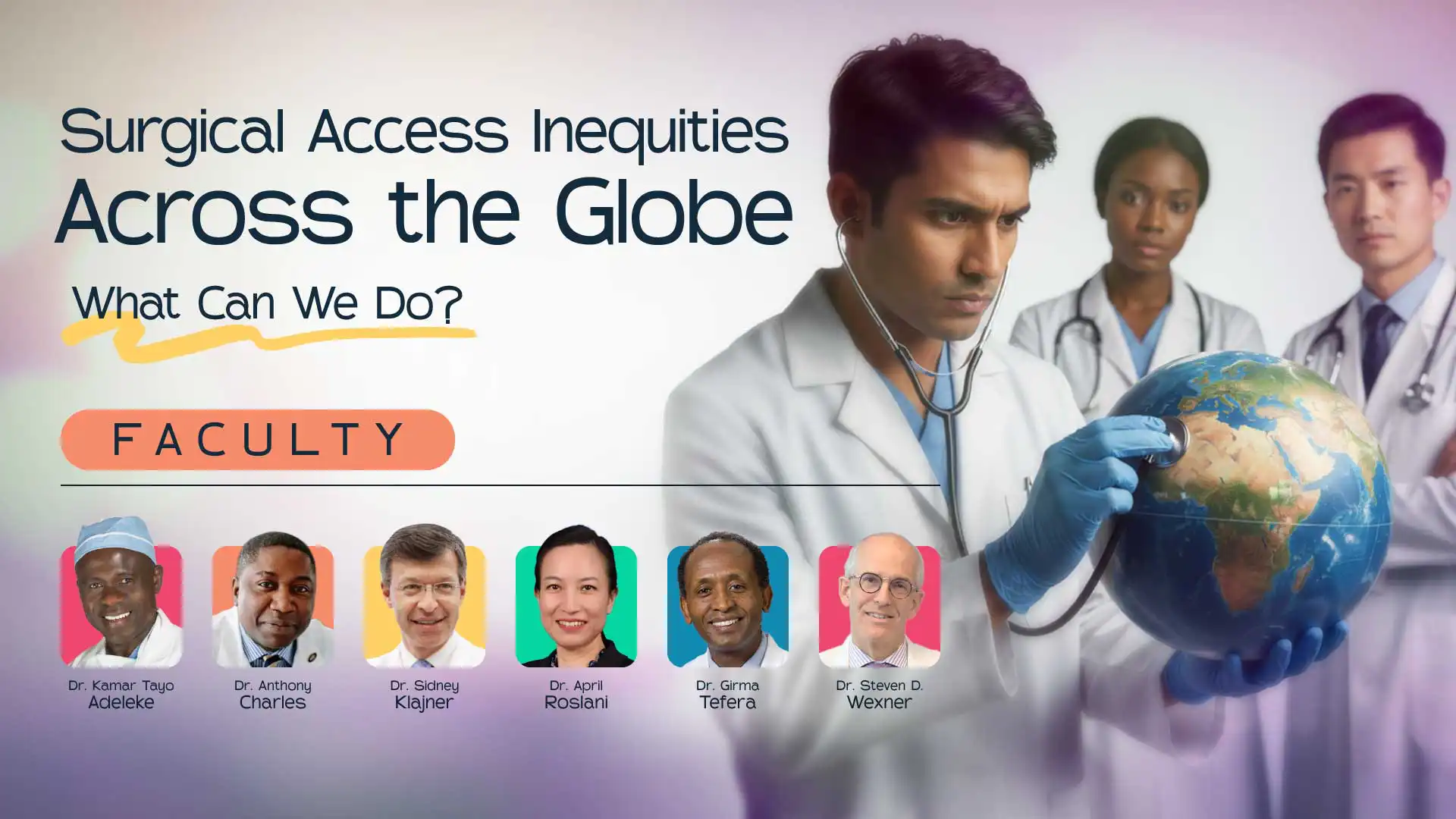
Inequities in access to timely and effective surgical care represent one of the most pressing and complex challenges in global health today. Millions of people worldwide, particularly those living in rural and remote regions of Africa, Southeast Asia, and South America, are excluded from essential procedures that can treat severe trauma, prevent disability, and save lives. These barriers are multifaceted, rooted in insufficient training infrastructure, lack of specialized technology, geographic challenges, and funding deficiencies. Addressing this massive global surgical gap is not just a clinical requirement but a moral and ethical imperative for achieving true universal health equity.
With Johnson & Johnson MedTech
Published
Dec 2025
.jpg)
The surgical workforce shortage is a major cause of lack of access to surgery in the Low and Middle-Income countries.
With American College of Surgeons
Published
Feb 2024

The unmet needs for surgical care are widely reported. It is recognized that up to 5 billion people have limited or no access to basic surgical needs. These populations are primarily located in the sub-Saharan region and southeast Asia. According to a report by the World Health Organization, workforce shortage is more critical than infrastructure problems. Training and retaining surgical and anesthesia workforce is a priority for all countries in the sub-Saharan region. The West African College of Surgeons (WACS) and the College of Surgeons of East, Central and Southern Africa (COSECSA) are leaders in the training and credentialing of the surgical workforce in their respective regions. In this broadcast we will learn about the history of these two surgical societies and the provision of surgical care. Women in surgery represent <10% of the surgeons in the region. We will explore the strategies to increase the number of women surgeons. Then the panel will discuss what the role of surgical associations in high-income countries, such as the American College of Surgeons, should be.
With Johnson & Johnson MedTech
Published
May 2022
Help your network discover Dr. Girma Tefera's clinical expertise.