
Dr Antonio Alcaraz is a well known and respected Urologist in Spain. He has an experience of over 19 years and is one of the pioneers in this field. His area of interests includes robotic and laparoscopic technique, surgical oncology ( prostate, kidney and bladder), kidney transplant surgeries. Dr Alcataz finished his Bachelor of medicine, MD and PhD from the University of Barcelona. He obtained his fellowship from the Mayo Clinic, Rochester, USA. He is currently the Head of the Service of Urology and Kidney transplantation a Hospital Clinic de Barcelona and is also an Associate professor of Urology at the Universitat de Barcelona. Dr Alcaraz is renowned for his experience and contribution to the field of urology. He was part of the team that performed the World's first transvaginal nephrectomy. He also performed the World's first transvaginal kidney extraction due to a tumour in 2009 and World's first robotic transvaginal kidney transplant in 2015. He has authored more than 170 research papers published in reputed national and international journals. He is a member of the European Association of Urology (EAU), American Urological Association (AUA).
Selected publications from PubMed
Correction: Pérez et al. Biomarker-Based Nomogram to Predict Neoadjuvant Chemotherapy Response in Muscle-Invasive Bladder Cancer. Biomedicines 2025, 13, 740.
Pérez M, Lozano JJ, Ingelmo-Torres M, Domenech M, Fernández Ramón C, Witjes JA, van der Heijden AG, Requena MJ, Coy A, Calderon R, Mellado B, Alcaraz A, Vilaseca A, Ribal MJ
Biomedicines. 2026 Jul 17;14(7) doi: 10.3390/biomedicines14071604.
Corrigendum to "Robot-assisted Kidney Transplantation: The 8-year European experience" [Eur. Urol. 87(4) (2025) 468-475].
Territo A, Afferi L, Musquera M, Gaya Sopeña JM, Pecoraro A, Campi R, Gallioli A, Etcheverry B, Prudhomme T, Vangeneugden J, Ortved M, Røder A, Zeuschner P, Volpe A, Garcia-Baquero R, Kocak B, Mirza I, Stockle M, Canda E, Fornara P, Rohrsted M, Doumerc N, Decaestecker K, Serni S, Vigues F, Alcaraz A, Breda A
Eur Urol. 2026 Jul 11 pii: S0302-2838(26)02166-4. doi: 10.1016/j.eururo.2026.05.004.
Digital Uromonitor® outperforms quantitative polymerase chain reaction Uromonitor and cytology for non-muscle-invasive bladder cancer surveillance: results from the 'External Validation of Uromonitor as a Biomarker for Optimization of NMIBC Management by the Club Urológico Español de Tratamiento Oncológico Group' (EVALUATION-CUETO) study.
Rubio-Briones J, Guerrero Ramos F, Mercadé Sánchez A, Bezana Abadía I, Martín Rodríguez R, Alcaraz A, Miqueleiz Legaz M, Lozano F, Arrabal Martín M, Luis Cardo A, Gonzalo Rodríguez V, Caño Velasco J, Serrano Liesa M, Ferreiro Pareja C, Espílez Ortiz R, González-Valcárcel de Torres I, Sánchez Zalabardo D, Guijarro A, Mengual L, Borque-Fernando A, Esteban Escaño LM, Palou Redorta J, Witjes F, Martínez Piñeiro L
BJU Int. 2026 Jul;138(1):75-84 doi: 10.1111/bju.70230.
Role of Bladder EpiCheck(®) in Bladder cancer: from primary diagnosis to surveillance.
Figueras M, Ingelmo-Torres M, Roldan FL, Gomà E, Galve P, Mercader C, Peri L, Franco A, Asiain I, Alcaraz A, Mengual L
J Transl Med. 2026 May 18;24(1) doi: 10.1186/s12967-026-08249-0.
Exploring donor-derived cell-free DNA as a rejection biomarker during uterus transplant follow up.
González-Roca E, Rius M, Ramírez-Bajo MJ, Montalbán-Casafont A, Bañón-Maneus E, Hierro-García N, Musquera M, Saco A, Alcaraz A, Brunet M, Palou E, Diekmann F, Carmona F, Puig-Butillé JA
Commun Med (Lond). 2026 May 12;6(1) doi: 10.1038/s43856-026-01602-w.
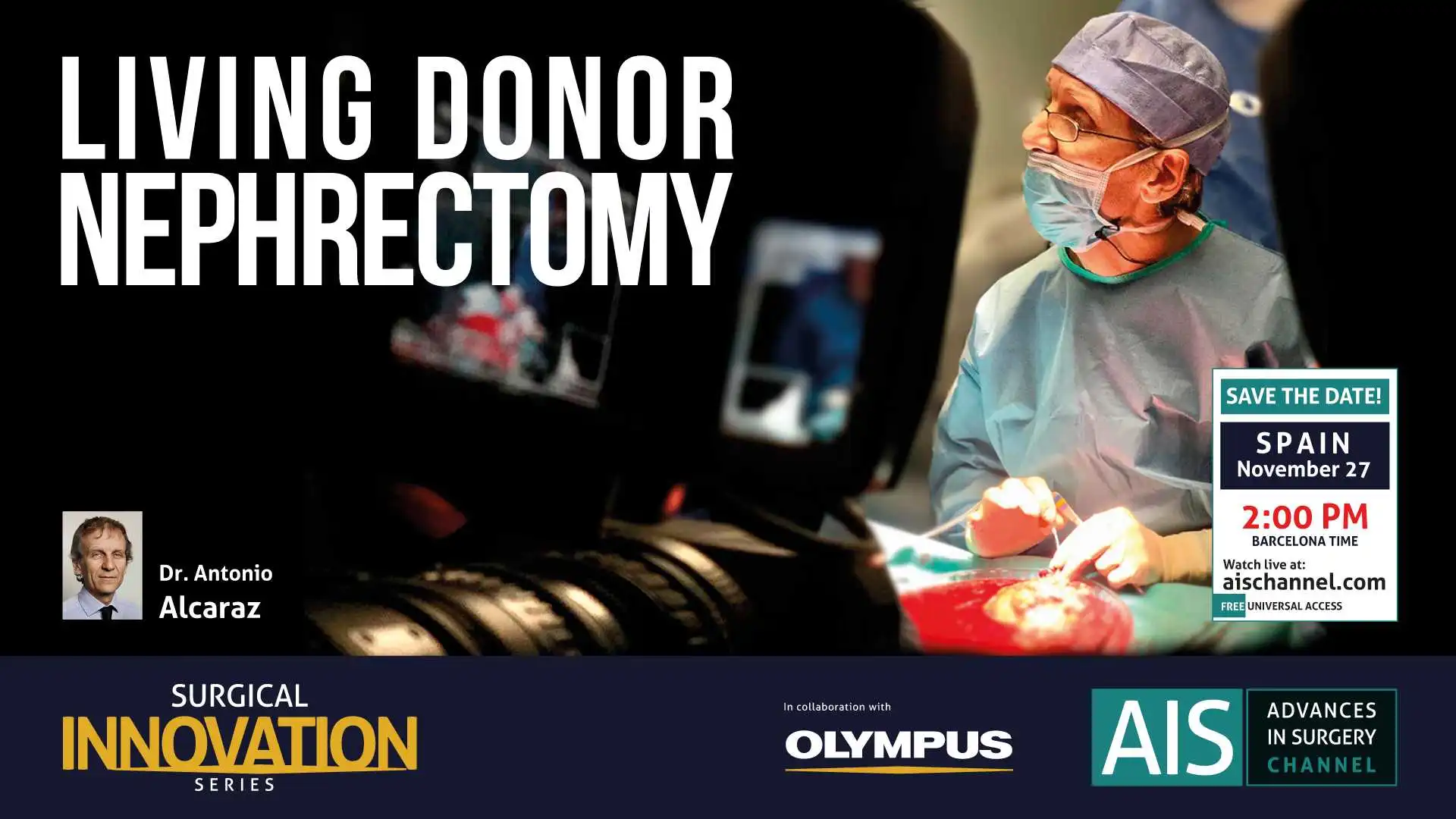
Dr. Antonio Alcaraz performs a Living-Donor Nephrectomy surgery to a 51 years old female, a candidate for living-doner nephrectomy from her son. It consists of a living-donor left laparoscopic nephrectomy with extraction through infraumbilical midline incision.
With Olympus
Published
Nov 2020
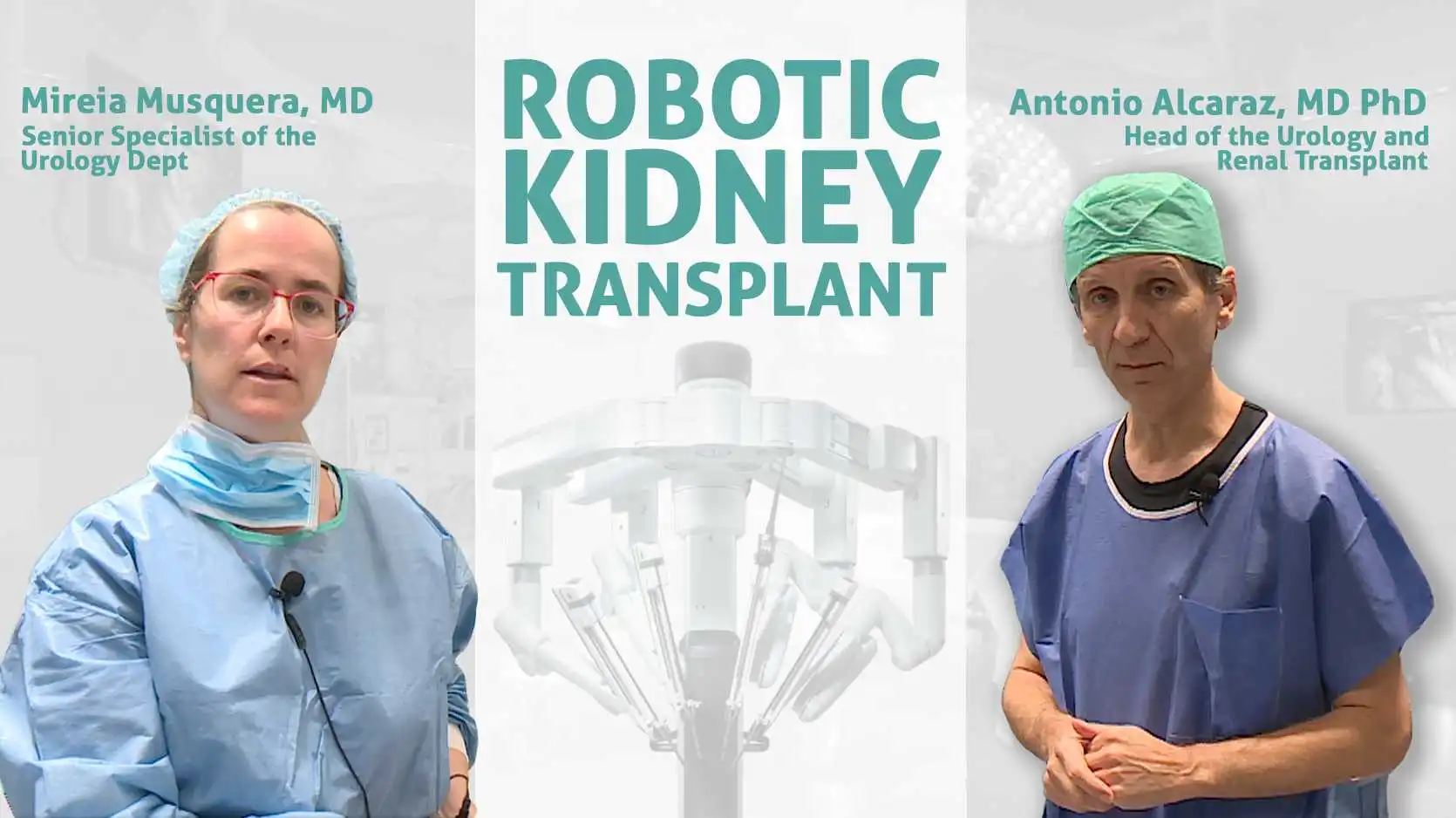
Kidney transplantation (KT) is regarded as the preferred treatment for patients with end-stage renal disease (ESRD) due to the higher survival rate and better quality of life by comparison to hemodialysis. Although the open approach remains the gold standard, minimally invasive techniques have been introduced to decrease the morbidity and mortality of open surgery, which could be especially important in immunocompromised and fragile KT patients. Following the first European experience in RAKT, the robotic approach to KT is now followed in a few European centers as an alternative to the open approach in selected patients. To date, 190 RAKTs, 40 of which were performed at Hospital Clinic Barcelona, mainly from living donors (98%), have been performed. Regarding the surgical aspects, their multicenter prospective study confirms that RAKT can be performed by surgeons with extensive experience in robotic and transplant surgery, even in the early stages of their learning curve. They would like to stress that to obtain such results, surgeons were trained in an animal laboratory before starting to perform RAKT on humans.
With Intuitive
Published
Feb 2018
Help your network discover Dr. Antonio Alcaraz's clinical expertise.