

Colorectal Surgery
Gastrointestinal Surgery Department, Hospital Clinic Barcelona, Spain
Dr. Silvia Valverde is an associate surgeon at the Lacy Surgical Institute. After her specialized training in gastrointestinal, colorectal and hepatobiliopancreatic surgery, she has deepened in the fields of emergency surgery, the polytraumatized patient and advanced colorectal oncologic surgery, complementing the daily practice with stays in specialized foreign centers and through the completion of specific courses. Member No. 47,116. She has also been particularly interested in cervical surgery, collaborating with the Endocrine Surgery team of the HUVH and is currently doing research in the field of complex Abdominal Wall in parallel to her daily professional practice.
Selected publications from PubMed
Use of a bioabsorbable mesh in midline laparotomy closure to prevent incisional hernia: randomized controlled trial.
Valverde S, Arbós MA, Quiles MT, Espín E, Sánchez-Garcia JL, Rodrigues V, Pereira JA, Villalobos R, García-Alamino JM, Armengol M, López-Cano M
Hernia. 2022 Oct;26(5):1231-1239 doi: 10.1007/s10029-021-02435-3.
The impact of fluorescence angiography on anastomotic leak rate following transanal total mesorectal excision for rectal cancer: a comparative study.
Otero-Piñeiro AM, de Lacy FB, Van Laarhoven JJ, Martín-Perez B, Valverde S, Bravo R, Lacy AM
Surg Endosc. 2021 Feb;35(2):754-762 doi: 10.1007/s00464-020-07442-6.

Robotic surgery is nowadays an emergent technological innovation in general surgery and therefore it demands for specific training. An effective curriculum should respond to a well-planned road map of training and effective assessment tools need to be standardized. Improved dexterity, precision, 3D visualization, and ergonomics are features inherent to robotic-assisted surgery that amplify the surgeon’s skills, overcoming some of the disadvantages associated with traditional laparoscopic surgery. However, inconsistent approaches to robotic training across general surgery residency programs reveal the disparity between the use of robotic technology and training for it. The diversity of robotic-assisted surgical training modalities is promising, as they all have demonstrated its validation. Nevertheless, comparison of overall surgical training curricula should be done to achieve a standardized robotic-assisted surgical curriculum model. More procedure-specific training modules are needed for different surgical specialties and surgical procedures. Professional associations and experienced robotic surgeons have the responsibility of leading in the achievement of robotic skills by young surgeons and residents.
Published
Jun 2021

The impact of appendectomy on the clinical course of UC is controversial, generally favoring a milder disease course. Most of the studies show a protective role but with important limitations, mainly due to small sample size and retrospective design. Prospective data suggest that prophylactic appendectomy might have a benefit in selected patients to improve clinical and pathological course.
Published
Mar 2021

Laparoscopic minimally invasive colorectal surgery has been established as a gold standard technique for colorectal pathology. However, there is limited data regarding the learning curve in robotic surgery. The criteria for proficiency and credentialing in robotic surgery vary among institutions. To date, there is a lack of standardization in training and certification of robotic surgeons. We review the training pathway for robotic colorectal surgery.
Published
Nov 2020
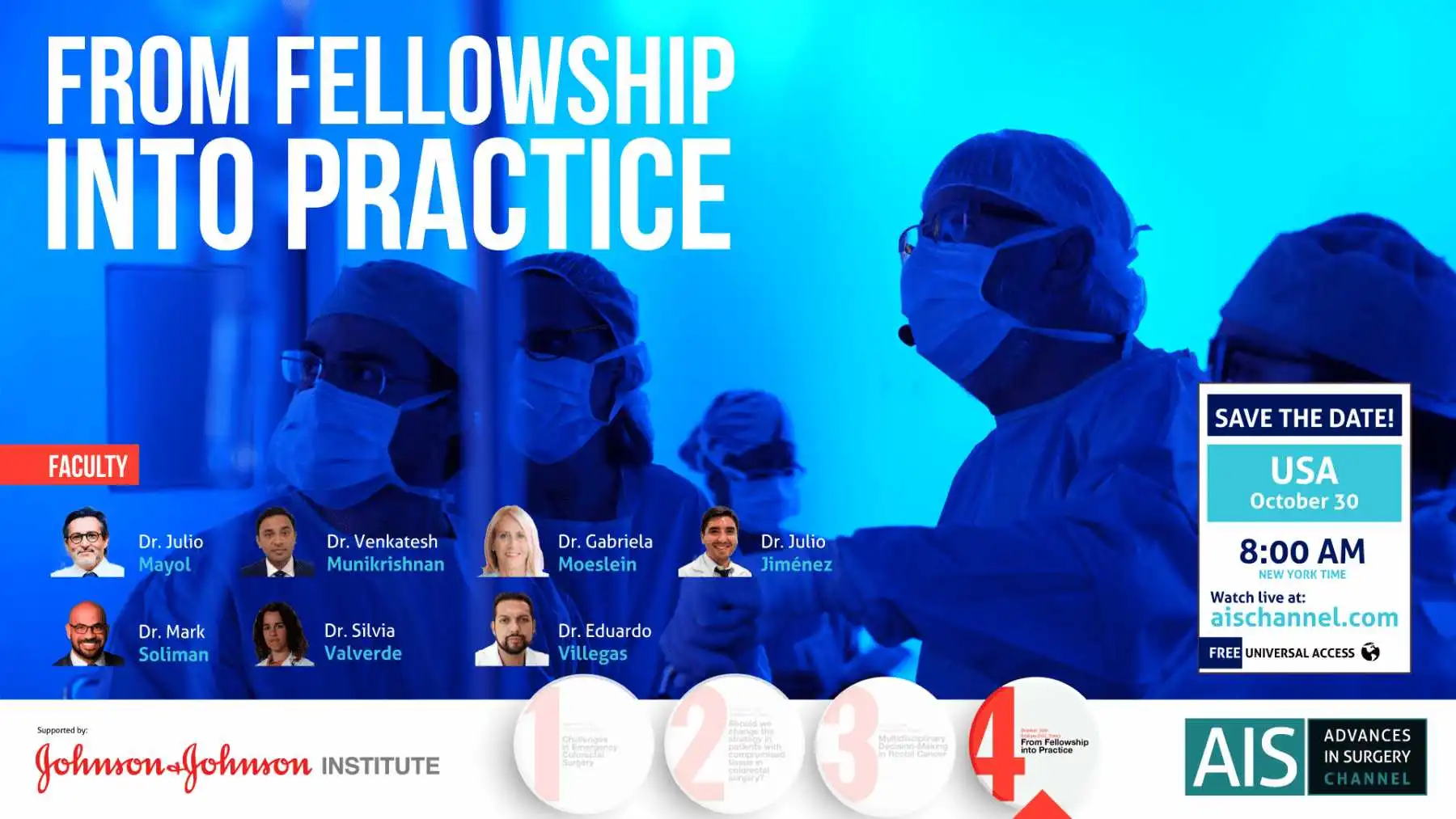
Dr. Venkatesh Munikrishnan, Dr. Gabriela Moeslein, Dr. Eduardo Villegas, Dr. Julio Mayol, Dr. Silvia Valverde, Dr. Mark Soliman, Dr. Julio Jiménez present "Dr. Julio Jiménez".
With Johnson & Johnson MedTech
Published
Oct 2020

Appropriate treatment strategies for lateral lymph node (LN) involvement in rectal cancer are unclear and surgery remains controversial. Differences between Eastern and Western countries and the lack of strong oncologic data have led to scarce evidence regarding lateral LN dissection indications, which are not included in total mesorectal excision procedures. Lateral recurrence is high when lateral lymph nodes are enlarged preoperatively. Neoadjuvant chemoradiotherapy can treat the lateral node compartment to prevent recurrence, but it might not be enough. In this video, we review the indications, technique and morbidity associated with lateral LN dissection.
Published
Sep 2020

Surgical Treatment of Type-2 Diabetes: what’s the current evidence? Diabetes affects about 387 million people worldwide. In the next 20 years, its prevalence is predicted to double, and more than half a billion people will be affected. Etiopathogenesis of type 2 diabetes and obesity In a subject at risk of having diabetes (obese patient or first-degree relative), the first thing that happens is insulin resistance. Most patients with diabetes are overweight or obese and suffer from increased visceral adiposity. There is ample evidence to prove that inflammation is directly related to insulin resistance. Both hyperplasia and hypertrophy of the adipocytes can contribute to the expansion of adipose tissue. This expansion can lead to a number of effects, including hypoxia, cell death of adipocytes, increased secretion of cytokines, and deregulation in fatty acid flows. Effect of surgery on type 2 diabetes Multiple research studies have been developed to try to clarify the physiopathological mechanisms by which diabetes and the glycemic profile improve after obesity surgery. Initially it was thought that these results were due to the restriction and/or malabsorption produced by the surgery. There is no doubt that weight loss has a crucial effect on resolution, but certain factors such as the fact that the improvement of glycemic metabolism after obesity surgery occurs even before weight loss made us think of other possible causes not related to weight loss that could also have an effect on this evolution. The anatomical alterations made in surgical procedures trigger certain physiological changes (hormonal, increased bile acids, changes in the microbiota and even changes in intestinal morphology) that may contribute to these results, although the main cause of the resolution of diabetes remains unknown. From bariatric to metabolic surgery The rising prevalence of diabetes that is being observed worldwide is related to the large number of overweight and obese subjects. The extent of the problem is significant, so different medical societies have been taking an interest in the treatment of diabetes from obesity and there are currently several published guidelines for the treatment of diabetes where surgical treatment has special prominence. Multiple studies have demonstrated the efficacy of surgery over conventional medical treatment, and these satisfactory results have led to an extension of the indications for obesity surgery to the so-called metabolic surgery, which would be defined as the one aimed at improving or curing poorly controlled diabetes with medical treatment in patients with grade I obesity or even in overweight patients.
Published
Jul 2020
Help your network discover Dr. Silvia Valverde's clinical expertise.