
Dr. Scott Alan Shikora is the director of the Center for Metabolic and Bariatric Surgery at Brigham and Women’s Hospital (BWH) and professor of surgery at Harvard Medical School. Dr. Shikora received his medical degree from Columbia University College of Physicians and Surgeons. He completed both his residency in surgery and his fellowship in hyperalimentation at Beth Israel Deaconess Medical Center. Dr. Shikora has been named one of Boston’s best doctors by Boston Magazine. Dr Shikora is both a past president and a former Executive Council member of the American Society for Metabolic and Bariatric Surgery. He is an associate editor of the surgical journal Surgery for Obesity and Related Diseases and the current editor-in-chief of Obesity Surgery. Dr. Shikora has authored numerous book chapters and journal publications and has made hundreds of presentations internationally on bariatric surgery topics. Dr. Shikora has clinical and research interests in minimally invasive bariatric and general surgery, neuromodulation, and new surgical technologies.
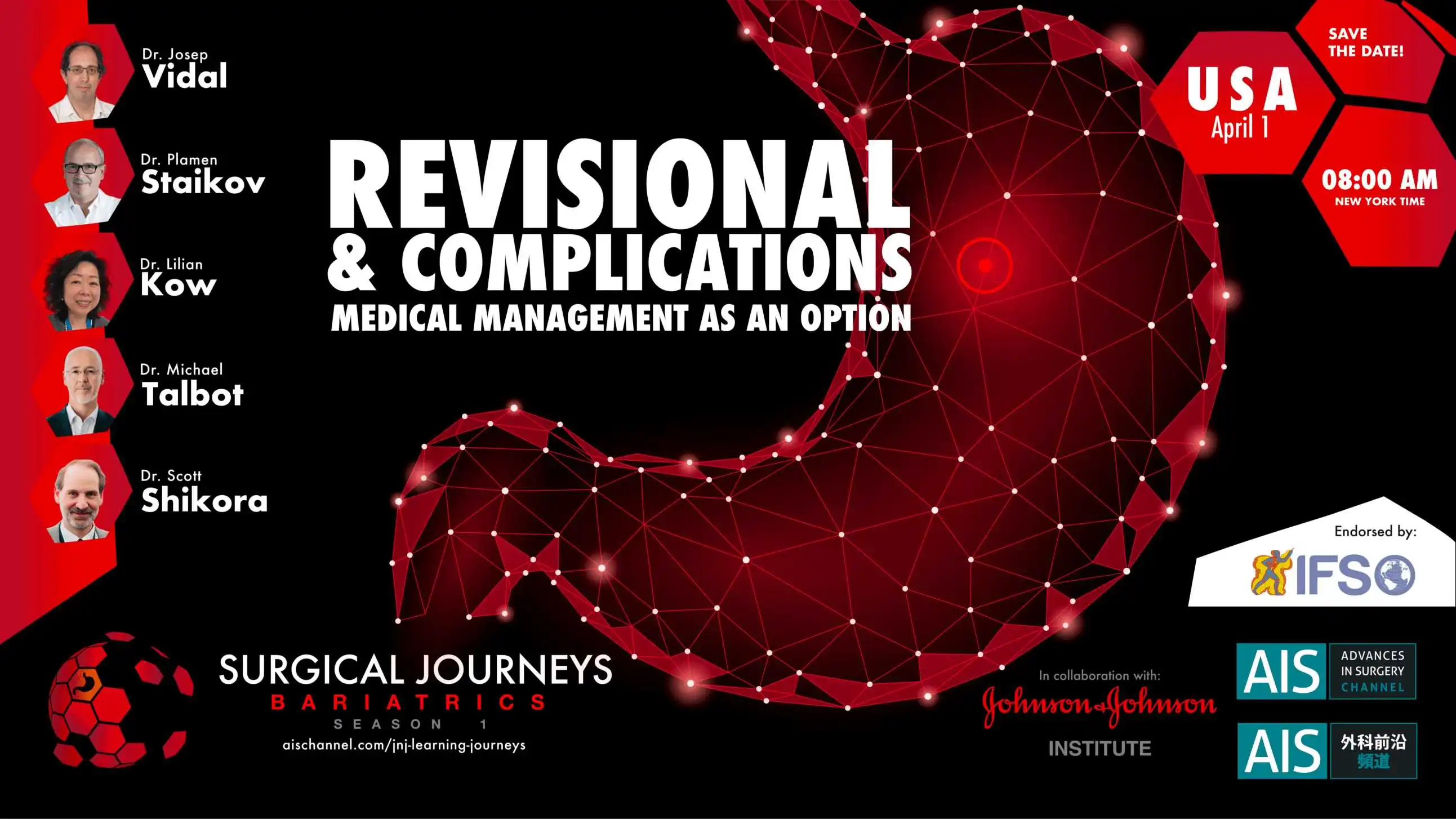
Dr. Lilian Kow, Dr. Scott Shikora, Dr. Michael Talbot and Dr. Plamen Staikov present Medical Management as an Option
With Johnson & Johnson MedTech
Published
Apr 2021

Professor Shikora, moderated by Ahmad Bashir, talks about the importance of publication for the dissemination of medical knowledge and for your personal academic career. He reviews the steps to take follow in order to improve the chances for a paper to be accepted for publishing. Rejection rates are high, specially for journals with a high submission rate, and even good papers may be rejected. Fresh, new or interesting material is needed and good English grammar is mandatory. Results and conclusion must be consistent. Original contributions and review articles have the best chance of being of interest for journals. Other categories include brief communications, letters to the editor, case reports, and new concepts. The structure of a manuscript must be respected and each journal has specific guidelines. The “hook” is the abstract and it should be succinct and organized, in order to avoid immediate rejection. The main parts of a manuscript should be the introduction, the methods, the results, the discussion, and the conclusion. Professor Shikora goes through all these questions and gives his advice based on his experience as chief editor for Obesity Surgery. He also gives examples of papers that would be rejected and goes through the reasons why. It is highly recommended that a mentor or senior review the manuscript before submitting it. Following the journal’s instructions is mandatory. After the presentation, there is a debate with the panel members (Ali Aminian, Abdelrahman Nimeri, Alan Saber) and the audience following a short quiz: - Have you ever submitted a paper for publication before? - Have you ever been rejected? - Did the rejection make you stop from submitting the paper again? - Did you revise the paper and then had it be accepted for publication?
Published
Feb 2019

Scott Shikora, MD FACS. Professor of Surgery, Harvard Medical School, Director of the Center for Metabolic and Bariatric Surgery, Brigham and Women’s Hospital, Boston (Massachusetts, USA) reviews the physiology of the vagal nerve and explains how its neuromodulation may be an alternative to metabolic and bariatric surgery. In this interesting lecture, Dr. Shikora explains the differences between neuromodulation and neuroblocking, and how incidental findings in patients with epilepsy lead to the hypothesis that neuroblocking of the vagal nerve may be a useful tool for weight control. Also, the current literature data on vagal nerve neuromodulation is thoroughly reviewed. Some questions are still unanswered, such as: what is the real mechanism of action? How can patients be selected? Where should the neuromodulator be placed: upper vagus, lower vagus...? And what are the optimal device parameters? Preliminary studies have suggested that reversible, programmable, vagal nerve blocking can safely achieve durable weight loss and metabolic benefits. It should be considered an option in patients not interested in or unable to undergo conventional bariatric surgical procedures. [Image]
Published
Apr 2018

Clinical Case Dr. Aminian , Associate Professor of Surgery at the Cleveland Clinic, discusses a new method for selecting the most appropriate surgical technique for treatment of patients with type 2 Diabetes Mellitus (T2DM). He divides T2DM into 3 validated stages of severity and presents an online calculator ( http://riskcalc.org/Metabolic_Surgery_Score ) that may help in the selection of the surgical procedure for each patient, thus enabling a more tailored treatment of obesity and T2DM . He emphasizes the importance of surgical intervention in early stages of T2DM in order to achieve sustainable results. An international panel of experts from IFSO: Dr. Himpens (IFSO President), Dr. Cohen (Hospital Alemão Oswaldo Cruz, Brazil), Dr. Cummings (University of Washington, USA), Dr. Shikora (Brigham and Women’s Hospital, Boston, USA) and Dr. Lee (Min-Shen General Hospital, Taiwan) discuss Dr. Aminian’s lecture, highlighting the importance of the duration of T2DM on results, the importance of gastroesophageal reflux disease (GERD) on the choice of surgical technique compared with T2DM, and the possible future importance of C-peptide in metabolic surgery. Dr. Lee from Taiwan discusses the results available on the Asian population compared to those presented by Dr. Aminian. Finally, clinical cases are discussed in order to explain the use of the online calculator. [Image]
Published
Oct 2017
Help your network discover Dr. Scott Shikora's clinical expertise.