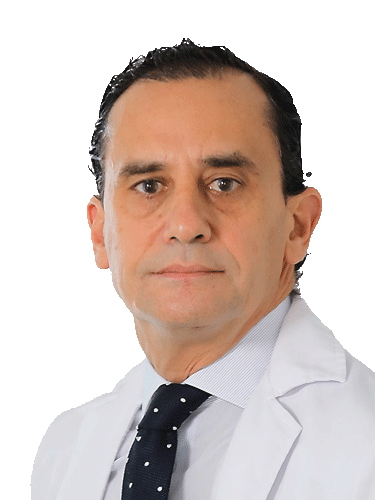
Degree and PhD in Medicine and Surgery from the University of Seville (Spain), specialist in General and Digestive System Surgery and Expert in Laparoscopic Surgery and Minimally Invasive Techniques. Past-President of the Spanish Association of Surgeons (AEC) and the European Association for Endoscopic Surgery (EAES) and currently President-Elect of thevEuropean Hernia Society. Extraordinary Doctorate Award of the University of Seville (thesis presented at the 2001-02 call).
One of the most important referents in Spain in the specialty of General and Digestive System Surgery. He is an academic surgeon, associate professor of surgery in the Department of Surgery of the University of Seville (Spain) and academic member of the Royal Academy of Medicine and Surgery of Seville and Lugo (Spain), with a great international activity. Named by Forbes magazine as one of the best surgeons in Spanish healthcare.
Selected publications from PubMed
Impact of Surgical Timing on Outcomes of Laparoscopic Cholecystectomy for Acute Calculous Cholecystitis: A Multicenter Real-World Analysis.
Bergamini C, Balla A, Montori G, Morales Conde S, Agresta F, Giordano A
J Laparoendosc Adv Surg Tech A. 2026 Aug 10;:10926429261478769 doi: 10.1177/10926429261478769.
Fluorescence-guided lymph node identification for biopsy for suspected lymphoproliferative disease or excision of lymph node recurrence.
Morales-Conde S, Vannucci M, Gómez-García B, Bellido-Luque J, Sobrino Brenes L, Tamburi V, Balla A
Minim Invasive Ther Allied Technol. 2026 Aug;35(4):260-268 doi: 10.1080/13645706.2026.2685184.
Video-based assessment tool for workflow analysis in minimally invasive colorectal surgery: expert consensus-based development and multicentre validation of ColoWorkflow.
Jain PP, Mascagni P, Massimiani G, Banik N, Goglia M, Arboit L, Baby B, Balla A, Baldari L, Silecchia G, Fiorillo C, CompSurg Colorectal Experts Group, Alfieri S, Morales-Conde S, Keller DS, Boni L, Padoy N
BJS Open. 2026 May 12;10(3) doi: 10.1093/bjsopen/zrag038.
EHS Guidelines on the Management of Primary Ventral and Incisional Hernias Under Emergency Conditions.
Stabilini C, Theodorou A, Pawlak M, Antoniou S, Berrevoet F, Bougard H, Bracale U, Capoccia Giovannini S, Fortelny R, Gaarder C, Garcia-Urena MA, Gilmore K, Gomez-Ochoa SA, Köckerling F, Mäkäräinen E, Morales-Conde S, Pecchini F, Pereira Rodríguez JA, Quiroga-Centeno AC, Renard Y, Romain B, Schembari E, Deerenberg E
J Abdom Wall Surg. 2026;5:16228 doi: 10.3389/jaws.2026.16228.
Training4all project - from an advanced minimally invasive surgery course to a national training program.
Gonçalves MR, Morales-Conde S, Marinho R, Ferreira C, Salido S, Oliveira A, Albuquerque A, Sánchez-Margallo FM, Sousa MC, de Matos JN
J Robot Surg. 2026 Mar 5;20(1) pii: 317. doi: 10.1007/s11701-025-02944-8.
.webp)
Anastomotic leak remains one of the most feared complications following bowel anastomosis. Although anastomotic techniques have changed from suturing to stapling, and both staplers and stapling techniques have evolved and improved, leak rates for pelvic anastomoses remain high. Although compression anastomosis has been intermittently used for almost 100 years, it was only about 10 years ago that its superiority over circular stapled anastomoses was demonstrated. This program will show the newest method of compression anastomosis and offer compelling evidence for its value.
With CarpoNovum
Published
Jul 2024

Fluorescence-guided surgery has swiftly transitioned from theoretical groundwork to seamless clinical implementation. This revolutionary approach employs fluorescent agents, particularly Near-Infrared (NIR) and Indocyanine Green (ICG), to illuminate target tissues, granting surgeons real-time, high-precision visuals. By bridging theory and practice, this technique enhances surgical accuracy, promising a future of minimally invasive, maximally effective interventions. In this event, featured by experts in the field, we will dive into the intricacies of NIR/ICG fluorescence-guided surgery and its profound impact on advancing colorectal and HPB procedures, unraveling the latest innovations and insights that are shaping the future of surgical excellence.
With International Society for Fluorescence Guided Surgery
Published
Nov 2023

London CRS returns in 2022 with a top-notch faculty from around the globe showcasing the latest innovative technologies in Digital Surgery. This is a 2- part event, including Advanced Tools and Imaging with a lively discussion between our diverse panelists. Leading surgeons and researchers will describe cutting-edge techniques and provide their personal insights on the future of surgery. Don't miss one of the highlights of the surgical calendar - LondonCRS22!
With Karl Storz
Published
Apr 2022

Bleeding before, during or after surgery can significantly compromise the success of surgical procedures and consequently the safety of patients. A large percentage of individuals who undergo surgery have either a form of bleeding disorder or require anticoagulant medication impacting their underlying risk of bleeding. As colorectal surgeons, we must make significant considerations, including assessing the risk of bleeding associated with the specific procedure, timing of interruption and resumption of anticoagulation therapy, and whether to use bridging therapy. Management of intraoperative bleeding can be divided between pharmaceutical (sealants) vs surgical maneuvers. Postoperative bleeding requires prompt identification and management, in the form of further surgery or the involvement of interventional radiology. For this important episode of the AIS channel Colorectal surgical journeys, we have brought together a selected group of experts to go over these important topics that impact decision-making in everyday surgical practice.
With Johnson & Johnson MedTech
Published
Mar 2022

When it comes to the future of surgery, many doctors say that it will be based on Artificial Intelligence, robots, and image-guided surgery. Image-guided surgery can be based on fluorescence imaging but also on tridimensional models. ICG has shown excellent outcomes for bowel perfusion, to identify ureter, and for oncologic surgery. It is used to identify tumors and to identify carcinomatosis, although the study will be focused on gastric cancer. Firstly, let’s identify the pathology that must be treated. Gastric cancer survival is related to the number of lymph nodes removed, which is why the standard care is to perform a lymphadenectomy. The high lymph node ratio is associated with better survival but this high extended lymphadenectomy will mean higher morbidity. Then, ICG can be used in gastric cancer as a lymphatic mapping and to identify the sentinel node. Sentinel node basin dissection avoids recurrence after a false-negative SN biopsy and has a high rate of success. Dr. Morales-Conde compares ICG to two other methods, Blue Dye and Radiocolloid. The main advantage of using ICG over Radiocolloid is that sensibility is higher, there is no radioactivity, and it can detect under fat tissue. It also is important that signal stability is higher and the quantitative assessment. Last but not least, it is the only one that can be used in laparoscopic surgeries. The conclusions are that with ICG a higher number of lymph nodes is obtained and there are no differences in terms of complications.
With Karl Storz
Published
Mar 2022
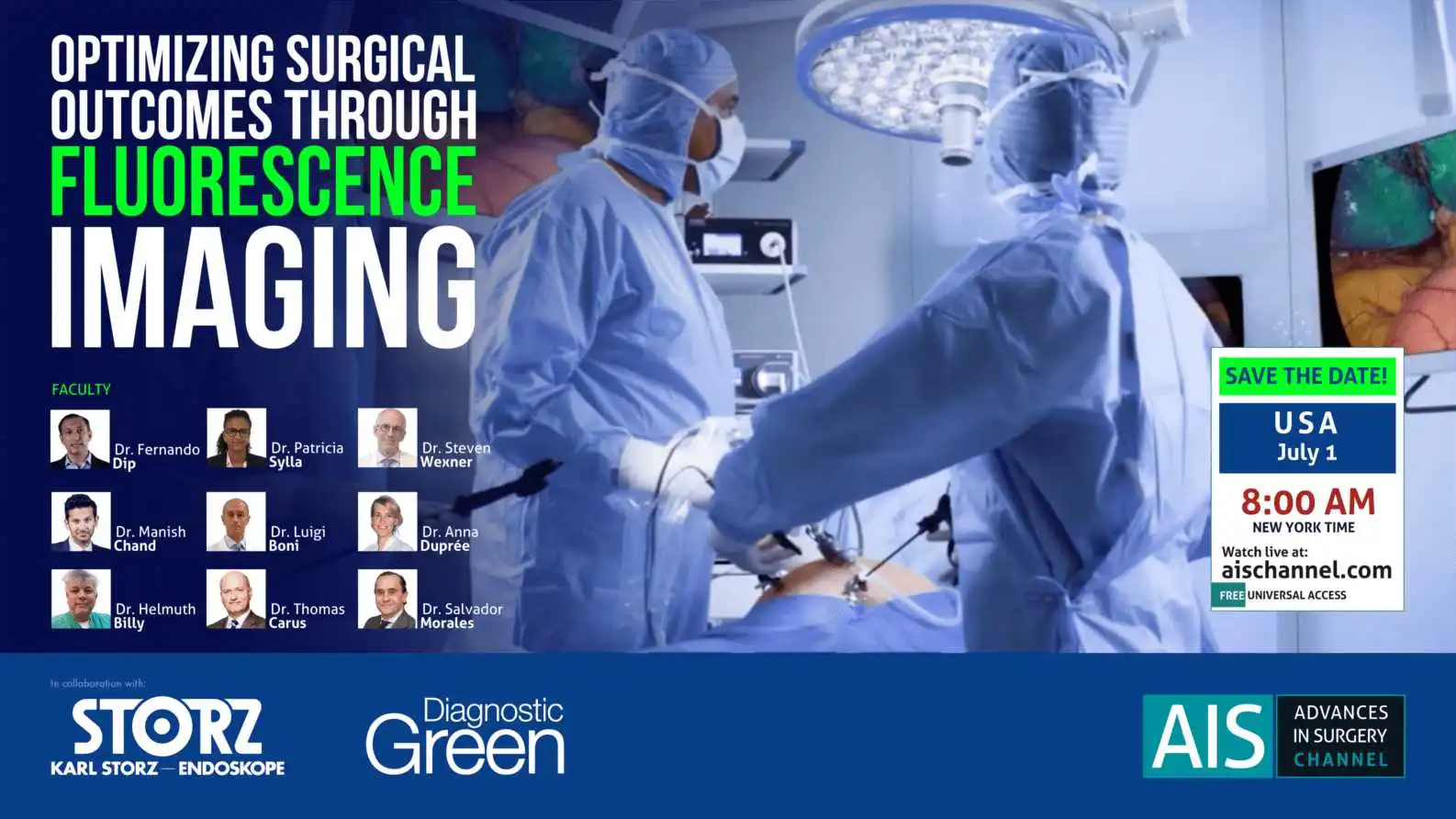
Fluorescence Imaging event presented by Dr. Manish Chand and Dr. Steven Wexner.
With Karl Storz
Published
Jul 2021
Help your network discover Dr. Salvador Morales-Conde's clinical expertise.