

Bariatric Surgery
MD, FACS, FRCS, FICS, FASMBS, DABS-FPDMBS, Clinical Professor, University of Houston Tilman J. Fertitta Family College of Medicine, Clinical Professor, Sam Houston State University College of Osteopathic Medicine, Medical Director of Bariatric Surgical…
Professor Rodolfo J. Oviedo, MD, FACS, FRCS, FICS, FASMBS, DABS-FPDMBS graduated from medical school at The University of Texas at San Antonio in 2007, and from Houston Methodist General Surgery Residency Program in 2013. Dr. Oviedo completed an Advanced Minimally Invasive Gastrointestinal and Bariatric Surgery Fellowship at Baptist Hospital of Miami in Miami, Florida, from 2017 to 2018. During this period, he developed his skills as a robotic surgeon. He is a Board-certified and fellowship-trained metabolic and bariatric surgeon, and general surgeon. His areas of expertise include robotic metabolic and bariatric surgery, abdominal wall reconstruction, anti-reflux surgery, and interventional bariatric endoscopy. He is a Fellow of the American College of Surgeons (FACS), a Fellow of the Royal College of Surgeons (FRCS), a Fellow of the International College of Surgeons (FICS), and a Fellow of the American Society for Metabolic and Bariatric Surgery (FASMBS). He is a Diplomate of the American Board of Surgery with a Focused Practice Designation in Metabolic and Bariatric Surgery (DABS-FPDMBS). Prof./Dr. Oviedo serves on multiple committees at ASMBS, SAGES, ICS, and TROGSS. He has written numerous peer-reviewed manuscripts and book chapters. He is the Deputy Editor for Journal of Robotic Surgery, and an Associate Editor for Obesity Surgery, official journal of IFSO. His current leadership roles include Medical Director of Bariatric Surgical Services and Robotics Program, and Vice Chief of Medical Staff at Nacogdoches Medical Center in Nacogdoches, Texas, USA. His commitment to excellence in patient care and the education of the next generation of surgeons continues as a Clinical Professor at the University of Houston Tilman J. Fertitta Family College of Medicine and as a Clinical Professor at Sam Houston State University College of Osteopathic Medicine. He is honored to serve as CEO of TROGSS - The Robotic Global Surgical Society (https://trogss.org) and as Chair of Global Surgery Specialty Group of the International College of Surgeons, US Section.
Selected publications from PubMed
Procedure-specific outcomes of robotic versus laparoscopic Roux-en-Y gastric bypass and biliopancreatic diversion with duodenal switch across a decade of MBSAQIP adoption.
Hany M, Zidan MH, Wafa A, Elmongui E, Al-Momani H, Hamdan K, Hindawi MD, Oviedo R
J Robot Surg. 2026 Sep 4;20(1) doi: 10.1007/s11701-026-03865-w.
Beyond treatment: can metabolic and bariatric surgery prevent idiopathic intracranial hypertension?
Lainas P, Oviedo R, Pascotto B
Surg Obes Relat Dis. 2026 Aug 7 pii: S1550-7289(26)00816-6. doi: 10.1016/j.soard.2026.08.001.
Correction: Revisional Metabolic and Bariatric Surgery Versus Semaglutide: Which Strategy Has Greater Efficacy for Recurrent Weigh Gain After Primary Bariatric Surgery?
Rivero-Moreno Y, Estrada A, Zamata-Ovalle D, Hindosh N, Choi J, Moran-Atkin E, Oviedo RJ, Camacho D
Obes Surg. 2026 Sep;36(9):5023 doi: 10.1007/s11695-026-08887-9.
Multi-centric international 10-year review of surgical magnetic mechatronics in HPB, bariatrics, OB-GYN, urology and neurosurgery: minimally invasive technology, robot design & actuator-sensor fusion.
Cornejo J, Vargas M, Cornejo J, Sebastian R, Maldonado-Gómez RR, Macias CA, Koutentakis M, Zucchini N, Goyal A, Babu A, Calcina CSG, Bedoya-Castillo M, Mendoza-Arias LM, Charapaqui S, De La Barra D, Charapaqui R, Sáenz-Vásquez LA, Oriundo-Arbizu DE, Ccellccaro C, Guevara-Pino S, Alarcon-Cutimbo M, Sánchez-Castillo IR, Sahuanay-Cáceres G, Mendoza RJ, Butrón-Verástegui VE, Charapaqui R, Custodio-Gilio A, Gastelú-Rodriguez KC, Nole-Vasquez JV, Grossmann RJ, Cornejo-Carrasco CE, Medrano H, Gonzales-Menéndez MJM, Arevalo-Venegas C, Castro FMG, Arango-Ochante PM, Gonzales-Medina CA, Grandez-Urbina JA, Caceres-Torres Ó, Riveros-Ruiz J, Pacheco-Barrios N, Rojas-Apaza R, Alva-Sánchez MS, Perez-Bonet A, Oviedo RJ
J Robot Surg. 2026 Aug 4;20(1) pii: 789. doi: 10.1007/s11701-026-03679-w.
Texas statewide incidence and severity of iatrogenic major vascular injury during inpatient laparoscopic surgery: a population-based cohort study.
Park J, Koutentakis M, Babu A, Zucchini N, Perez-Bonet A, Oviedo RJ, Clapp B
Surg Endosc. 2026 Sep;40(9):7514-7522 doi: 10.1007/s00464-026-13052-5.
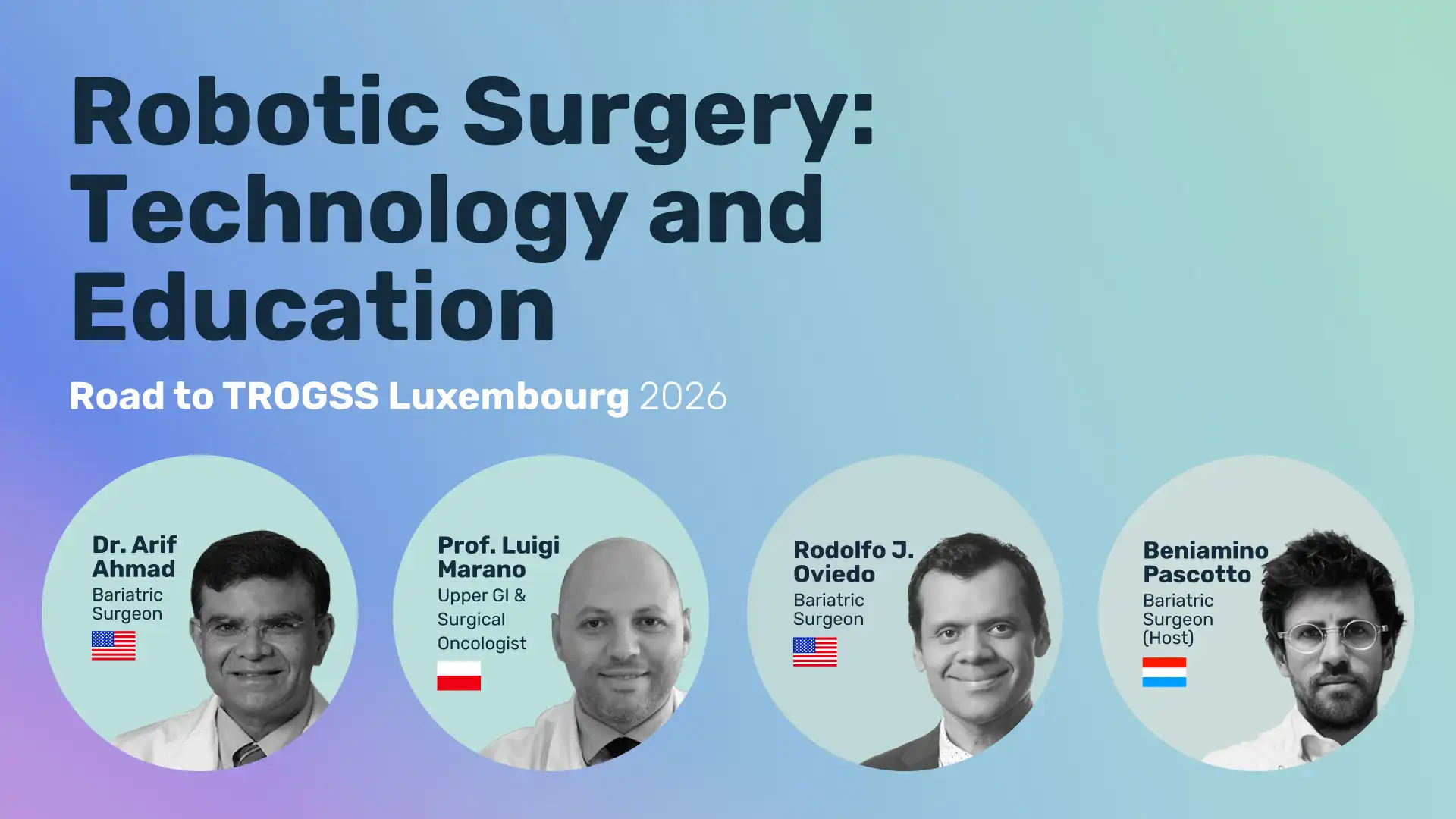
As the global surgical community prepares for the highly anticipated TROGSS Luxembourg Congress, AIS Medical Network presents an exclusive pre-event panel: "Robotic Surgery: Technology and Education." This session serves as the definitive scientific prelude to the main congress, bringing together a distinguished faculty of global pioneers to provide a strategic roadmap of the key themes that will define the meeting in Luxembourg. Our panel of experts will engage in a high-level discussion, bridging the gap between cutting-edge clinical practice and the educational pillars essential for the modern surgeon. In alliance with The Robotic Global Surgical Society (TROGSS)
Published
Jul 2026
.webp)
This Masterclass offers a visionary look into the technological horizon of robotic surgery. We will explore the groundbreaking innovations, from AI-powered analytics to next-generation platforms, that are not just enhancing but fundamentally redefining what is possible in the operating room. This session is a blueprint for the future, designed for those who will lead the next surgical revolution. Topics addressed: The New Generation of Platforms: Expanding Clinical Horizons The Data-Driven OR: Integrating AI, Vision, and Analytics Intuitive Interaction: The Evolution of the Surgeon-Robot Interface Future-Proofing Surgery: The Power of Open and Modular Systems Strategic Readiness: Preparing Your Institution for the Next Wave of Innovation
With Rob Surgical
Published
Nov 2025
Published
Sep 2023

Robotic Single Anastomosis Duodeno-Ileal Switch (SADI-S) is a minimally invasive weight loss surgery that has gained popularity in recent years. It is a modification of the traditional duodenal switch procedure, and it involves creating a single anastomosis between the stomach and the ileum, bypassing a significant portion of the small intestine to reduce the amount of calories absorbed. The use of robotics in SADI-S surgery has advantages such as improved visualization, more precise dissection, and reduced tissue trauma compared to traditional open surgery. The indications for robotic SADI-S are similar to those for traditional weight loss surgeries, including a body mass index (BMI) of 40 or greater or a BMI of 35 or greater with obesity-related comorbidities. Patients with a history of previous abdominal surgeries or significant gastroesophageal reflux disease may not be suitable candidates for the procedure. The history of SADI-S surgery can be traced back to the early 2000s when it was first described as a modification of the duodenal switch procedure. It was initially performed using traditional open surgery techniques but has since evolved to minimally invasive laparoscopic and robotic-assisted surgery. Robotic SADI-S was first reported in the literature in 2014, and since then, numerous studies have reported its safety and efficacy in weight loss and comorbidity improvement. In conclusion, robotic SADI-S is a minimally invasive weight loss surgery that has gained popularity in recent years. It is indicated for patients with a BMI of 40 or greater or a BMI of 35 or greater with obesity-related comorbidities. The use of robotics in SADI-S surgery allows for improved visualization, more precise dissection, and reduced tissue trauma. Robotic SADI-S has shown to be safe and effective in weight loss and comorbidity improvement, and it continues to evolve as a surgical option for the treatment of obesity.
Published
Mar 2023

The super specialty of complex abdominal wall reconstruction continues to evolve based on advanced techniques built upon the shoulders of those who created the initial stages of component separation at the end of the twentieth century. With the advent of technological advances such as robotic surgery, a refined approach has been developed which allows for bilateral myocutaneous flaps creation from an extraperitoneal plane, specifically preperitoneal, known as the extended preperitoneal (eTEP) approach. The robotic platform offers numerous ergonomic advantages to the surgeon which allow for performance of a complex reconstruction of the abdominal wall with attention to detail in all aspects of hernia repair including dissection of the hernia sac and reduction of the hernia contents, a primary repair of the defect under minimal or no tension, plication of associated rectus diastasis, and mesh implantation as a preperitoneal/retrofascial/retromuscular sublay. This SOC will illustrate the robotic extended totally extraperitoneal (eTEP) approach for ventral hernia repair with plication of associated rectus diastasis as a useful adjunct to the minimally invasive surgeon’s toolset and the most recent novel technique for complex abdominal wall reconstruction.
Published
Sep 2022
Help your network discover Dr. Rodolfo Oviedo's clinical expertise.