
Mohit Bhandari is an Indian bariatric surgeon known for his work in laparoscopic and robot-assisted surgery. He is the first surgeon in Asian sub-continent to perform more than twenty one thousand bariatrics and metabolic surgeries.
Selected publications from PubMed
Expert Consensus on Obesity Management Protocols - A Joint Position Statement by Obesity and Metabolic Surgery Society of India (OSSI) and Endocrine Society of India (ESI).
Bhasker AG, Kapoor N, Baig S, Parmar C, Shaikh S, Wadhawan R, Shah S, Kotwal N, Harikumar K, Das S, Baro A, Katakwar A, Unnikrishnan AG, Shaikh A, Mithal A, Monteiro AS, Shrivastava A, Pradhan A, Prasad A, Vashishtha A, Anne B, Kulshreshtha B, Selvan C, Goel D, Priya G, Jammu GS, Phatale H, Maisnam I, Khare J, Pandit K, Agarwal K, Kona L, Kular KS, Nagendra L, Kopalle LN, Goel M, Narwaria M, Baijal M, Khaitan M, Motwani M, Ismail M, Shenoy MT, Bhandari M, Lakdawala M, Dukkipati N, Raizada N, Lal P, Shah PS, Chowbey P, Palanivelu PR, Narayan P, Bharath R, Santosh R, Jindal R, Palaniappan R, Khullar R, Rajput R, Walia R, Goel R, Jaiswal R, Madhu SV, Mittal S, Lodha S, Aggarwal S, Julka S, Kalra S, Bhattacharya S, Bajaj S, Joshi S, Shah S, Dhorepatil S, Ghosh S, Saggu SS, Kumar Kota S, Mishra S, Ugale S, Jindal S, Lathia T, Lotwala V, Khatri V, Bindal V
Obes Surg. 2026 Sep;36(9):4961-4982 doi: 10.1007/s11695-026-08870-4.
Preoperative low-energy diets for patients with a body mass index >30 kg/m2 undergoing non-bariatric surgery: pilot feasibility randomized clinical trial and a systematic review and meta-analysis of efficacy data.
McKechnie T, Kuszaj O, Perks H, Rattansi S, Meyhofer Pedroso C, Staibano P, Thabane A, Leitch J, DuMerton D, Griffin S, Koutoukidis DA, Ramji K, Patel SV, Doumouras A, Eskicioglu C, Parpia S, Thabane L, Bhandari M
Br J Surg. 2026 May 7;113(5) doi: 10.1093/bjs/znag023.
Treatment Algorithm for Patients with Obesity in India: A Joint Consensus by Endocrine Society of India and Obesity Surgeons Society of India.
Baig SJ, Bhaskar AG, Parmar C, Wadhawan R, Shah S, Shaikh S, Kapoor N, Das S, Harikumar K, Kotwal N, Baro A, Katakwar A, Unnikrishnan AG, Shaikh A, Mithal A, Monteiro AS, Shrivastava A, Pradhan A, Prasad A, Vashistha A, Anne B, Kulshreshtha B, Selvan C, Goel D, Priya G, Jammu GS, Phatale H, Maisnam I, Khare J, Pandit K, Agarwal K, Lakshmi K, Kular K, Nagendra L, Kopalle LN, Goel M, Narwaria M, Baijal M, Khaitan M, Motwani M, Ismail M, Shenoy MT, Bhandari M, Lakdawala M, Dukkipati N, Raizada N, Lal P, Shah P, Chowbey P, Palanivelu PR, Narayanan P, Bharath R, Santosh R, Jindal R, Palaniappan R, Khullar R, Rajput R, Walia R, Goel R, Jaiswal R, Madhu SV, Mittal S, Lodha S, Aggarwal S, Julka S, Kalra S, Bhattacharya S, Bajaj S, Joshi S, Shah S, Dhorepatil S, Ghosh S, Saggu SS, Kota SK, Mishra S, Ugale S, Jindal S, Lathia T, Lotwala V, Khatri V, Bindal V
Obes Surg. 2026 May;36(5):2534-2544 doi: 10.1007/s11695-026-08669-3.
Safety and early results of immediately patent magnetic jejuno-jejunal anastomoses (IMPA-JJ) in Roux-en-Y gastric bypass.
Bhandari M, Contreras JE, Marin P, Bhandari M, Brunaldi VO, Mathur W, Reddy M, Tiwari A, Teixeira A, Wilson EB, Galvao Neto M
Surg Endosc. 2026 Feb;40(2):1719-1725 doi: 10.1007/s00464-025-12490-x.
The World's First Long-Distance Tele-Robotic Bariatric Surgery Using an Indigenous Robotic Platform: A Landmark Case Series of One Anastomosis Gastric Bypass with the SSI Mantra System.
Bhandari M, Mathur W, Neto MG, Reddy M, Bhandari M, Kosta S
Obes Surg. 2025 Nov;35(11):4853-4857 doi: 10.1007/s11695-025-08302-9.
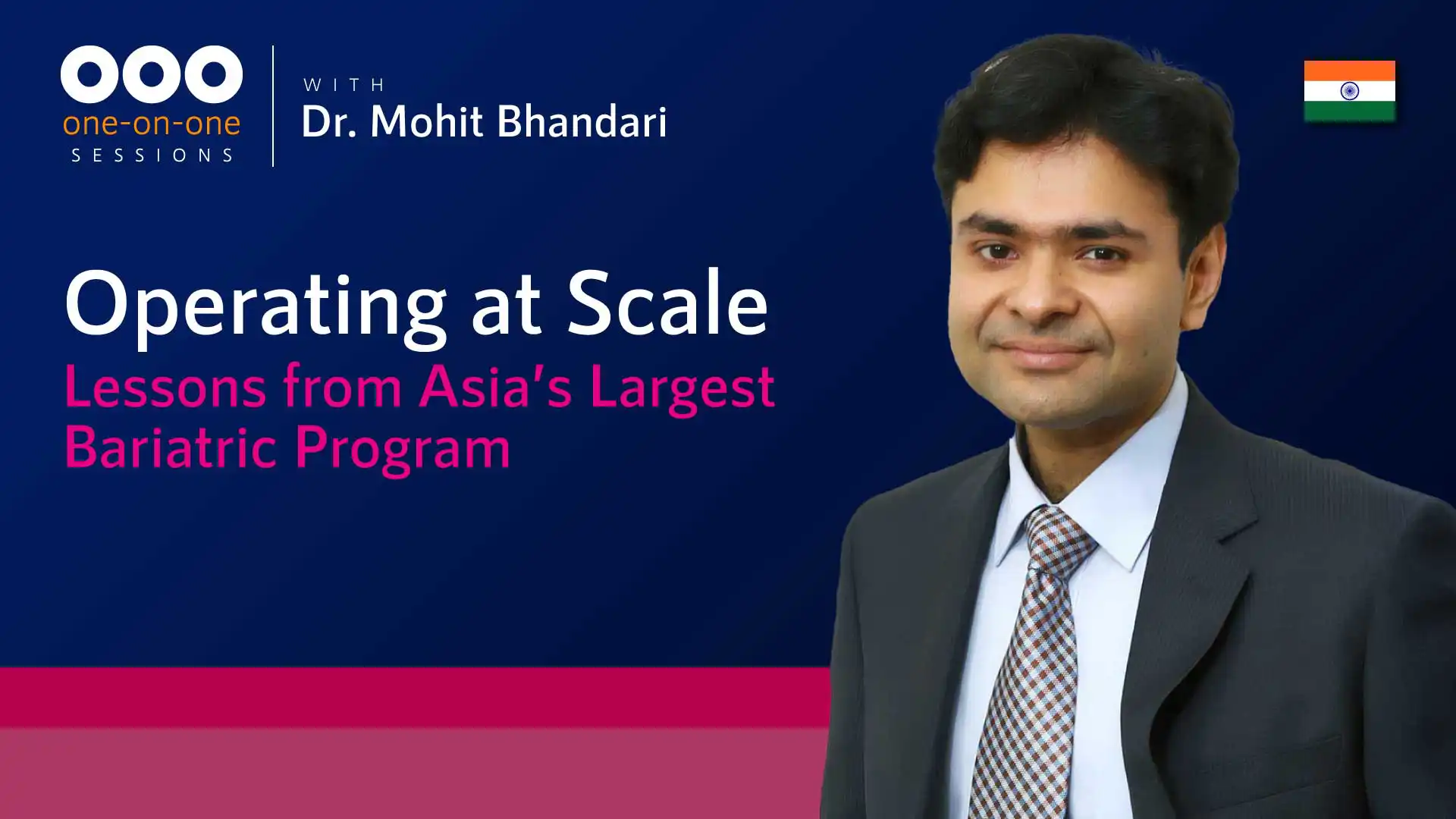
Mohit Bhandari is an Indian bariatric surgeon known for his work in laparoscopic and robot-assisted surgery. He is the first surgeon in Asian sub-continent to perform more than twenty one thousand bariatrics and metabolic surgeries.
Published
Aug 2025

Bariatric surgery remains the most effective and durable weight loss method available to patients. However, a significant percentage of patients may regain weight resulting in frustration, depression, and return of obesity-related co-morbidities. Revision surgery is the one of the treatment modalities for such weight regained patients. The more you do bariatric surgery, the more you need to prepare for revision surgery.
With Johnson & Johnson MedTech
Published
Sep 2022

Leadership is an essential skill in a surgeon. But leadership qualities can be developed during residency rather than waiting until later in your career. The surgical training process in itself requires initiative and motivation and successful residents must begin to develop leadership qualities during their training. Often finding a suitable mentor either within the department or elsewhere can provide essential guidance.
With Johnson & Johnson MedTech
Published
Jun 2022

Obesity is now a global public health issue and has nearly doubled worldwide since 1980. Bariatric surgery is on the rise, but little focus has been placed on the quality impacts of surgery. The purpose of this study is to explore our knowledge with respect to the quantity and quality of bariatric surgery from our last ten years’ experiences. The main focus of this work is to gain an understanding of the successes and challenges faced before and after surgery with the advances in surgical techniques and technologies available for its treatment. We outline the different options in bariatric surgery and summarize the recommendations for selecting and assessing potential candidates before proceeding to surgery. Standardization of bariatric metabolic procedures provides patients with better quality of life and a longer lifespan. For the enhancement of quality, a fellowship programme and the Virtual Bariatric University (VBU) have started to provide knowledge on bariatric (weight loss) surgery to all minimal-access surgeons. We constantly provide data on post-surgical outcomes and evaluate the psychosocial and economic effects of bariatric surgery. Uniform measurement is a fundamental requirement to understand the elements in each procedure that correlate with beneficial weight loss and metabolic effects. Our experiences revealed that standardization and changes to improve care based on the data analysis are key metrics to establish whether the final anatomic configuration following a procedure strengthens bariatric surgical practice, research, and patient outcomes.
Published
Sep 2021

he Covid 19 in India program is designed to update the entire world as to how the country is managing the second wave of this pandemic. Resources were limited in India with lack of ICU beds and meager supply of oxygen.
With Johnson & Johnson MedTech
Published
Jun 2021

The number of laparoscopic bariatric surgical procedures is rapidly increasing all over the world, as it has the advantage of improving recovery time and reducing surgical morbidity. Laparoscopic bariatric procedures require appropriate equipment and instrumentation and surgeons are required to have advanced surgical skills. The operating room must be equipped with an adequate bed with a capacity of approximately 400 kg which makes it possible to safely position an obese patient and prevent musculoskeletal injuries. For bariatric procedures is essential: Optical devices: preferably a 30 or 45 degree telescope, provided with a white light illumination source and a video camera of high resolution. A TV monitor is required for reproduction of endoscopic images and the 4K monitors are recommendable. A DVD recorder allows for documentation of procedures performed. Equipment to creatine / maintain the domain: For performing laparoscopy is necessary a high flow CO2 insufflator which can deliver up 20 liters/min, to maintain a level of 12-15mmHg. Instruments for access: the Veress needle is commonly used, it should be appropriate for the size of the abdominal wall. Operative instruments: Trocars: available in various diameters and sizes according to requirements. Graspers: Bullet nose grasper and Dorsey intestinal fenestrated grasper are the most commonly used and are completely atraumatic. Dissectors: like Maryland and bipolar dissector. Scissors: Hook scissors or dissecting scissors with diathermy are used as required. Bowel and lung clamps: they are not frequently used, but are useful in revision procedures. Energy sources: There’s currently a shift towards the use of bipolar instead of monopolar in bariatric surgery. Tissue approximation/ hemostasis: Laparoscopic ligating suture delivery system Needle driver Clip applicators Mechanical stapling devices: completely changed the bariatric surgery. A range of staple lengths (2.5-3.8mm) is available depending on the thickness of the tissue to be divided. Miscellaneous: like aspiration/irrigation probes or organ extraction devices. It is also important to set a bariatric unit with adequate entrances and routes, lobbies and waiting areas for obese patients, appropriate bedrooms and bathrooms to improve the quality of attention for these patients. Endorsed by: [Image]
With Johnson & Johnson MedTech
Published
May 2021
Help your network discover Dr. Mohit Bhandari's clinical expertise.