
Dr. Suzuki is the professor at the department of General Thoracic Surgery, Juntendo University School of Medicine. Dr. Suzuki graduated from National Defense Medical College in 1990, and was a resident at National Defense Medical College Hospital for two years, and at Japan Self Defense Forse Hospital Yokosuka for three years. In 1993, he went abroad to the US to study diving medicine, and received training of diving medicine at San Antonio, Tx, Groton, Ct, and Panama city, Fl. Dr. Suzuki graduated from US navy diving medical officer course. After coming back to Japan, he moved to National Cancer Center Hospital East for training as thoracic surgeon in 1995. His first attendance to international meeting was world conference on lung cancer held at Dublin, Ireland in 1997. In this conference, he received young investigator award by presenting molecular analysis of lung cancer on microsatellite instability. He became a chief resident of National Cancer Center Hospital East in 1997, and learned also pathology, molecular biology. In 1999, he was appointed to the attending thoracic surgeon at National Cancer Center Hospital, Tokyo. In 2008, he moved to Juntendo University.
Dr. Suzuki is the author for more than 300 English peer reviewed journals and has done many international lectures. He received the following awards; Young Investigator Award at the 8th World Conference of Lung Cancer (1997), Merit Award at the 34th ASCO Annual Meeting (1998), Shinoi/Kawai Award of Japan Lung Cancer Association (1999), Japan Cancer Society Award (2004), Takamatsunomiya Award (2005), Japan Association for Chest Surgery Award (2009).
Dr. Suzuki’s interest are sublobar resection, salvage surgery, sleeve, extended sleeve resection, radiological diagnosis, augmented reality, robotic surgery for lung cancer and mediastinal tumor.
Dr. Suzuki is also the CEO of Thoracentes Inc. which was established in February 2023 to introduce XR technology for medical community.
Selected publications from PubMed
Commentary: Title lobectomy improves disease-free survival over sublobar resection for high-risk stage IA non-small cell lung cancer.
Suzuki K
J Thorac Cardiovasc Surg. 2026 Sep 23 pii: S0022-5223(26)01237-7. doi: 10.1016/j.jtcvs.2026.08.018.
Pulmonary resection post-coronary artery bypass grafting: Feasible, but right-sided procedures demand caution.
Kidachi Y, Watanabe I, Takamochi K, Hattori A, Fukui M, Matsunaga T, Tomita H, Suzuki K
JTCVS Open. 2026 Aug;32:101683 doi: 10.1016/j.xjon.2026.101683.
Comparative outcomes based on pre-Bronchoscopic lung volume reduction (BLVR) Six-minute walk distance (6MWD).
Mahajan AK, Patel PP, Duong DK, Shah N, Collar N, Muldowney F, Wang H, Khan A, Jang H, Subramanian M, Suzuki K, Randhawa S, Weyant MJ
Respir Med. 2026 Aug-Sep;260:108954 doi: 10.1016/j.rmed.2026.108954.
Postoperative pleurodesis using OK-432 for pulmonary air leak in lung cancer patients with idiopathic interstitial pneumonia: A retrospective study.
Fukui M, Ueda T, Suzuki K, Matsunaga T, Hattori A, Tomita H, Takamochi K, Suzuki K
Surg Today. 2026 Aug;56(8):1488-1494 doi: 10.1007/s00595-026-03255-7.
Surgical techniques and outcomes of robot-assisted anatomical lung resection in patients with complete pleural adhesions.
Watanabe Y, Uchida S, Ichinokawa H, Fukui M, Hattori A, Matsunaga T, Takamochi K, Suzuki K
Gen Thorac Cardiovasc Surg. 2026 Jul 28 doi: 10.1007/s11748-026-02369-6.
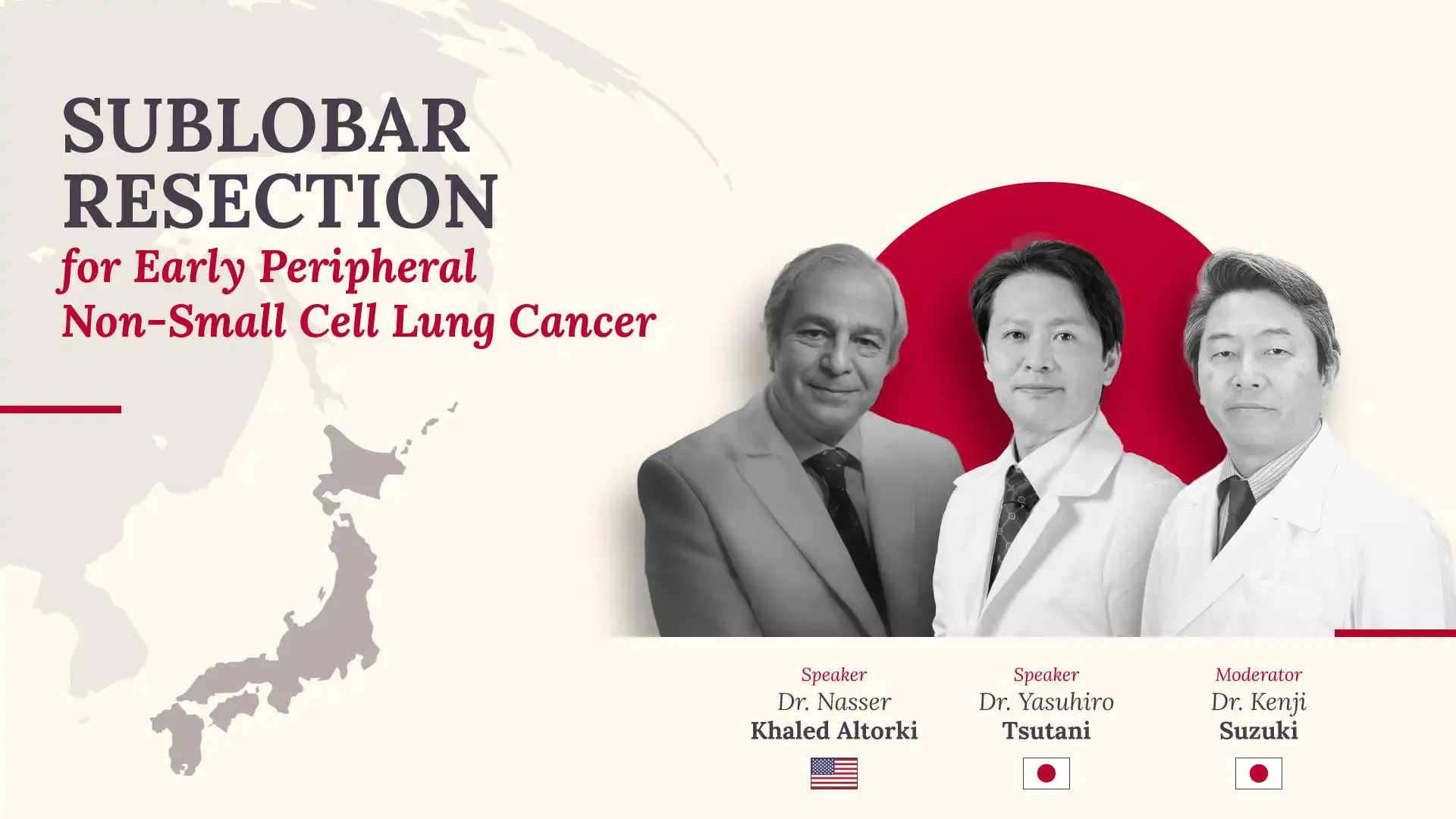
The optimal surgical approach for early-stage peripheral non-small cell lung cancer is a topic of significant clinical debate. While lobectomy has long been the standard of care, recent evidence from two landmark clinical trials, JCOG0802/WJOG4607L and CALGB140503, is challenging traditional practices and refining the role of sublobar resection. Establishing clear indications for less invasive, lung-sparing procedures like segmentectomy and partial resection is essential for improving patient outcomes in thoracic surgery.The optimal surgical approach for early-stage peripheral non-small cell lung cancer is a topic of significant clinical debate. While lobectomy has long been the standard of care, recent evidence from two landmark clinical trials, JCOG0802/WJOG4607L and CALGB140503, is challenging traditional practices and refining the role of sublobar resection. Establishing clear indications for less invasive, lung-sparing procedures like segmentectomy and partial resection is essential for improving patient outcomes in thoracic surgery.
With Johnson & Johnson MedTech
Published
Oct 2025
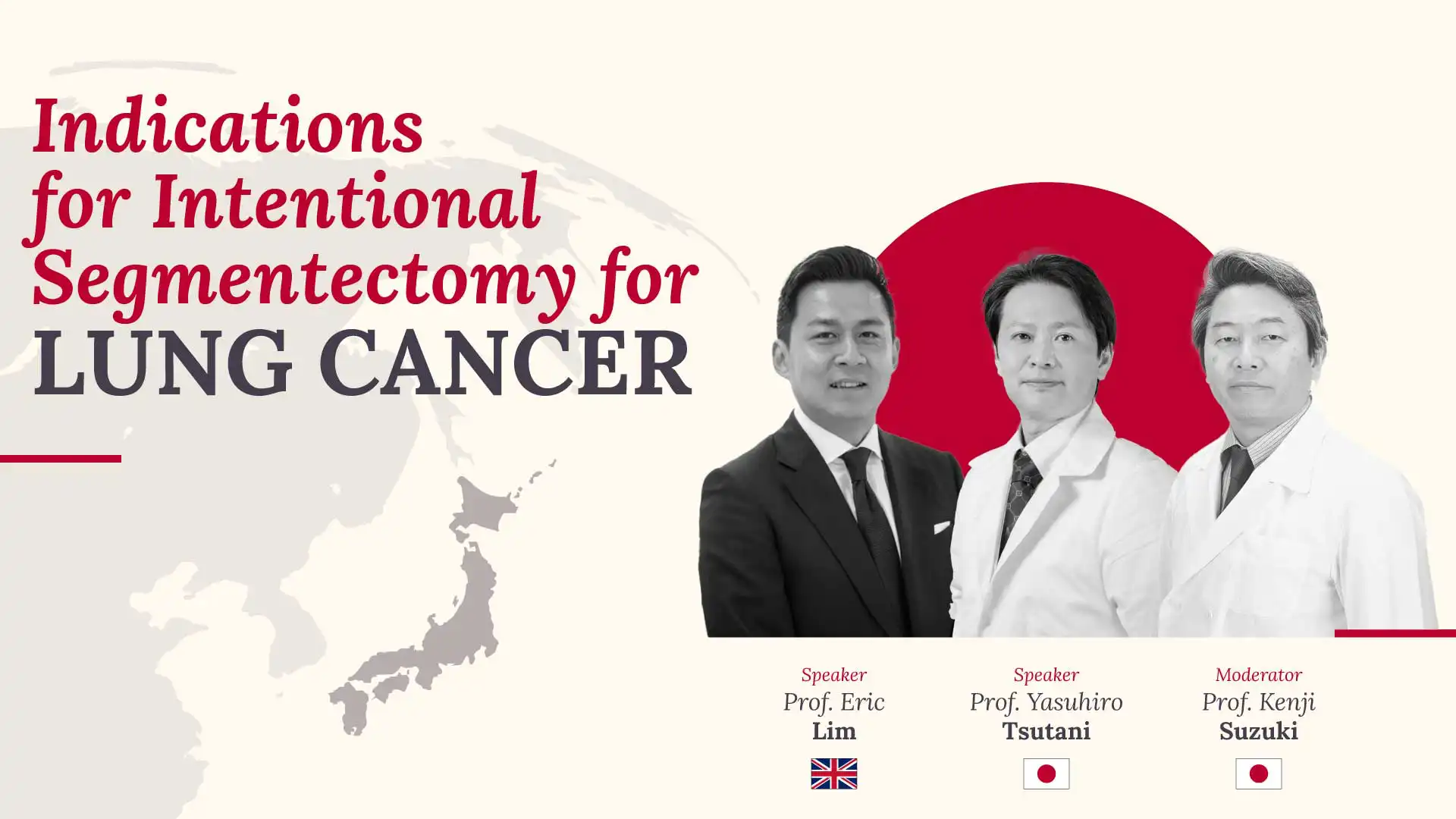
For many years, lobectomy has been considered the gold standard oncologic resection for non-small cell lung cancer (NSCLC). However, as technology advances and a deeper understanding of segmental anatomy, segmentectomy has gained attention as a viable alternative. This less invasive option has shown promising results, although the oncologic equivalency between these techniques still remains under investigation. This event will bring together the two perspectives on this critical topic. On one hand, one of the pioneering countries of the practice and adoption of segmentectomy, Japan. On the other hand, the defending viewpoint of lobectomy over segmentectomy from a leading expert in Europe.
With Johnson & Johnson MedTech
Published
Oct 2024
Help your network discover Prof. Kenji Suzuki's clinical expertise.