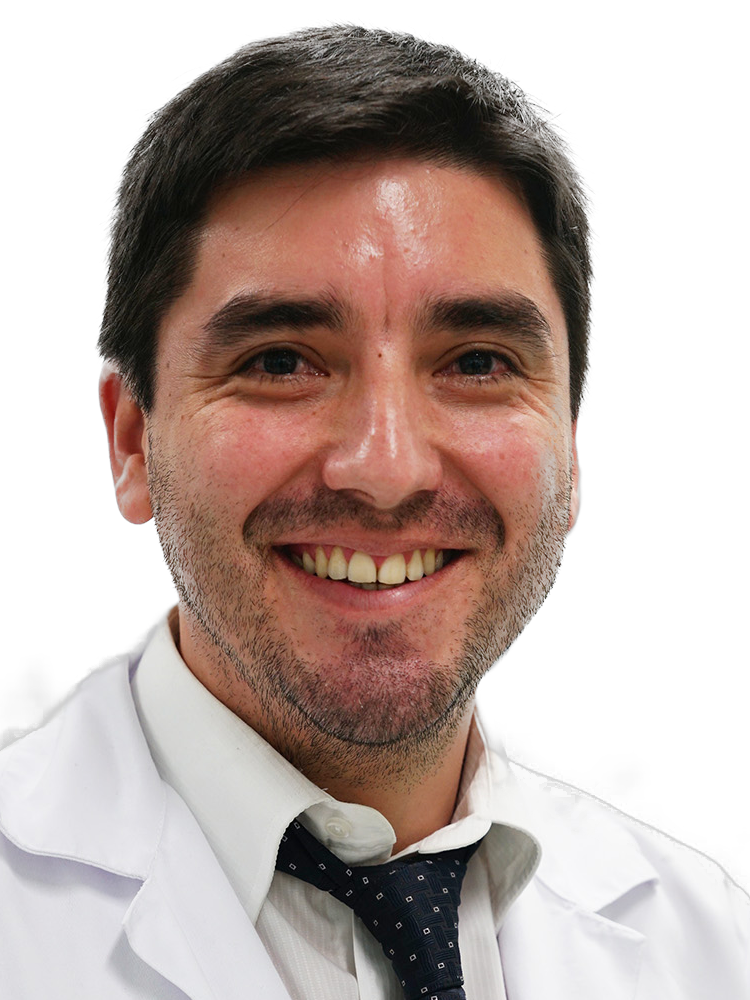
Dr. Julio Jiménez is a bariatric and gastrointestinal surgeon at Hospital Santiago Oriente Dr. Luis Tisne Brousse. He completed his medical training at Pontifical Catholic University of Chile, Hospital Clinic of Barcelona, and the University of Chile, where he currently serves as a surgical professor at the Faculty of Medicine.
Dr. Jiménez is passionate about surgery and teaching. He proudly serves as an ambassador for AIS Channel in Chile, contributing to the advancement of surgical education for new surgeons in his country and worldwide, aiming to improve patient health outcomes through enhanced medical training.
Selected publications from PubMed
Robotic Magnetic Surgery: Results From the First Prospective Clinical Trial.
Romero-Velez G, Robles I, Jiménez J, Cabrera C, Luengas R, Portenier D, Kroh M
Ann Surg Open. 2022 Dec;3(4):e225 doi: 10.1097/AS9.0000000000000225.
Changes in the Bone Mineral Density after Sleeve Gastrectomy vs. Roux-En-Y Gastric Bypass 2 Years after Surgery.
Castro MJ, Jiménez JM, López M, Cao MJ, González-Ramírez G, de Lourdes Bolaños-Muñoz M, Ruiz-Tovar J
Nutrients. 2022 Jul 26;14(15) doi: 10.3390/nu14153056.
Health Equity and Social Determinants of Health in Pediatric Gastroenterology.
Daniel R, Jimenez J, Pall H
Pediatr Clin North Am. 2021 Dec;68(6):1147-1155 doi: 10.1016/j.pcl.2021.07.004.
Retraction Note to: Long-term follow-up after sleeve gastrectomy versus Roux-en-Y gastric bypass versus one-anastomosis gastric bypass: a prospective randomized comparative study of weight loss and remission of comorbidities.
Ruiz-Tovar J, Carbajo MA, Jimenez JM, Castro MJ, Gonzalez G, Ortiz-de-Solorzano J, Zubiaga L
Surg Endosc. 2021 Mar;35(3):1492 doi: 10.1007/s00464-021-08298-0.
Analgesic effect of postoperative laparoscopic-guided transversus abdominis plane (TAP) block, associated with preoperative port-site infiltration, within an enhanced recovery after surgery protocol in one-anastomosis gastric bypass: a randomized clinical trial.
Ruiz-Tovar J, Gonzalez G, Sarmiento A, Carbajo MA, Ortiz-de-Solorzano J, Castro MJ, Jimenez JM, Zubiaga L
Surg Endosc. 2020 Dec;34(12):5455-5460 doi: 10.1007/s00464-019-07341-5.

What superpower would like to have as a surgeon? The superpower would be ubiquity; state or capacity of being everywhere. Every surgeon would like to have the best specialist advising them during surgery at any time. AIS TeleSurgeon is a telementoring and remote surgical training system based on surgery learning that combines hardware and software. The full-fledged system allows plugins and plays images, videos, and any data from laparoscopic devices or an audio-visual signal in the operating theatre to allow remote surgeons to give visual indications to OR screens. Moreover, the system allows audio connection between the surgeon in the operating room (OR) with anyone outside the OR (from home, from an office, or another place in the hospital), that could be, for instance, another specialized surgeon or a sales representative who sold any medical instrumentation. The main goal of AIS Telesurgeon is to connect remotely surgeons around the world, to open a new world of collaborative surgeries and remote training. Dr. Julio Jiménez will share with us his experience as the first surgeon in Chile to perform collaborative surgery in real-time using 5G.
Published
Oct 2022

Gastric cancer is the 5th most frequent cancer worldwide, with more than a million new cases per year. This cancer also has a high mortality rate: 1 out of 12 oncological deaths is attributable to gastric cancer, resulting in a 5-year survival that varies from 10 to 30 percent depending on the country. Mostly this high mortality is attributable to late-stage diagnosis and poor outcomes in advanced cases. The traditional treatment scheme initiates right after diagnosis and staging, where tumours are classified as operable in the best.case scenario or as inoperable or metastatic. This is a critical step, as in gastric cancer patients surgical intervention gives the best outcomes with a 5-year survival rate for pre-metastatic diagnosis of 67%. Inoperable or metastatic patients are often treated with several lines of chemotherapy and only recently has immunotherapy been approved for metastatic gastric cancer. Immunotherapy has definitely revolutionized gastric cancer treatment, significantly improving patient survival. To understand how this therapy works we need to take a look at the cancer immune response.
Published
Mar 2021

While the use of robotic surgical technology has experienced exponential growth in many parts of the world and across numerous specialties, including bariatric surgery, standardized training and credentialing of robotic surgeons unfortunately remains in a nascent state. The need for a standardized robotic training curriculum is much needed and long overdue. The lack of a standardized training curriculum lends itself to serious disparity in the quality of robotic training depending on trainee location and specialty.
Published
Dec 2020

Dr. Venkatesh Munikrishnan, Dr. Gabriela Moeslein, Dr. Eduardo Villegas, Dr. Julio Mayol, Dr. Silvia Valverde, Dr. Mark Soliman, Dr. Julio Jiménez present "Dr. Julio Jiménez".
With Johnson & Johnson MedTech
Published
Oct 2020

Laparoscopic sleeve gastrectomy has become increasingly popular as a primary bariatric procedure and, according to recent data, is the most common bariatric surgery worldwide. However, this primary surgery may fail, either due to poor weight loss results or due to specific complications of the procedure. In this conference we will briefly review revision surgery for sleeve gastrectomy and answer 3 questions: Why is this surgery performed? (Revision indications) What surgery is performed? (Surgical alternatives) How is surgery performed? (Surgical approach)
Published
Jun 2020

In this lecture we will briefly review bariatric surgery in Chile. Obesity and Diabetes Mellitus are a public health problem in Chile. Almost 75% of the population in Chile is overweight or obese. Chile is the OECD country with the highest obesity rate, the first in Latin America in childhood obesity and 14,000 people die each year from obesity-related diseases. When comparing the results with the previous national statistics, obesity grew from 22.9 to 31.2% in the last 6 years, while overweight remained at 40%. Regarding T2DM, the proportion of people older than 15 with DM increased from 4.2% in 2003 to 12.3% in 2017.Bariatric surgery is the most effective treatment alternative for obesity and current clinical evidence indicates that surgical treatment is superior to medical management in a vast majority of type-2 diabetic patients. According to data from the Chilean Society of Bariatric Surgery, approximately 8,000 bariatric surgeries are performed annually in Chile, where 64.6% correspond to sleeve gastrectomy and 33.2% to gastric bypass. 6.6% correspond to revision surgery. Recently the Chilean Societies of Endocrinology and Diabetes and of Bariatric and Metabolic Surgery decided to generate a consensus regarding the importance of other factors related to DM2 that would allow a better selection of candidates for surgery.
Published
Apr 2020
Help your network discover Dr. Julio Jiménez's clinical expertise.