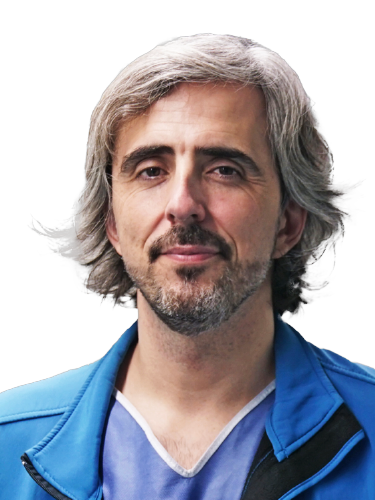
Dr. José M. Balibrea is the Head of the Endocrine-Metabolic & Bariatric Surgery Division at Germans Trias i Pujol University Hospital in Badalona-Barcelona, Spain. He earned his medical degree and doctorate from Complutense University of Madrid, receiving extraordinary prizes in 2002 and 2006. He trained at Hospital Clínico San Carlos in Madrid.
Dr. Balibrea is also a Full Professor of Surgery and has many roles in the medical community. He advises the Surgical Infection Committee of the Spanish Surgical Society, is the Academic Chairman of the AIS Channel (aischannel.com), and holds editorial positions with Cirugía Española, Frontiers in Surgery, the British Journal of Surgery, and the Surgical Infection Society-Europe. He is a Fellow of the American College of Surgeons and sits on the board of the Spanish Society for Bariatric Surgery (SEIQ).
He is recognized as a full professor by ANECA and AQU, and is accredited in robotic and bariatric surgery. Dr. Balibrea leads several research projects and has published over 110 scientific papers. He has received multiple awards, including the St. Nicholas Prize and the Lino Torre Award for Research in Surgery.
Dr. Balibrea is dedicated to improving surgical practices and medical education, with a focus on advancing Surgery 4.0 and the digital transformation of medical teaching.

In this one-on-one conversation, Dr. Jose Balibrea shares practical strategies for breaking down the barriers to robotic surgery adoption. In a casual 30-minute Q&A session, he will answer audience questions and discuss how to make advanced surgical technology accessible for every hospital and surgeon. The discussion will cover: Overcoming the steep learning curve: new training pathways for surgeons. Bridging the gap between simulation and the operating room. Building cost-effective and sustainable robotics programs for any institution. Rethinking mentorship and credentialing for widespread, safe adoption. The role of industry and new platforms in democratizing surgical robotics.
With Rob Surgical
Published
Nov 2025

In this session, Dr. Antonio M. de Lacy remotely guided Dr. José M. Balibrea through a complex gastric bypass surgery on a 27-year-old patient with a BMI of 36. Using the 4RemoteHealth platform by Zerintia Healthtech, Dr. de Lacy provided real-time guidance from his office, communicating seamlessly with the surgical team in the operating room led by Dr. Balibrea. Even while attending a separate meeting, Dr. de Lacy remained fully connected to the procedure, using the platform to offer timely feedback through his mobile device. This session highlights the revolutionary potential of remote surgical mentoring, made possible by the AIS Telesurgeon and Zerintia Healthtech. The platform enables specialists to guide live surgeries from anywhere in the world, offering high-quality audiovisual communication, enhancing surgical precision, and improving patient outcomes. This is the way for improving surgical education and collaboration, expanding access to expert mentorship and fostering a new era of connected surgery. PROGRAM: 4RemoteHealth Platform Demonstration - Complex Gastric Bypass surgery - Dr. José M. Balibrea (Spain) and Dr. Antonio M. de Lacy (Spain)
With Zerintia HealthTech
Published
Sep 2024

The three sides of the tale about gastroesophageal reflux and sleeve gastrectomy: yours, mine and the truth, Conversion from SG to RYGBP and Panel discussion & closing remarks.
With Johnson & Johnson MedTech
Published
Jan 2023

Degree (extraordinary prize 2002) and Doctor in Medicine and Surgery from the Complutense University of Madrid (extraordinary prize 2006). Trained at the Hospital Clínico San Carlos in Madrid. Currently Head of the Endocrine-Metabolic & Bariatric Surgery Division at Germans Trias i Pujol University Hospital in Badalona-Barcelona (Spain), Full Professor of Surgery, advisor of the Surgical Infection Committee of the Spanish Surgical Society, Academic Chairman of the AIS Channel (aischannel.com), Senior Editor of Cirugía Española, Associate Editor of Frontiers in Surgery, Member of the Council of the British Journal of Surgery and Surgical Infection Society- Europe, Fellow of the American College of Surgeons as well as a member of the board of directors of the SEIQ. Accreditation as a full professor by ANECA and AQU as well as in robotic surgery and is an expert in bariatric surgery by the Spanish Society for Bariatric Surgery (SECO). PI in 3 FIS Research Projects. Author of more than 110 scientific papers with an IF >300, more than 1600 citations, H-index 21. Director of 17 Doctoral Theses. St. Nicholas Prize of the Royal Spanish Academy of Medicine. Lino Torre Award for Research in Surgery in 2013. Hospital Clinico San Carlos' Gimbernat Award in 2020. Interested not only in research and innovation, my intention is to bring real value to both the practice and teaching of medicine in general. My purposes are twofold: to contribute to the development of surgery 4.0 and to complete the digital transformation of medical education. As a Surgeon, always more than a Physician, never less. As a Teacher, a transformer of empty minds into open minds.
Published
Dec 2022

Obesity is considered to be one of the 21st century epidemics. Bariatric surgery has shown excellent results for weight loss and comorbidity resolution in the long-term. In the case of super obese patients, one of the options is to perform a two-step procedure. First, a restrictive procedure such as a sleeve gastrectomy (SG) will allow the patient to lose weight and improve their comorbidities, thus facilitating the surgical technique and perioperative management in the performance of the second and definitive procedure, usually a malabsorptive technique. In this case, a conversion from SG to single anastomosis duodeno-ileal bypass (SADI-S) was performed on a 49-year-old male with a BMI of 38 Kg/m2. He had undergone a SG 7 years earlier, with an initial weight loss of nearly 50 Kg, and a subsequent weight regain of 25 Kg. He had also undergone a laparoscopic cholecystectomy 3 years before the second-step procedure. He showed no symptoms of GERD. A robotically assisted SADI-S was performed. The surgery was uneventful and took 135 minutes. A hand-sewn two-layer duodeno-ileal anastomosis was made 275 cm previous to the ileocecal valve. The postoperative course was also uneventful, and the patient was discharged on the second day after surgery.
Published
Mar 2022

Obesity is the fastest growing disease worldwide in the last few decades. Among its effects, it increases the risk and mortality of cancer in several organs. In fact, nowadays it is thought that around 20% of all cancers can be attributed to obesity. Several obesity-associated conditions have been positively associated with cancer in the gastrointestinal tract. The adenomatous polyposis coli (APC) gene is a key tumor suppressor gene. Mutations in APC have been found in ∼60% of sporadic carcinomas and adenomas, while germ-line mutations in the APC gene result in familial adenomatous polyposis (FAP). Recent studies published in the literature have examined the promotion of carcinogenesis in the gastrointestinal tract in relation to obesity: hypermethylation of APC promoter 1A, genetic and epigenetic events in APC, hyperinsulinemia and high IGF-1 concentrations in blood due to the increase in visceral fat are key factors in the relation between obesity and carcinogenesis. In this surgical open classroom, we will consider two scenarios regarding surgical considerations. The first one is the diagnosis of FAP in an obese patient in need of elective proctocolectomy, while the second one is when a patient with previous bariatric surgery is diagnosed of FAP or an attenuated form of FAP. In the first case, technical considerations will be analyzed, taking into account the increase in complexity and surgical complications that obese patients who need to undergo a restorative proctocolectomy with ileal pouch-anal anastomosis will be exposed to. Secondly, an analysis of the possible complications that patients with previous bariatric surgeries who have to undergo proctocolectomies due to FAP will be performed, with special focus on patients with previous mixed or malabsorptive techniques with duodenal exclusion.
Published
Nov 2021
Help your network discover Dr. José M. Balibrea's clinical expertise.