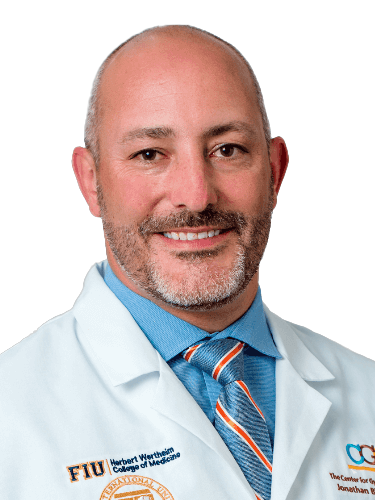
I grew up in a medical family and was determined not to be a doctor. While I respected the profession, I elected to major in economics, film, and media studies. I interned for Kodak and worked for Red Bull; I then did some deep soul searching and decided to pursue a career in medicine, a decision I have never regretted. I chose the specialty of gynecologic oncology because it is the perfect symbiosis of medicine and surgery. This rare combination of gynecologic, urological, gastrointestinal, and vascular surgery is the only specialty where the surgeon also acts as a medical oncologist, thereby allowing for a special long-term relationship with the patient, a major bonus for me. One of the most pivotal experiences in my life was a Semester at Sea, a 100-day voyage where I circumnavigated the globe on a steamship which doubled as a floating university. While we were on the ship, we were required to take college courses and when we were at port, we had the opportunity to freely travel and experience the country, people, foods, and culture. I learned about world history, different cultures. I learned to take risks and to be open to new experiences. Most importantly, I learned every person has a unique story and something to teach you. And I learned a smile and a hug go a long way. I know that experience has really shaped how I practice medicine. Most people assume curing cancer and saving lives is what I would enjoy the most. While I treasure the positive outcomes, my relationship with my patients is my true passion. We effectively work as a team. My patients put their trust in me to provide exceptional medical and surgical care, while I make sure they have all the information needed to make knowledgeable decisions about their treatment and the confidence to make personal medical choices. I am proud to be part of my family legacy of talented medical professionals. But I am equally proud of being a good person and doing the right thing with a smile on my face, a hug to offer, and a hand to hold.
Selected publications from PubMed
Clonal LIMD1 loss drives PD-L1 immune evasion via ARIH1-dependent ubiquitination in lung cancer.
Shah KM, Kennedy PT, Black JR, Pawlik P, Litchfield K, Thakkar K, Contreras-Gerenas MF, Brooksbank K, Yuan O, Grevitt P, Charrot S, Davies J, Dahal LN, Lagos D, McGranahan N, Sharp TV
Life Sci Alliance. 2026 Oct;9(10) doi: 10.26508/lsa.202603812.
Temporal associations between nightmares and PTSD symptoms in the acute post-sexual assault period: An ecological momentary assessment study.
Boland A, Reyes LD, Black J, Serrano K, McLean SA, Short NA
J Mood Anxiety Disord. 2026 Sep;15:100191 doi: 10.1016/j.xjmad.2026.100191.
Mediating effects of depression, stigma, and self-efficacy on self-management improvement in an evidence-based epilepsy self-management program.
Armah L, Tan L, Branning R, Ghearing G, Tyrrell M, Fiorelli N, Black J, Krehel-Montgomery J, Adeniyi C, Sajatovic M, Briggs F
Epilepsy Behav. 2026 Sep;182:111117 doi: 10.1016/j.yebeh.2026.111117.
To Climb or Not to Climb: A Cross-Sectional Investigation of Risks and Benefits During Pregnancy and Postpartum.
Davenport MH, Osachoff L, Ray L, Black J, Cheung NKY, McHugh TL
Sports Med. 2026 Sep;56(9):2295-2311 doi: 10.1007/s40279-026-02452-1.
Beyond the inbox: Exploring shared cognitive mechanisms underlying susceptibility to and reporting of deception across digital domains.
Sabo KE, Sarno DM, Black JT
Appl Ergon. 2026 Sep;135:104771 doi: 10.1016/j.apergo.2026.104771.

The video shows a completed robotic hysterectomy, with the doctor performing the divisional closure using Ethicon antibacterial suture. The closure is made from the anterior to the posterior which is not a traditional technique. The procedure starts at the anterior apex, pushing the bladder down a little bit using the backside of the small driver and taking the midline with stride effects. The surgeon follows the same technique going from anterior to posterior with a barbed suture. Finally, he goes through the deeper second layer. The final scenes show the closure where other ligaments are away from the closure. The main conclusion is that the bladder is very anterior to where the anterior closure is.
With Johnson & Johnson MedTech
Published
Jun 2022

PROGRAM Welcome and Introduction - Dr. Zoe Garoufalia (USA) Science of Wound Healing - Dr. Zoe Garoufalia (USA) Surgical site infection prevention - Dr. Liza Ovington (USA) Surgical Video Case - Wound closure in GYN Oncology Surgery - Dr. Jonathan Black (USA) Leadership Skills: Mentorship support for Residents - Dr. Steven D. Wexner (USA) Panel discussion - All faculty moderated by Dr. Zoe Garoufalia (USA)
With Johnson & Johnson MedTech
Published
Mar 2022
Help your network discover Dr. Jonathan Black's clinical expertise.