
Ines Rubio-Perez (MD, PhD) is a colorectal surgeon from Madrid, Spain. She completed her residency training in General Surgery in 2012 at La Princesa University Hospital (Madrid) and then was appointed staff surgeon in the colorectal surgery unit at La Paz University Hospital, where she currently works. She is an Associate Professor of Surgery in the Autonomous University of Madrid.
She has a special interest in surgical infections and postoperative complications, and has been actively involved in various research projects, such as the study of clinical profiles and risk factors of multi-resistant infections in surgical patients, which was the subject of her PhD thesis in 2015. She is a member of the Board of the Surgical Infections Section in the Spanish Surgical Association (AEC), the Spanish Observatory for Infection and Councilor and Education Committee Chair of the Surgical Infection Society Europe (SIS-E), where she strives to involve surgeons in the knowledge and importance of infections.
Her main areas of expertise in colorectal surgery are colorectal cancer and functional disorders, especially pelvic floor and SNS therapy. She has visited London (St. Mark’s), Oxford and Brisbane in different fellowships awarded by the Spanish Surgical Association (AEC) and the European Society of Coloproctology (ESCP). She is author of over 100 publications in indexed journals and actively participates in various national and international research projects and collaborations. She is also part of the Editorial Board of Colorectal Disease and Surgical Infections journals.
She is involved in education and innovation, organizing events for students, residents and specialists, and participating as speaker in multiple congresses and courses (both national and international) She is engaged with scientific social media and new technologies.

Surgical site infections (SSIs) are infections in the skin where an incision is made, infections below the incision in muscles and tissues and infections in deep organ spaces surrounding parts of the body involved in the surgery. Despite established guidelines and known risk factors, SSIs continue to be a common and costly issue in every type and class of surgical procedure. In fact, SSI are the most common SSIs are the most common and costly of all hospital-acquired infections. SSI incidence is directly related to higher mortality, re-intervention, and increased length of hospital stay. In the United States alone, an estimated 300,000 SSI occur annually at a cost of $10 billion. However, they are a global burden, with substantially higher SSI incidence in Low and Middle Income Countries. Thus, there is both an opportunity and an imperative to reduce SSI worldwide. In this episode of the AIS Channel Colorectal Surgical Journeys series, we bring together a group of experts to discuss the current state, known methods, and future possibilities for reducing SSI and improving the associated healthcare outcomes after surgery.
With Johnson & Johnson MedTech
Published
Mar 2022
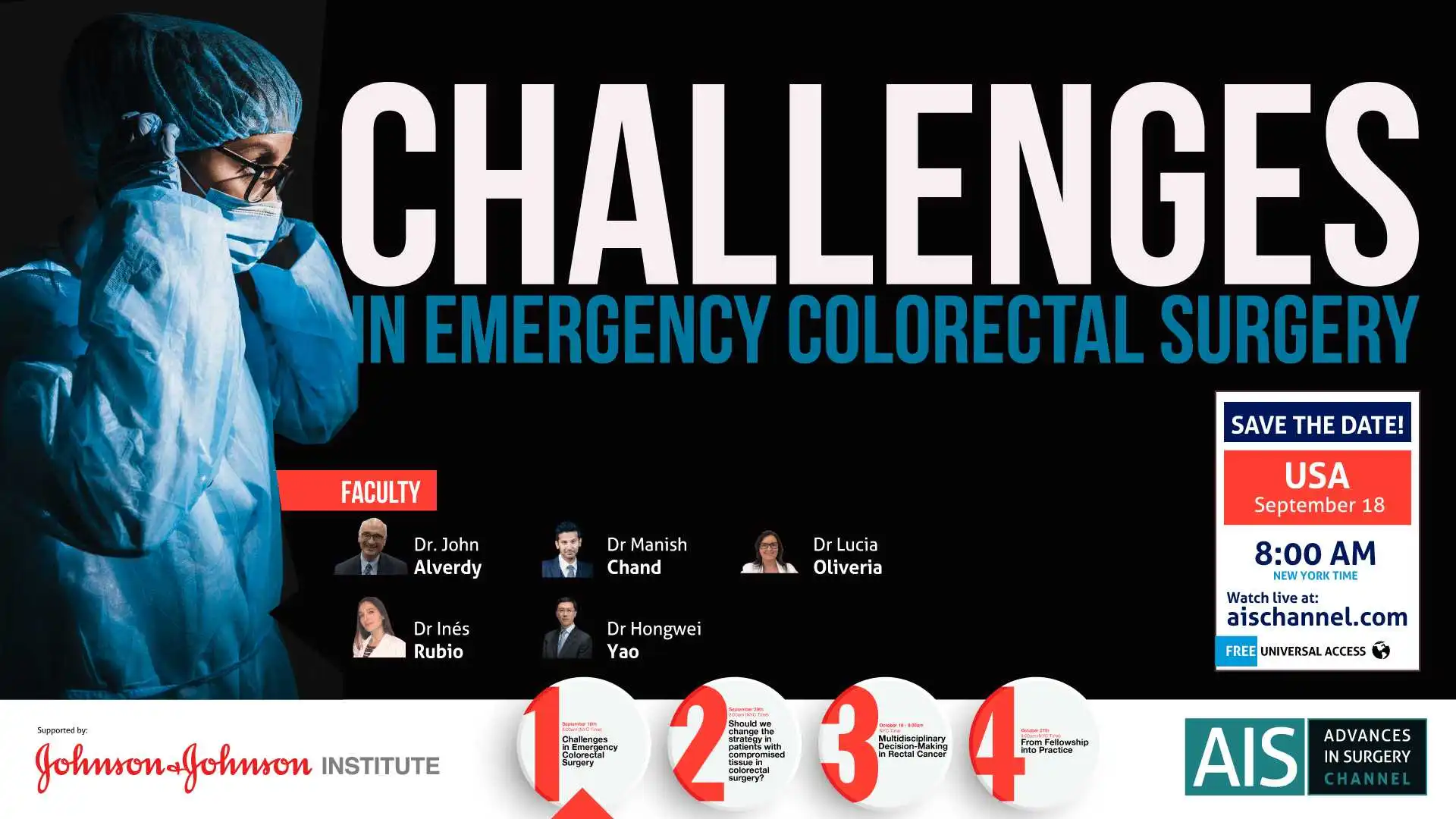
Dr. John Alverdy, Dr. Manish Chand, Dr. Lucía Oliveira, Dr. Inés Rubio and Dr. Hongwei Yao present the Challenges in Emergency Colorectal Surgery.
With Johnson & Johnson MedTech
Published
Jul 2020

Surgical site infections (SSIs) are defined as infections that affect the site incision (SSI by superficial or deep incision) or deep tissues up to 30 days after surgery, or up to 1 year if a prosthesis or implant has been placed. SSIs have significant consequences, both economically and in the quality of life, morbidity and even mortality. That is why its prevention is considered a fundamental aspect in all surgical services, with established clinical guidelines and ongoing research to increase the degree of evidence. In Spain, the SSI rate is high, at approximately 21.6%.In this conference, Dr. I Rubio-Pérez elegantly presents a study based on the analysis of the attitude of Spanish surgeons to deal with SSIs. It is known that the measures proposed to prevent SSIs have different levels of adoption among surgeons and, therefore, their study focuses on asking which measures were used, but also the personal preferences. After 835 responses that seem to be generalizable throughout the Spanish territory, the results require an exhaustive analysis. More emphasis should be placed on knowing the optimal treatment of skin hair, antisepsis of the skinor the role of wound edge protectors. Due to the consequences of SSIs at a personal level and at the level of the health system, it is important to promote interventions that can reduce its index. In addition, analyses such as that presented by Dr. I. Rubio-Pérez are essential as internal audits and to detect areas of improvement. The full study can be found at this link.
Published
Feb 2019

Clinical Case It can be difficult to define what a complex abdominal infection is: a diffuse peritonitis? Is it technically difficult to manage? Is it life threatening for the patient? Or is it a tertiary/nosocomial peritonitis in a critically ill patient? In many cases it can be a combination of all these factors, and we will have to tailor the approach. The best approach will be the one that considers all variables related to the patient as a whole, and not just the type or location of infection. Clinical risk factors, hemodynamic situation, early and appropriate therapy and source control, are all important if we are to deliver the best possible treatment. Most guidelines and consensus such as the newly updated SIS Guidelines (Mazuskiet al. Surg Infect 2017) and worldwide initiatives such as the Surviving Sepsis Campaign stress the importance of this. Specific severity scores such as the one developed by the World Society of Emergency Surgery (WSES) can be useful to predict mortality in patients with complicated abdominal infections. Source control is one of the most important measures that a surgeon can apply: an appropriate source control is essential to increase survival, and it should always be as definitive as possible at the time of the index procedure. Minimally invasive techniques, including drainage and laparoscopy, have demonstrated to be as efficient as laparotomy in some cases, increasing the surgeon’s options. The optimal approach is to achieve adequate source control using the least aggressive technique, following the principles of the ‘step-up approach’ used in pancreatitis. However, in some cases it is inevitable to perform extreme interventions, including leaving the abdomen open. Although this is still an option in very critical patients with infections, evidence has shown that indications should be very limited in this context. There is no place anymore for planned re-laparotomy in complex patients, and indications should be considered to be ‘on-demand’.
Published
Oct 2017
Help your network discover Dr. Inés Rubio Pérez's clinical expertise.