
Ms. Daniah Alsaadi, MD, MBA, MSc, MRCS, is a dedicated and highly motivated Urology Specialist Registrar (SpR) at University Hospitals in Ireland, affiliated with the Royal College of Surgeons in Ireland. She has built a strong academic and clinical profile underpinned by a clear commitment to excellence in urological care, minimally invasive surgery, and healthcare leadership.
She holds a Doctor of Medicine (MD), a Master of Science (MSc) in Advanced Minimally-Invasive Surgery from University College London, with specialised training in Da Vinci Xi robotic surgical systems, and a Master of Business Administration (MBA) in Healthcare Management. Her multidisciplinary background uniquely positions her at the intersection of advanced surgical practice, innovation, and healthcare systems leadership.
Ms. Alsaadi has extensive clinical and surgical experience in urology, complemented by a proven leadership track record. She previously served as Regional Principal NCHD and Perioperative Directorate Lead, demonstrating strong capabilities in clinical governance, service development, and team coordination. She is a published author with an active academic interest and a strong commitment to continuous professional development, medical education, and mentorship.
She is a member of the Irish Medical Council, General Medical Council (UK), Irish Society of Urology, Medical Protection Society, Association of Surgeons in Training, and the Irish Medical Organisation. Her professional interests include minimally invasive and robotic urological surgery, perioperative management, leadership, and the advancement of high-quality, patient-centred surgical care.
Selected publications from PubMed
Bacillus Calmette-Guérin therapy in the management of upper tract urothelial carcinoma in-situ: a systematic review.
Garras Y, Alsaadi D, Kinnear N, Hennessey D
Transl Androl Urol. 2026 May 30;15(5):186 doi: 10.21037/tau-2026-0232.
Associations of Bioactive Constituents of Aster yomena with Environmental Variables.
Wang D, Alsaadi DHM, Sugimura K, Ishimoto T, Watanabe T
Chem Pharm Bull (Tokyo). 2026;74(6):503-512 doi: 10.1248/cpb.c25-00649.
Cyclophosphamide for the Treatment of Refractory Immune Effector Cell-Associated Neurotoxicity Syndrome Following CD19-Targeted CAR T-Cell Therapy.
Frisch A, Marino L, Alsaadi D, Kasarabada A, Hua G, Ajebo G, Medlin S, Gul Z
J Med Cases. 2026 Jan;17(1):28-31 doi: 10.14740/jmc5211.
Comparative outcomes of ERAS and conventional methods in laparoscopic sleeve gastrectomy: a 5-Year prospective cohort study in Saudi Arabia.
Aref H, Yunus T, Farghaly M, ElDahshan Y, Khan HJ, Alsaadi D, Jacobo FAA, Ahmed A, Mohamed A, Saber AY, Ali K, Alefranji F, Miranda E, Dakkak O
BMC Gastroenterol. 2025 Aug 23;25(1):615 doi: 10.1186/s12876-025-04036-1.
Safety and efficacy of prophylactic onlay resorbable synthetic mesh with a comprehensive wound bundle at laparotomy closure in high-risk emergency abdominal surgery: an observational study.
Kelly E, Lloyd A, Alsaadi D, Stephens I, Sugrue M
World J Emerg Surg. 2025 Mar 6;20(1):18 doi: 10.1186/s13017-025-00579-6.

Why do healthcare systems still tend to focus on individual blame when things go wrong? In the high-pressure environment of the operating room, the "culture of infallibility" often masks systemic issues, leading to silence, fear, and repeated errors. To address this, Ms. Daniah Alsaadi and Dr. Kristina Brown (RCSI) explore the transformative framework of Just Culture and its vital application in modern surgery.
Published
Jul 2026
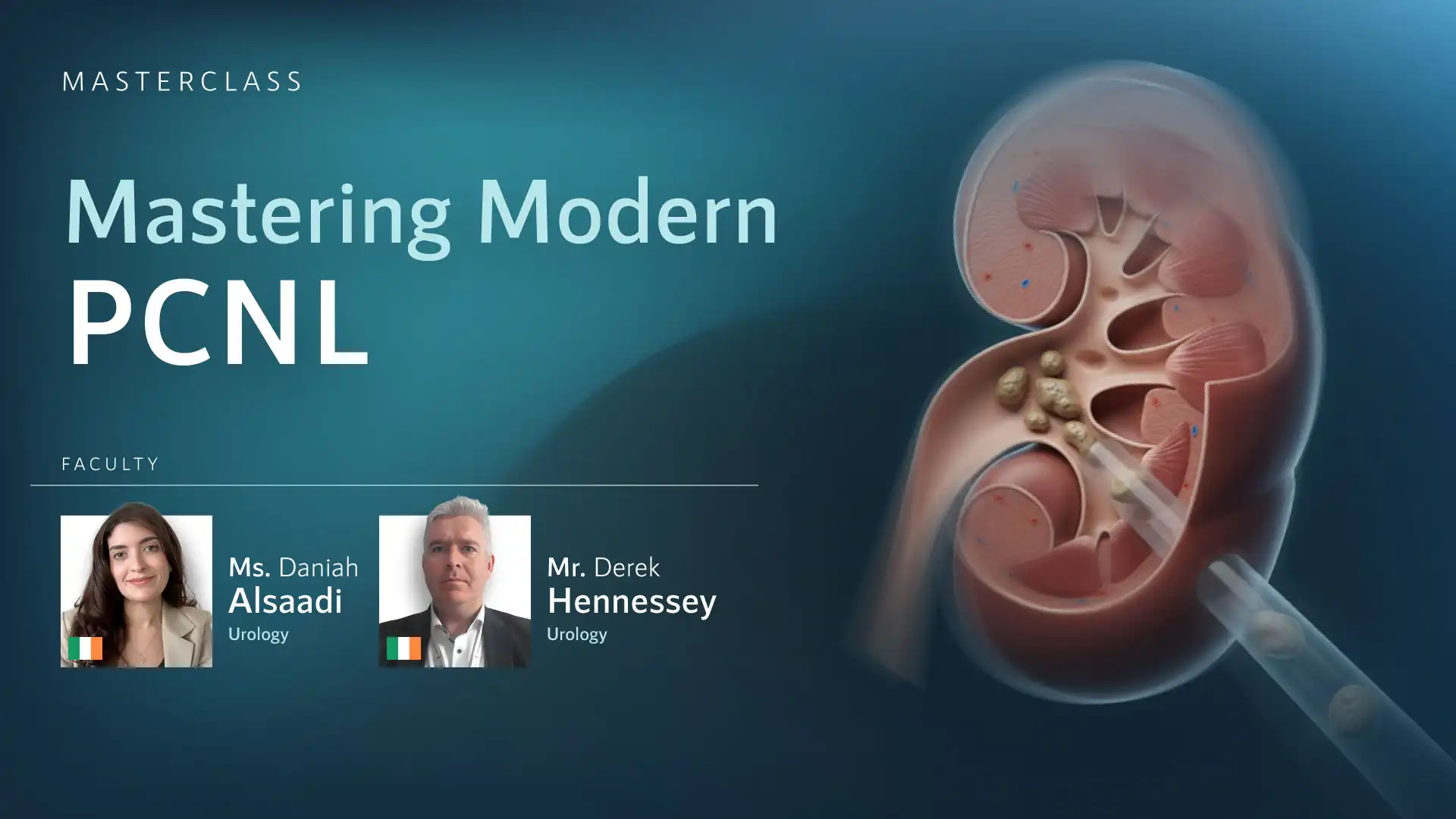
Discover how modern Percutaneous Nephrolithotomy (PCNL) is being refined to achieve higher stone-free rates with lower morbidity in the management of kidney stones and complex renal calculi. In this documentary-style episode, Mr. Derek Hennessey and Dr. Daniah Alsaadi explore the step-by-step principles of contemporary percutaneous renal access, from preoperative CT planning, calyceal selection and papillary puncture to tract dilation, intrarenal pressure management, suction-enabled systems and lithotripsy. The session also examines the latest advances in Mini-PCNL, Ultra-mini PCNL, Micro-PCNL, and the growing role of robotic assistance, 3D reconstruction and augmented reality in endourology. Historical milestones are also included to provide context on how PCNL evolved into a gold-standard technique in stone surgery.
Published
Apr 2026

Acute urinary retention (AUR) is the inability to voluntarily pass urine. It is the most common urologic emergency. Treatment includes a urinary catheter insertion to decompress and empty the bladder. This OC includes a retrospective case presentation of a 77-year-old male patient who went into acute urinary retention during admission and following rapid bladder decompression via catheterization was found to have moderate-severe bladder injury evident by prolonged hematuria. A urology registrar implied that this could have been prevented by gradual decompression. The use of gradual bladder decompression instead of rapid bladder decompression in acute urinary retention is thought to prevent or decrease the likelihood of post-decompression bladder injury by some clinicians. This SOC dismantles this myth by looking into the research evidence.
Published
Apr 2021

The Pringle maneuver, first described by J. Hogarth Pringle in 1908, is used to reduce bleeding during liver surgery and in some other abdominal surgeries. It leads to occlusion of inflow to the liver from the hepatic artery and portal vein, either by manual compression or with the use of an atraumatic vascular clamp or vessel loop. The common bile duct is also compressed by this action. The maneuver can is easily and commonly accomplished within a matter of seconds due to the anatomic fact that all three structures run together in the hepatoduodenal ligament. The history, anatomy, surgical technique, clinical indications and contraindications, as well as clamping duration and complications are briefly described in this OC.
Published
Dec 2020

Colorectal cancer is a leading cause of cancer related death in Europe and the USA. There is no universally accepted effective non-invasive screening test for colorectal cancer. The gold standard investigation for suspected colorectal cancer is colonoscopy. An emerging number of studies demonstrate the potential value of exhaled volatile organic compounds as a diagnostic and triaging test for colorectal cancer. Volatile organic compounds are a subtype of metabolites and are linked with oxidative stress or cell membrane peroxidation. They can be detected in several types of biological samples such as faeces, urine, serum, sputum and breath. Cancer is a metabolic disease that uses cellular metabolic changes to maintain a high rate of proliferation. Wherever those volatile organic compounds are produced they can reach the pulmonary system where they are exhaled allowing for an objective method of measurement.
Published
Oct 2020

The Pringle maneuver, first described by J. Hogarth Pringle in 1908, is used to reduce bleeding during liver surgery and in some other abdominal surgeries. It leads to occlusion of inflow to the liver from the hepatic artery and portal vein, either by manual compression or with the use of an atraumatic vascular clamp or vessel loop. The common bile duct is also compressed by this action. The maneuver can is easily and commonly accomplished within a matter of seconds due to the anatomic fact that all three structures run together in the hepatoduodenal ligament. The history, anatomy, surgical technique, clinical indications and contraindications, as well as clamping duration and complications are briefly described in this OC.
Published
Apr 2020
Help your network discover Ms. Daniah Alsaadi's clinical expertise.