
Camilo Boza Wilson is a Digestive and Bariatric Surgeon from the Pontificia Universidad Católica de Chile. He completed a Fellowship in Minimally Invasive Surgery at the Hospital Clinic of Barcelona and completed his training in Bariatric Surgery Research at Cornell University, New York. Founder and first president of the Chilean Society of Metabolic and Bariatric Surgery and is the president elect for the next IFSO World Congress of the specialty in 2025. He has published more than 50 papers in international journals and more than 10 book chapters.
His areas of specialty are Bariatric and Metabolic Surgery with extensive experience in Gastric Sleeve, Gastric Bypass, with special emphasis on revisional surgery. He has the largest national volume in Endoscopic Gastroplasty as well as a significant number of Elliptical and Endoscopic Balloon Gastroplasty. He and his group have spearheaded many minimally invasive procedures such as anti-reflux surgery with the new LINX magnetic device, gallbladder surgery, inguinal hernias and abdominal wall surgery.
Selected publications from PubMed
The Future of Obesity Care: Exploring Synergies Between Metabolic Bariatric Surgery, Interventional Endoscopy and Pharmacotherapy.
Brown WA, Sumithran P, Cowley M, Cohen R, Le Roux C, Schauer P, Agarwal S, Ard J, Boza C, Cargiuolo JL, Ceccarelli L, Coverdale J, Dunkin B, Finucane F, Gupta K, Kaplan LM, Kurian M, Lingvay I, Miras A, Pearlman C, Petry T, Pournaras D, Purnell J, Ruiz R, Schiavon C, Tahrani A, Tarek H, Tomaszewski J, Tumik S, Younes R
Obes Surg. 2026 Jun;36(6):3326-3337 doi: 10.1007/s11695-026-08692-4.
Reversal of Roux-en-Y Gastric Bypass: A Multi-Centric Analysis of Indications, Techniques, and Surgical Outcomes.
Plath L, Vannijvel M, Okkema S, Deleus E, Lloyd A, Lo Menzo E, Tadros G, Raguz I, San Martin A, Kraljević M, Mantziari S, Frey S, Gensthaler L, Sammalkorpi H, García Galocha JL, Sujathan V, Zapata A, Tatarian T, Wiggins T, Bardisi ES, Goreux JP, Seki Y, Kasama K, Himpens J, Hollyman M, Welbourn R, Aggarwal R, Beekley A, Sepulveda M, Torres A, Juuti A, Salminen P, Prager G, Iannelli A, Suter M, Peterli R, Boza C, Rosenthal R, Higa K, Lannoo M, Hazebroek E, Pring C, Hawkins W, Slater G, Dillemans B, Bueter M, Gero D
Obes Surg. 2025 Feb;35(2):471-480 doi: 10.1007/s11695-024-07650-2.
Metabolic and Bariatric Surgeon Criteria-An International Experts' Consensus.
Kermansaravi M, Chiappetta S, Shikora SA, Musella M, Kow L, Aarts E, Abbas SI, Aly A, Aminian A, Angrisani L, Asghar ST, Bashir A, Behrens E, Billy H, Boza C, Brown WA, Caina DO, Carbajo MA, Chevallier JM, Clapp B, Cohen RV, Jazi AHD, De Luca M, Dilemans B, Fried M, Gagner M, Neto MG, Garneau PY, Gawdat K, Ghanem OM, Al Hadad M, Haddad A, ElFawal MH, Herrera MF, Higa K, Himpens J, Husain F, Kasama K, Kassir R, Khoursheed M, Khwaja H, Kristinsson JA, Kroh M, Kurian MS, Lakdawala M, LaMasters T, Lee WJ, Madhok B, Mahawar K, Mahdy T, Almomani H, Melissas J, Miller K, Neimark A, Omarov T, Palermo M, Papasavas PK, Parmar C, Pazouki A, Peterli R, Pintar T, Poggi L, Ponce J, Prasad A, Pratt JSA, Ramos AC, Rezvani M, Rheinwalt K, Ribeiro R, Ruiz-Ucar E, Sabry K, Safadi B, Shabbir A, ShahabiShahmiri S, Stenberg E, Suter M, Taha S, Taskin HE, Torres A, Verboonen S, Vilallonga R, Voon K, Wafa A, Wang C, Weiner R, Yang W, Zundel N, Prager G, Nimeri A
Obes Surg. 2024 Sep;34(9):3216-3228 doi: 10.1007/s11695-024-07395-y.
Early Exercise Through Telerehabilitation After Bariatric Surgery: Is It Feasible?
Pino-Zúñiga J, Olivares M, Muñoz G, Boza C, Duque C, Cancino-López J
Obes Surg. 2024 Jun;34(6):2101-2110 doi: 10.1007/s11695-024-07185-6.
Metabolic Bariatric Surgery Across the IFSO Chapters: Key Insights on the Baseline Patient Demographics, Procedure Types, and Mortality from the Eighth IFSO Global Registry Report.
Brown WA, Liem R, Al-Sabah S, Anvari M, Boza C, Cohen RV, Ghaferi A, Våge V, Himpens J, Kow L, Morton J, Musella M, Pattou F, Sakran N, Clapp B, Prager G, Shikora S, IFSO Global Registry Collaboration
Obes Surg. 2024 May;34(5):1764-1777 doi: 10.1007/s11695-024-07196-3.

The three sides of the tale about gastroesophageal reflux and sleeve gastrectomy: yours, mine and the truth, Conversion from SG to RYGBP and Panel discussion & closing remarks.
With Johnson & Johnson MedTech
Published
Jan 2023
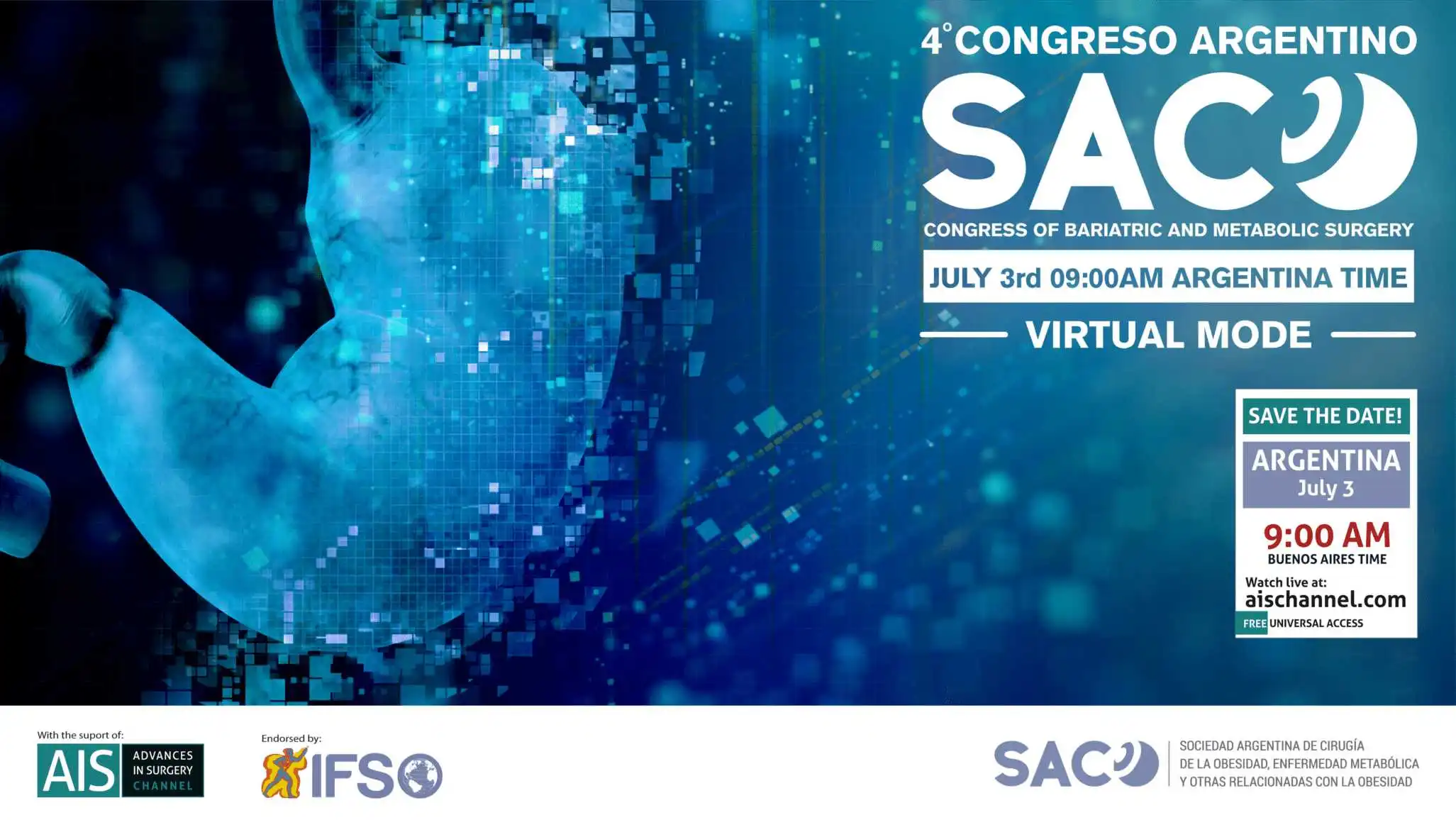
4th International Bariatric Club Symposium at the Argentinian Society of Bariatric Surgery (SACO) Annual Congress
Published
Jul 2021

In this interesting masterclass, Dr. Boza reviews in detail the main aspects of the application of enhanced recovery protocols (ERAS) in bariatric surgery. ERAS protocols, together with the implementation of the minimally invasive approach, are two of the fundamental pillars of modern surgery. This type of protocols began to be implemented and developed in the field of colorectal surgery, until they were extended to the rest of general and digestive surgery subspecialties. Dr. Boza explains, through an extensive compilation of high quality studies (mainly meta-analyses), the advantages of its application in bariatric surgery. It is associated with a lower number of adverse symptoms and complications (major and minor), improvement in multiple clinical management parameters (including costs), as well as in the quality perceived by patients. In addition, Dr. Boza explains his own ERAS protocol in detail, specifying the measures he considers fundamental as well as the four main phases for its application (preoperative education, intraoperative phase, discharge criteria, and recommendations). Finally, he describes the dynamic nature of these protocols, which must be able to adapt to the needs of each patient as well as incorporate any new developments in this field. Endorsed by: [Image]
With Johnson & Johnson MedTech
Published
May 2021

Sleeve gastrectomy (SG) has become the most commonly performed bariatric procedure worldwide. It is very important to know all the tips and tricks to perform a SG in order to complete a safe and technically adequate procedure. We will take into account aspects regarding patients, anatomy, surgical technique and also the postoperative period. Preoperative weight loss: Can greatly facilitate surgical dissection by decreasing the amount of visceral fat and liver size, making dissection easier even in patients with higher BMIs than in patients with lower BMIs but without preoperative weight loss. Trocar placement: The use of optical trocars may be a good alternative to try to minimize inadvertent injury to other structures with the placement of the first port. Intraoperative hemorrhage: Spleen hemorrhage may be due to excessive traction of the omentum adhesions by the assistant. A good option is to place a gauze and apply pressure to perform hemostasis, since visualization of the origin of the bleeding can be very difficult due to the anatomical characteristics of the patients. On the other hand, if the bleeding is due to the dissection of small vessels, trying to control it quickly is plausible if the source is identified, and the use of a bipolar forceps is recommended. Gastroepiploic vessels hemorrhage: in order to avoid it is important to perform a correct dissection of the greater curvature, using hemostatic devices can be helpful. With transient hypotension in some patients during surgery, bleeding can go unnoticed and be the cause of urgent surgical reintervention in the immediate postoperative period. Stapling of the stomach: It is important to be symmetrical and take as much of the anterior aspect as of the posterior aspect of the stomach, as well as to avoid stenosis when making the multiple staplings required to complete the SG. The use of buttressing material or manual reinforcement of the stapling line can be considered in an attempt to avoid postoperative hemorrhages and even leaks according to some evidence in the literature.Leaving some space between the GE-junction and the last stapling can help to avoid leaks in this high-risk area. Postoperative period: ERAS protocol: enhances postoperative recovery and patients can be discharged soon, even in the first 24 hours after surgery. The appearance of fistulas occurs in most cases during the first postoperative week, so leaving drains has now been discarded by many surgeons. On the other hand, when there is a suspicion of possible complications, early abdominal CT scan is recommended. Endorsed by: [Image]
With Johnson & Johnson MedTech
Published
Apr 2021

Moderated by Almino Ramos and Camilo Boza, Ricardo Cohen and Rami Lufti discuss the advantages and disadvantages of both sleeve gastrectomy and gastric bypass. For decades, RYGB remained the gold standard procedure in bariatric surgery, but in recent years, sleeve gastrectomy has become the bariatric procedure most performed worldwide. The latest figures on procedure incidence and its relevance are reviewed and discussed. The efficacy of sleeve gastrectomy vs. gastric bypass in terms of weight loss and metabolic control, as well as postoperative complications, are also discussed. Gastroesophageal reflux after sleeve gastrectomy,, late complications and weight regain after both techniques are also reviewed.
Published
Jan 2019

In previous events, four of the best bariatric surgeons in the world performed LIVE four of the most common revisional techniques. NOW it’s time to report, analyze and discuss their results and the rationale for their choices! In an interactive format, featuring Dr. Karl Miller as moderator, Dr. Camilo Boza, Dr. Bruno Dillemans, Dr. Michel Gagner and Dr. Robin Blackstone are discussing the mid-term outcomes of: Gastric Sleeve to Re-Sleeve, Gastric Sleeve to Gastric Bypass, Gastric Sleeve to Duodenal Switch & Revision of Banded Gastric Bypass respectively, regarding not only weight loss and co-morbidities resolution, but also complications and patient satisfaction.
With Johnson & Johnson MedTech
Published
Nov 2018
Help your network discover Dr. Camilo Boza's clinical expertise.