Bilal Chughtai, MD is an Associate Professor of Urology and an Associate Professor of Urology in Obstetrics and Gynecology at Weill Cornell Medicine. He is also an Associate Attending Urologist at NewYork-Presbyterian Hospital. Dr. Chughtai specializes in Voiding Dysfunction, Female Urology, and Neurourology. Dr. Chughtai treats the body as a cohesive system with a focus on urological care. He believes it is just as important to address immediate symptoms as it is to examine the underlying causes of the urological complaint. Dr. Chughtai engages his patients in a manner that improves their present urological conditions and actively involves them in their future wellbeing. The effectiveness of his medical and surgical treatment relies heavily on strong doctor/patient relationships, and on the patient's resolve to make healthy changes. As Dr. Chughtai's patient, you are promised a passionate and supportive partnership to understand your urological condition. Prior to his arrival at Weill Cornell/NewYork-Presbyterian, Dr. Chughtai completed his Residency in General Surgery and Urology at Albany Medical Center, followed by a Fellowship in Female Urology, Neurourology, and Voiding Dysfunction at Weill Cornell Medical Center and Memorial Sloan Kettering Cancer Center. He earned his Doctor of Medicine at State University of New York at Stony Brook after graduating Magna cum Laude from New York University with a major in Biological Sciences. Dr. Chughtai is also an active researcher. He has served as primary & co-investigator in numerous studies. He has published over 160 peer-reviewed articles, authored chapters and books, and has presented at numerous prestigious national meetings. Dr. Chughtai maintains a successful urological practice in both men and women. If you are interested in a consultation with Dr. Chughtai, please call to set up an appointment at (646) 962-4811.
Selected publications from PubMed
Pharmacologic and clinical considerations of phosphodiesterase type 5 inhibitors and β-adrenergic receptor type 3 agonists for lower urinary tract symptoms and benign prostatic hyperplasia.
Fields E, Elterman D, Bhojani N, Polo J, Chughtai B
Expert Opin Drug Metab Toxicol. 2026 Aug;22(8):633-649 doi: 10.1080/17425255.2026.2725917.
Navigating the New Landscape: A Clinical Commentary on the 2026 AUA Guideline on Management of Lower Urinary Tract Symptoms Attributed to Benign Prostatic Hyperplasia.
Elterman D, Bhojani N, Chughtai B
J Urol. 2026 Aug 20;:101097JU0000000000005269 doi: 10.1097/JU.0000000000005269.
Recalibrating sham-relative superiority thresholds in BPH device trials.
Polo J, Mugglin A, Bhojani N, Zorn K, Kaplan S, Elterman D, Chughtai B
World J Urol. 2026 Aug 13;44(1) pii: 559. doi: 10.1007/s00345-026-06645-1.
Diagnostic accuracy of intravesical prostatic protrusion (IPP) for bladder outlet obstruction using urodynamics as reference standard: a systematic review and meta-analysis.
Han Y, Yaghi MH, Polo J, Elsadany M, Elterman D, Bhojani N, Chughtai B
World J Urol. 2026 Aug 1;44(1) pii: 539. doi: 10.1007/s00345-026-06664-y.
Long-Term Outcomes of Sacral Neuromodulation Explantation: A 12-Year Experience at a High-Volume Tertiary Center.
Fiorido C, Siqueira MHB, Aldoukhi M, Alamri N, Fields E, Bhojani N, Chughtai B, Buksh O, Shprits S, Lajkosz K, Elterman D
Neurourol Urodyn. 2026 Jul 9 doi: 10.1002/nau.70374.
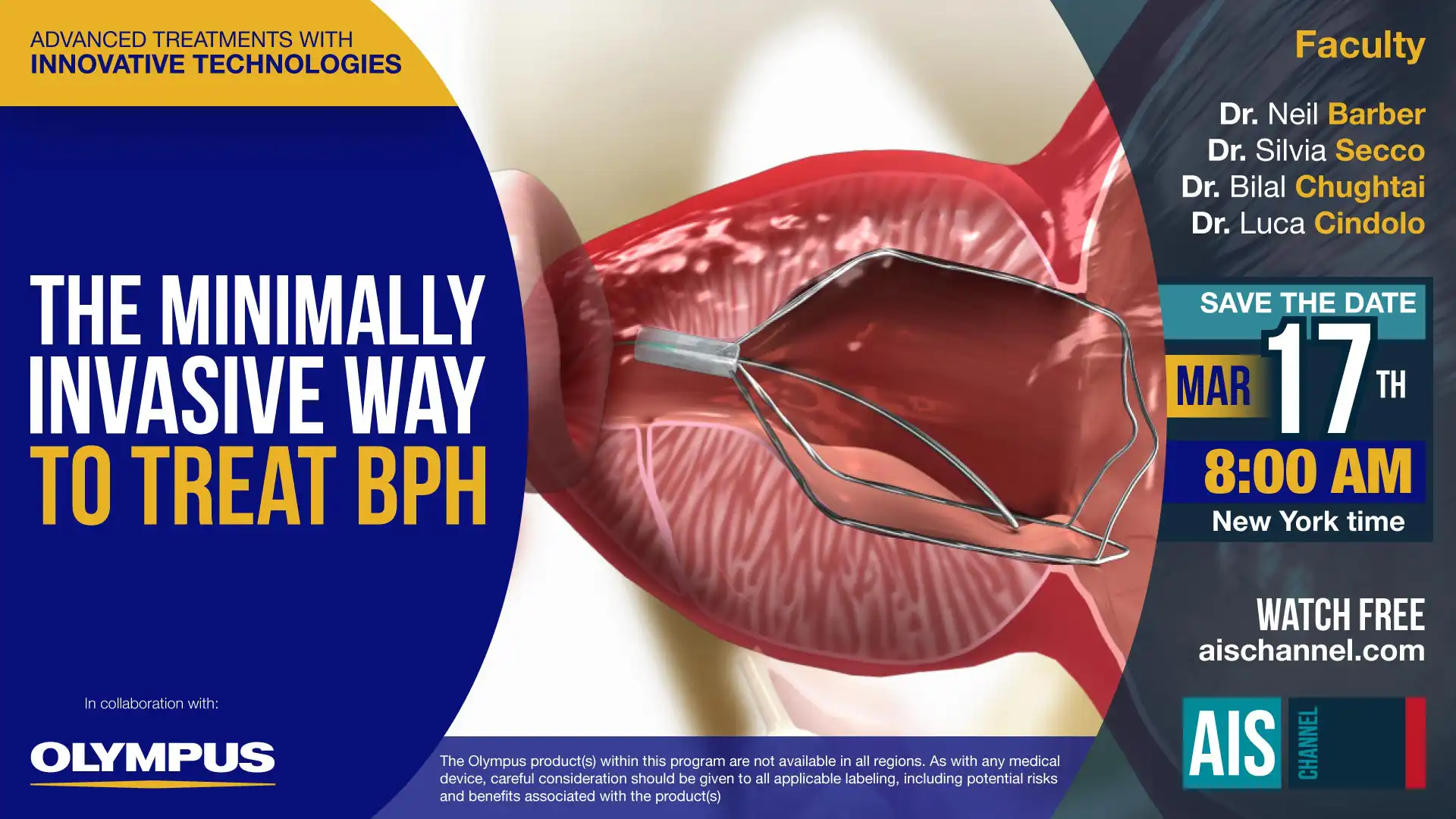
The last decade has seen a significant shift and growth in the surgical options available in the management of symptomatic BPH. Not least driven by patients keen to take up options that avoid a general anaesthetic, that are truly ambulatory, allowing a more rapid return to normal activities but also that avoid the risk of significant post-operative complications, including the development of permanent dry ejaculation and/ or impotence.
With Olympus
Published
Mar 2023

The less invasive Rezum treatment is, the higher the likelihood of meeting the patient's expectations regarding risks and benefits. That’s why performing less invasive Rezum treatments is recommended to achieve the greatest benefits when dealing with benign prostatic hyperplasia.
With Boston Scientific
Published
Nov 2021
Help your network discover Dr. Bilal Chughtai's clinical expertise.