
Selected publications from PubMed

In this video Dr. Jänes will show some tips and tricks on avoiding accidents during surgery. Monopolar electrosurgery involves the use of a return electrode as a resistor. A current goes through the patients to come back to the generator. The current from the patient to the pad can cause the pad to become warm. If it is poorly affixed to the patient, it will increase the current and cause increased heat buildup. Dr. Jänes points out the potential risks of monopolar electrosurgery. When there are adhesions that you want to take down, resistance increases, electrons take another path and concentrate in a small bridge near to a vital organ causing necrosis. If you do not control your instrument, it can be damaged by repeated sterilization, electrical heating or even a manufacturing defect. When it comes to ultrasonic technology, the construction of the blade determines how it should be used. As the blade vibrates, the displacement is greater at the distal part of the blade, which is why there are more distal cuts. The power setting is also important, as it specifies the current delivered by the generator, which determines blade displacement. The ultrasonic instruments are important because they are multifunctional tools, with five main factors impacting cut and coagulation: power level, tissue tension, blade pressure, blade sharpness and blade location. Finally, Dr. Jänes concludes that monopolar devices are the best for heat, bipolar for time, and advanced bipolar for compression.
With Johnson & Johnson MedTech
Published
Feb 2022

Can you optimize the outcome for patients by choosing the right type of energy? Each energy modality delivers energy and interacts with the targeted tissue differently. Surgeons should make their decision based on what they want to achieve in the Operating Room. So which is the safest instrument? The one that the surgeon knows and feels more comfortable with. The decision of choosing the right device is up to the surgeon. There are several advantages and drawbacks for each type of energy: monopolar, advanced bipolar, and ultrasonic technologies. In this presentation, the features of each technology are assessed: ease of use, multifunctionality, speed, more tissue captured in a bite, vessels in tissue bundles, vessels under tension, spot coagulation, small or large vessel sealing, lateral thermal spread, precise energy delivery, dissection with energy, and blunt dissection. Considering the features of each technology, Advanced Bipolar technology rates highest, followed very closely by Ultrasonic, with Monopolar coming last.
With Johnson & Johnson MedTech
Published
Jan 2022

Adaptive controls basically means advanced energy. The generator and the hand piece work together to sense the impedance in the tissue. Then, the instrument optimizes energy delivery based on changing tissue conditions and by default you can see larger vessels. These machines optimize the balance between compression, heat, and time. The main improvements are a stronger and more secure sealing and the ability to seal larger vessels (up to and including 7mm vessels). This can be done with minimal lateral thermal damage, reducing the tissue trauma and device heat.
With Johnson & Johnson MedTech
Published
Jan 2022

Bipolar electrosurgery is not new, but it was not until the 1990s that instruments technology started to improve. The main advantages of advanced bipolar instrumentation are the better compression for larger vessel sealing and the addition of a cutting mechanism. We must also highlight stronger sealing abilities, better heat management, and reduce thermal spread. A current of electrons moves through tissue and the compression heats the tissue. The main difference with monopolar technologies is that the current does not pass through the patient. The current goes from the active electrode to the returned electrode of the passing through the tissue and back to the generator. The sealing procedure starts with compression because coagulation requires compression of the tissue. When you generate heat inside the tissue you are breaking hydrogen bonds and all proteins in the cell are denatured forming a sticky coagulum. Advanced bipolar technology generates heat by the electrical energy flowing into the tissue and coagulates the tissue and the mechanical blade is used in the transection of the tissue. Traditional bipolar devices lack compression and are limited to smaller vessels. Traditional devices rely more on heat, which results in tissue shrinkage and thrombus formation. Nevertheless, advanced bipolar devices optimize the combination of compression, heat, and time, which enables larger vessel sealing up to 7mm. Ultrasonic technology is based on a generator that is a source of electrical energy which is converted to mechanical motion in the hand piece thanks to a transducer. It adjusts voltage to maintain the frequency and displacement of the blade. As mentioned before, coagulation requires tissue compression. Hydrogen bonds are broken via friction and proteins in the cells are denatured forming sticky coagulum. Then, frictional heat desiccates and coagulates the tissue. When tissue is coagulated, tissue is transected. This technology is critical for sealing.
With Johnson & Johnson MedTech
Published
Jan 2022

There are several types of basic energy: cautery, electrocautery, and electrosurgery. The cautery consists of the surgical use of heat, whereas the electrocautery is the process of destroying tissue with an object that is heated with electricity. Also, there is no current flowing through the patient for electrocautery energy. There is electrosurgery based on the use of alternating current passed through the patient to cut and coagulate tissue. The basic facts about electricity in surgery are: iit always takes the path of least resistance; power is constant among variable voltage generators; and the injury is proportional to current concentration. This is important to keep in mind in electrosurgery. When it comes to monopolar electrosurgery, the current flows from a small (active) electrode to and through the patient to a larger, grounded electrode. The patient is crucial to close the circuit. Dr. Jänes points out that electric current follows the path of least resistance. He also highlights the direct proportion to the water content of tissue. As tissue desiccates, resistance increases, and the current seeks an alternate pathway. When you use monopolar electrosurgery you must be aware of the potential risks involved. Sealing is a multifactorial and dynamic procedure. There are controllable factors such as compression, heat, and time. Nevertheless, the uncontrollable factors are purely biological, such as collagen, elastin, and water. Energy devices improve hemostasis and minimize lateral thermal damage using physical and controllable factors. Optimizing the controllable factors influences the quality of the seal. When it comes to large vessels, you must keep in mind the vessel size, angle of approach, atherosclerosis, calcification, hypertension, and other patient factors. If you reduce thermal damage, you will be able to reduce inflammation, achieving faster healing and less pain. When the temperature is over 65ºC it causes irreversible damages.
With Johnson & Johnson MedTech
Published
Jan 2022
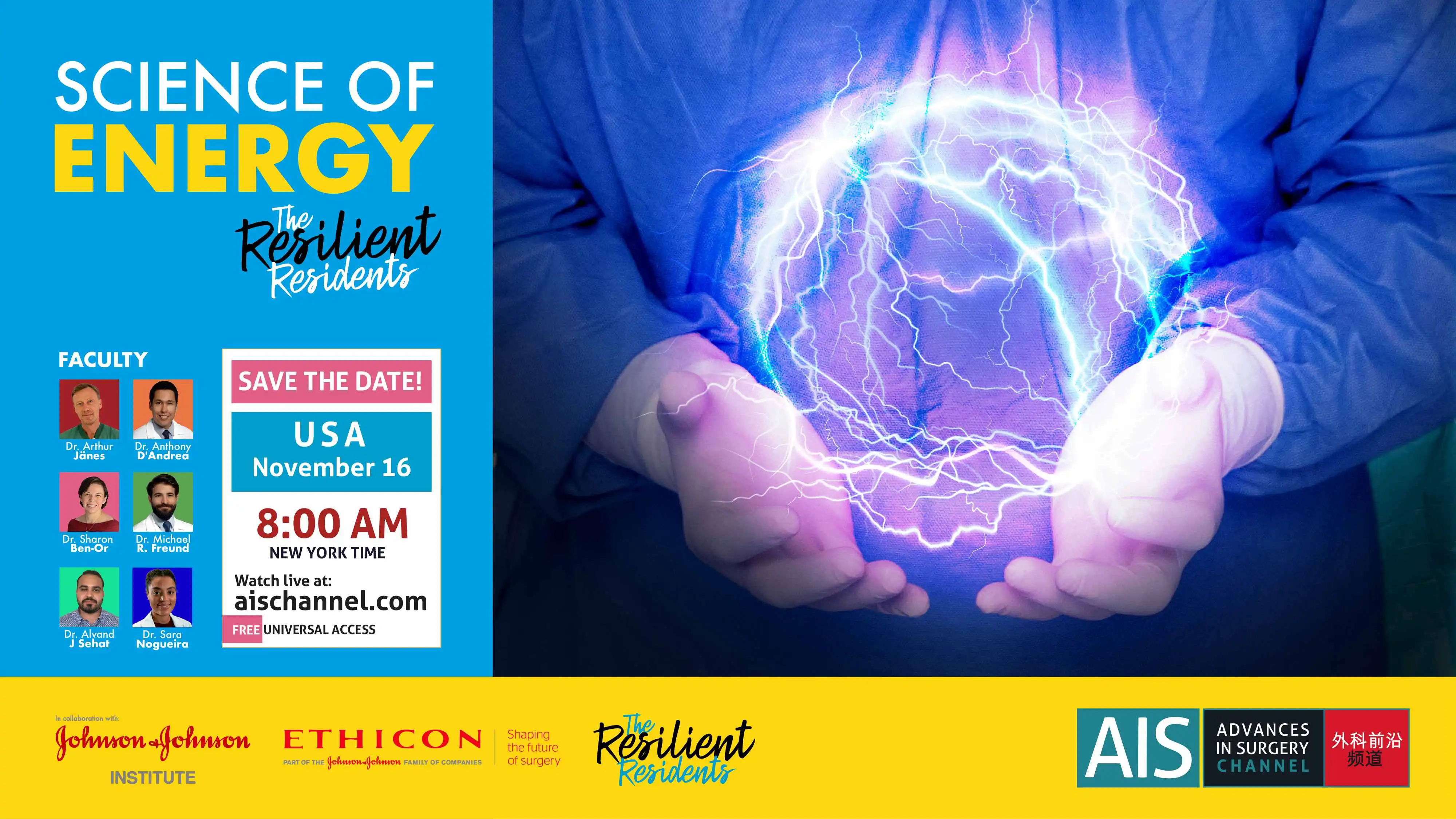
Program Welcome and faculty introduction. - Dr. Sara Nogueira (Spain). Why is this Important? - Dr. Jänes (Sweden) & Dr. Sehat (USA). Principles of electricity, tissue & vessel sealing - Dr. Jänes (Sweden). Bipolar devices - Dr. Jänes (Sweden). Ultrasonic devices - Dr. Jänes (Sweden). Advanced energy – what’s that? - Dr. Jänes (Sweden). Optimizing patient outcomes: Choosing the right device for the procedural task - Dr. Jänes (Sweden). Optimizing patient outcomes: Tips, tricks and avoiding accidents - Dr. Jänes (Sweden). Leadership Skills: Managing Surgical Burnout - Dr. Sharon Ben-Or (USA). Panel discussion - All faculty moderated by Dr. Freund (USA).
With Johnson & Johnson MedTech
Published
Nov 2021
Help your network discover Dr. Arthur Jänes's clinical expertise.