Selected publications from PubMed
4th International Bariatric Club Symposium at the Argentinian Society of Bariatric Surgery (SACO) Annual Congress
Published
Jul 2021

CASE 1: Transjejunal laparoscopic-assisted ERCP a technique to deal with choledocholitiasis after a Roux-en-Y reconstruction. The patient is a female of 31 years old that undergone a Roux-en-Y Gastric Bypass two years earlier and presented periodic abdominal pain. MRCP showed stones on the biliary common duct. In the preoperative CT scan no internal hernias were found. TREATMENT: It was decided to perform a laparoscopic-assisted ERCP. The first thing to do was to identify the gastro-jejunal anastomosis and the jejunal-jejunal anastomosis. An internal hernia in the Petersen space was found but immediately reduced and closed. Then the cholecystectomy was performed. Once the limb near the Treitz ligament was identified and pulled through a mini-laparotomy, a colonoscope was introduced and a plastic stent was placed in the papilla, which was the reference for the sphincterotomy. After doing that, a 5mm stone came out. Then the bile duct was checked with a fogarty balloon catheter and a cholangiogram. Then enterotomy was closed and it was checked for any biliary lesions. OUTCOME: After the surgery the patient started liquid diet the first day and was dismissed after 4 days. Questions were about the use of colonoscope rather than duodenoscope, absorbable suture, mini-laparotomy and transgastric and totally endoscopic approach for similar cases. CASE 2: Endoscopic tunneled stricturotomy with full-thickness dissection in the management of a sleeve gastrectomy stenosis. The patient was a 28 years old women with a history of a sleeve gastrectomy in 06/2018. (BMI: 35.3) who was presenting dysphagia to solid food. During the progression to solid food she developed food regurgitation and vomiting and that is why upper-GI series were performed (stenosis was identified). To treat this stenosis she underwent 3 endoscopic pneumatic balloon dilatations. Those were not effective and she lost 30kg in 5 months so it was decided to perform an endoscopic tunneled stricturotomy with full-thickness dissection. TREATMENT: To start the procedure, once the stenosis was identified a submucosal injections is performed 3-5 cm before the stenotic area. Then, an incision was performed to tunnel submucosally. In this part of the surgery is important to stay on the submucosal layer and not go full-thickness. Then a myotomy was performed and in the area marked with both yellow arrows (stapled line) we dissect out performing the full-thickness stricturotomy. After that, we close using clips. We can see a comparison before and after performing the procedure showing a much larger lumen. OUTCOME: The patient had no post-procedure symptoms and during follow-up the patient tolerated diet and no recurrence of the symptoms appeared. At 2 months, we can see the differences in the upper-GI series and in the endoscopy. As a conclusion endoscopic tunneled stricturotomy with full-thickness dissection appears to be safe and effective in the management of stenosis after sleeve gastrectomy. This procedure can be used after conventional techniques such as pneumatic balloon dilatation or stents fail, or may be considered as an initial therapy for sleeve stenosis. Discussion was based on patient selection, indications, myotomy technique and leak rates. CASE 3: From Nissen Fundoplication to RYGB to treat both GERD and morbid obesity Patient was a 31 year-old woman that had an open Nissen fundoplication on 2010 and a surgical revision with a redo of it on 2012. She complained with dysphagia and morbid obesity so an extensive preoperative workout was done. In the Barium swallow, an esophageal dilatation with a cardial stenosis was presented, and also, an additive image on the left side of the esophagus suggestive of an ulceration. The Upper-GI endoscopy revealed an esophagitis grade C and the manometry showed incomplete waves at lower 3rd and inappropriate release of LES. In the pH-metry acid reflux and positive DeMeester score were evidenced. TREATMENT: The procedure starts dissecting the perigastric tissue, that is challenging as it presented high fibrotic component. Then the dissection of the gastric valve and the hiatal region from the right to the left was completed. Once that was performed an small gastric pouch of 20cc was created to reduce the acid production. Then as in a normal RYGB the biliopancreatic is done at 50cm and the alimentary at 150cm. Jejuno-jejunal and gastro-jejunal were handsewn. OUTCOME: No events were presented in the postoperative, patient at two years follow-up has a BMI of 27, No GERD and no IPP. As a conclusion RYGB is a great option to treat GERD in obese patients. We cannot forget dysphagia as a complication of Nissen fundoplication and conversion from Nissen to RYGD allows us to treat dysphagia, GERD and obesity. Different topics were discussed after the presentation of this case as: short gastric pouch, differences with regular bypass, situations where you cannot undo the Nissen fundoplication, mesh indications above others. CASE 4: From RYGB to SADS Patient was a 49 year-old woman with an initial BMI of 57 and it was decided to convert to SADS for weight regain. TREATMENT: The first thing to do was remove all adhesions from previous surgeries and then dissect the Hiss angle. Once this has been done, he identifies the Roux limb and dissects it 25cm after the gastric pouch. The next thing to do was to connect the greater curve with the Hiss angle. He disconnects the previous anastomosis and performs a gastro-gastrostomy. It is important to do it near the lesser curve as after that a Sleeve gastrectomy will be performed using a Bougie of 42 frames as a reference. The transection of the duodenum is performed conserving as much vascularization as it is possible in order to maintain sleeve well irrigated. After that duodenum-ileal anastomosis handsewn was performed. Anastomosis were checked with methylene blue. OUTCOME: The outcome was good and the patient was discharged 2 days after the procedure with no complications. Questions were about rate of complications, length of limbs, roux limb, conversion after RYGB and weight loss after conversion. CASE 5: PETERSEN’S HERNIA AFTER OAGB Patient was a 48 years-old woman with a BMI of 52, she was referring bile reflux with no response to medical treatment. So it was decided to convert mini-gastric bypass to RYGB. TREATMENT: As the surgery started, an internal hernia was identified on the Petersen’s defect, in this case the hernia was protruded from medial to lateral something that is rare as normally it is the other way around. To start the procedure we need to identify the proximal and distal limb of gastrojejunal anastomosis. On the proximal limb of this anastomosis an enterotomy was performed and 75cm of the alimentary limb were measured to perform the jejunojejunal anastomosis. After that the jejunojejunal and Petersen’s defect were closed. After doing that, the transection of biliopancreatic limb from alimentary limb was performed. OUTCOME: The outcome was good and the patient was discharged 1 day after the procedure with no complications. A short term follow-up at 3 months was symptoms free. In this last case, discussion was based on rate bile reflux, biliopancreatic limb length, indications for conversion, causes for bile reflux and hernia defect closures.
Published
Feb 2020

Moderated by Almino Ramos and Camilo Boza, Ricardo Cohen and Rami Lufti discuss the advantages and disadvantages of both sleeve gastrectomy and gastric bypass. For decades, RYGB remained the gold standard procedure in bariatric surgery, but in recent years, sleeve gastrectomy has become the bariatric procedure most performed worldwide. The latest figures on procedure incidence and its relevance are reviewed and discussed. The efficacy of sleeve gastrectomy vs. gastric bypass in terms of weight loss and metabolic control, as well as postoperative complications, are also discussed. Gastroesophageal reflux after sleeve gastrectomy,, late complications and weight regain after both techniques are also reviewed.
Published
Jan 2019
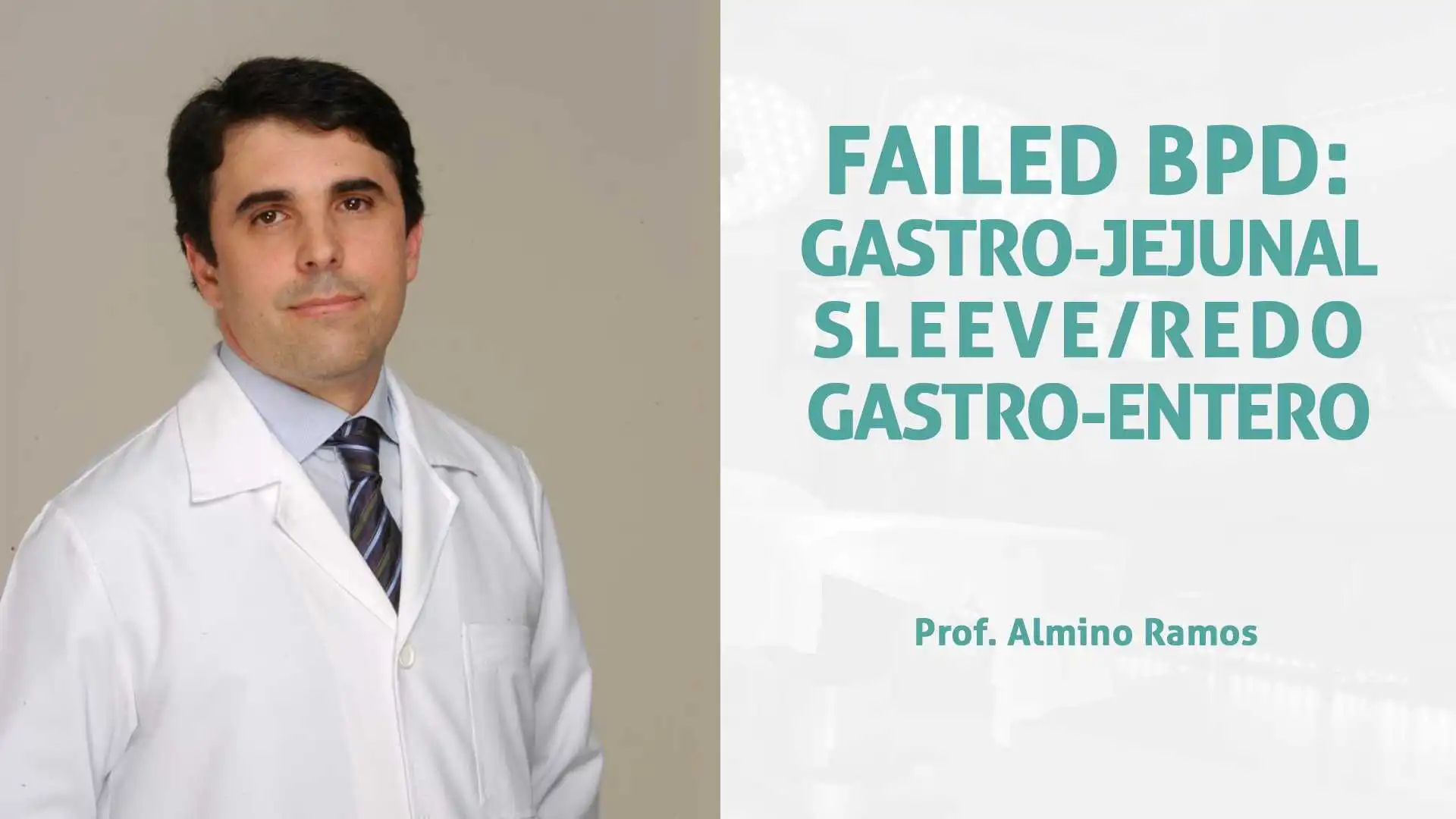
The preview medical information was about a case of weight recidivism after an Open Biliopancreatic Diversion (BPD) procedure performed 20 years ago on a patient with a BMI of 49.6 kg/m2 who reached a nadir BMI of 23 kg/m2 and presented weight recidivism returning to a BMI of 44.1 kg/m2. Patient presented with a good nutritional status, with a light anemia, no diarrhea, and no malodorous gas or feces. Surgery started with a pneumoperitoneum performed with a Veress needle and placement of the trocars. As the first procedure was open there were many adhesions to remove. Although the information was that the first procedure was a BPD, with the progress of the dissection it could be seen that the real surgery had been a Gastric Bypass with transmesocolic retrogastric reconstruction. For these cases a good strategy is moving the dissection to the retrogastric space by dividing the greater curvature vessels that will allow a direct approach to the alimentary limb. Finally, after adhesion removal, a banded long and wide pouch, a 4 cm gastrojejunostomy, and a large candy cane were found. Once we examined the anatomy, we decided to resize the resizing of the pouch and perform a new gastrojejunostomy. The pouch dissection started by approaching the smaller curve, reaching the retrogastric space, making it possible to staple with the green cartridge, reducing pouch length to 3 cm, and reducing pouch width to 2 cm with the vertical staple. Reinforcement of these staple lines was ensured by using the Seamguard. The alimentary limb was divided in order to resect part of pouch and the candy cane, and a new 15 mm gastrojejunostomy was performed. A methylene blue test was performed with a negative result. The highlights of the video could be linked to the importance of having a good previous surgical report in order to make the procedure easier – exactly the opposite than in this case, in which the information provided was not correct. It is very important to proceed with a wide dissection and a clear anatomy in order to have all the information so as to make the best decision about the procedure strategy.
With Johnson & Johnson MedTech
Published
Jan 2019

IFSO 2018 in Dubai brought together world leaders in metabolic and bariatric surgery. More than 1200 abstracts from more than 90 countries were presented. Several communications on obesity and metabolic surgery were given, focusing on the different techniques and the best indications for each of them. Type 2 Diabetes Mellitus control, postoperative complications reduction and comparison of weight loss in different procedures were some of the main topics discussed during the congress. This webinar summarises the highlights of the 23rd IFSO World Congress in Dubai. Asim Shabbir, Ali AMiniam, Ahmad Bashir, Alex Escalona and Bart van Wagensveld present and discuss about 30 of the best abstracts. They also present 9 Randomized Clinical Trials, 10 Registry studies, 3 Matched case control studies, 4 Non matched controlled studies, and 3 other studies. In the first abstract, R. Gadiot found that after a 1-year follow-up, there was no significant difference in weight loss between the Very long Roux limb -RYGB and the standard limb -RYGB groupds. There were no differences regarding deficiencies either. Similar results were found in other abstracts in 2016. The experts agree that with longer follow-ups, the differences between the two groups should be significant in terms of weight loss and nutritional deficiencies. The study by Ruiz de Gordezuela compares SADI-S vs Duodenal Switch. In this comparison there were no significant differences, except as regards surgical time. However, the Duodenal Switch shows better weight loss results after 3 years (BMI reduction of 46.95% vs 36.61%). J.Ruiz-Tovar’s group showed the Impact of implementation of ERAS on Large Roux in Y Gastric Bypass (LRYGB). It associates lower postoperative pain, lower incidence of postoperative nausea and vomiting, and earlier hospital discharge. Another group shows that weight loss 3 months after the primary bariatric surgery is predictive for weight loss up to 60 months, giving us the opportunity to select low responder patients. In this video you will see the entire discussion on these abstracts and the opinion of the experts in the 23rd IFSO World Congress.
Published
Jan 2019

Laparoscopic bariatric surgery demands a tailored approach from the surgical team, especially the anesthesiologist and surgeon. Collaboration is key in the attempt to achieve good outcomes and decrease the rate of complications. Deep neuromuscular blockade during laparoscopic surgery helps to improve the surgical space conditions, facilitate the use of low-pressure pneumoperitoneum, prevent sudden patient movements and reduce postoperative pain.
Published
Nov 2018
Help your network discover Dr. Almino Cardoso Ramos's clinical expertise.