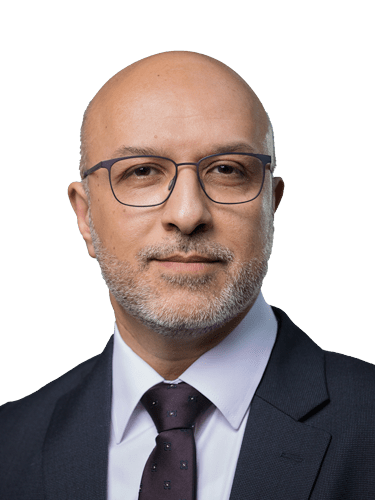
Dr. Alaa El-Hussuna is a prominent leader in the field of medical research, with a focus on the development of new research tools through the implementation of information technologies. He is the Chairperson and founding member of the European Society of Colo-Proctology (ESCP) cohort studies committee, and has conducted many prospective international audits and studies. He is also a member of the Surgical Steering Committee in the European Crohn Colitis Organisation (S-ECCO), and has been the leader of the ESCP 2017 snapshot audit (prospective study), which focussed on left colon, sigmoid and rectal resections. This study collected data on 5,641 patients at 335 sites across 49 countries. Other roles include being a member of the ESCP Research Committee, an Expert Panel to work out the National Action Plan for the Treatment of Autoimmune Diseases (presented in Danish Parliament in November 2020), an Associate Professor of Surgery at Aalborg University, a Co-Examiner (Assessor) for medical students (surgical and medical disciplines), a Danish Health Authority Inspector of Education and Training of Young Surgeons, a member of the ESCP Education Committee (planning courses, workshops and ESCP conferences), an author of 70 articles published in peer-reviewed international scientific journals, including 13 reviews, an author of 22 published conference abstracts, and a member of the ECCO Guidelines Working Group to write “Roadmap to optimal peri-operative care in IBD” in 2021.
Dr. Alaa El-Hussuna has a long and broad-spectrum international experience in surgery and is an invited session moderator in many international conferences. He has also been an invited speaker in international conferences, a member of the GRADE Guidelines Committee in the European Crohn Colitis Organisation, a Member of Social Media Guidelines Committees in ESCP, a Supervisor of research projects (Master Degree, Bachelor Degrees and Research Year Projects), a Reviewer in the committee that select abstracts to the European Crohn’s Colitis Organisation’s conference in 2021, a Reviewer in surgical and medical journals, a Member of Editorial Boards in surgical and medical journals, a Grant recipient of many national and international grants, an Organizer and Teacher in many courses and workshops, a Physician/Surgeon for Doctors Without Borders (MSF) in Liberia and Tchad, and an active health care advocate and debater in social media (Twitter and LinkedIn). Dr. Alaa El-Hussuna has an H-index of 18.
Selected publications from PubMed
ECCO Guidelines on Therapeutics in Ulcerative Colitis: Medical Treatment.
Gisbert JP, Chaparro M, Verstockt B, Kienle P, Minozzi S, Allocca M, Atreya R, Avellaneda N, Barreiro-de Acosta M, Battat R, Bettenworth D, Blumenstein I, Brown SR, Burke JP, Caprioli F, Casanova MJ, Christou N, de Buck van Overstraeten A, Doherty G, Eder P, El-Hussuna A, Ellul P, Fantini MC, Furfaro F, Greuter T, Hazel K, Holubar S, Kapizioni C, Kopylov U, Leong RW, Leventoglu S, Limdi JK, Noor NM, Papaconstantinou I, Peros G, Pouillon L, Reenaers C, Saibeni S, Schmidt C, Sousa P, Stassen LPS, Uzzan M, Vieujean S, Visser E, Myrelid P, Adamina M, Kucharzik T
J Crohns Colitis. 2026 Jul 7;20(7) pii: jjag066. doi: 10.1093/ecco-jcc/jjag066.
ECCO Guidelines on Therapeutics in Ulcerative Colitis: Surgical Treatment.
Adamina M, Kienle P, Chaparro M, Verstockt B, Minozzi S, Allocca M, Atreya R, Avellaneda N, Barreiro-De Acosta M, Battat R, Bettenworth D, Blumenstein I, Brown SR, Burke JP, Caprioli F, Casanova MJ, Christou N, De Buck Van Overstraeten A, Doherty G, Eder P, El-Hussuna A, Ellul P, Fantini MC, Furfaro F, Greuter T, Hazel K, Holubar S, Kapizioni C, Kopylov U, Leong RW, Leventoglu S, Limdi JK, Noor NM, Papaconstantinou I, Peros G, Pouillon L, Reenaers C, Saibeni S, Schmidt C, Sousa P, Stassen LPS, Uzzan M, Vieujean S, Visser E, Kucharzik T, Gisbert JP, Myrelid P
J Crohns Colitis. 2026 Jun 7;20(6) pii: jjag072. doi: 10.1093/ecco-jcc/jjag072.
Evaluating the feasibility of a scalable, digitally supported model for global collaborative surgical research: protocol for a prospective, international, multicentre observational study in cryptoglandular anal fistula treatment (CRAFT).
Tabakovic N, Kimman M, Keatley J, El-Hussuna A, Tozer P, Zimmerman DDE, Magill L, Mitalas L, van Kuijk S, Pinkney T, Breukink S
BMJ Open. 2026 May 21;16(5):e118766 doi: 10.1136/bmjopen-2026-118766.
Results of the Ninth Scientific Workshop of the European Crohn's and Colitis Organisation (ECCO): artificial intelligence in endoscopy, radiology, and histology in inflammatory bowel disease diagnostics.
Mookhoek A, Sinonquel P, Allocca M, Carter D, Ensari A, Iacucci M, Kopylov U, Verstockt B, Baumgart DC, Noor NM, El-Hussuna A, Sahnan K, Marigorta UM, Noviello D, Bossuyt P, Pellino G, Soriano A, de Laffolie J, Daperno M, Raine T, Cleynen I, Sebastian S
J Crohns Colitis. 2026 Apr 8;20(4) pii: jjaf133. doi: 10.1093/ecco-jcc/jjaf133.
Results of the Ninth Scientific Workshop of the European Crohn's and Colitis Organisation (ECCO): Artificial Intelligence in medical management and precision medicine.
Kopylov U, Verstockt B, Marigorta UM, Noviello D, Bossuyt P, Mookhoek A, Sinonquel P, El-Hussuna A, Sahnan K, Baumgart DC, Noor NM, Allocca M, Carter D, Ensari A, Iacucci M, Pellino G, Soriano A, de Laffolie J, Daperno M, Raine T, Cleynen I, Sebastian S
J Crohns Colitis. 2026 Apr 8;20(4) pii: jjaf134. doi: 10.1093/ecco-jcc/jjaf134.

Effective healthcare innovation requires active and early engagement of key stakeholders—patients, industry, healthcare authorities, and academia—to ensure that new solutions are practical, sustainable, and widely adopted. This presentation examines historical case studies, such as Pfizer's Exubera and Google Health, where limited stakeholder involvement led to significant market and operational challenges. The discussion underscores the importance of a multidisciplinary approach in designing patient-centered innovations, highlighting methods such as focus groups, patient advisory boards, and industry-academic partnerships. Furthermore, the role of healthcare authorities in regulatory support and academia's contribution to foundational research are emphasized. Key strategies for overcoming collaboration barriers include open communication, shared objectives, and governance structures that foster impactful, scalable healthcare advancements. This roadmap provides a framework for improving outcomes in surgical and healthcare interventions through comprehensive stakeholder engagement.
Published
Nov 2024

This presentation highlights the crucial role of storytelling in driving innovation within the fields of surgery and scientific research. It explores historical examples where poor communication hindered the acceptance of groundbreaking innovations, such as Tesla’s alternating current and Boltzmann’s statistical mechanics. These cases demonstrate that even revolutionary ideas can falter without effective dissemination. The presentation emphasizes the need for scientists and innovators to adopt strong communication strategies, using analogies, visuals, and metaphors to convey complex ideas to diverse audiences. Examples like Einstein’s use of simple explanations for relativity and Rosalind Franklin’s pivotal DNA images are discussed to showcase how visuals and simplified narratives can make scientific concepts more accessible. A key point addressed is the tension between simplicity and complexity in scientific communication. While simplification is necessary to engage a broader audience, oversimplification risks misrepresenting the science. The presentation advocates for a balance, ensuring accuracy while reaching wider audiences through media platforms like YouTube, TED talks, and social media. It also emphasizes the importance of training scientists in storytelling, suggesting interdisciplinary collaboration and the use of modern communication tools to bridge the gap between research and public understanding. The goal is to foster innovation by improving how scientific stories are told, thus inspiring new ideas and advancing the field. In conclusion, storytelling is presented as an essential tool for innovation, particularly in surgery, where engagement with stakeholders and effective communication can enhance the adoption of new technologies and interventions.
Published
Nov 2024

Surgical care is a complex system that involves numerous stakeholders, including surgeons, nurses, anesthetists, and administrators, all working in a highly coordinated environment. The dynamic nature of surgical interventions, particularly the unpredictability of emergency operations, adds layers of complexity to resource allocation and patient care. To address these challenges, operational research (OR) science offers valuable tools and methodologies. OR utilizes mathematical models, statistics, and algorithms to optimize various aspects of surgical care. This includes workforce management, scheduling, patient flow optimization, and decision support systems. By applying OR principles, hospitals can improve overall efficiency, ensuring that resources are utilized effectively while maintaining high-quality care standards. Key OR techniques include statistical analysis, modeling, simulation, and optimization. For example, simulation allows healthcare professionals to replicate and study the behavior of complex systems like operating room workflows. Meanwhile, optimization helps identify the best solutions given specific constraints, such as staffing or available operating rooms. Practical applications of OR in surgery include managing staffing levels, optimizing operating room schedules, improving patient flow, and conducting cost-benefit analyses. These methods not only streamline surgical care but also help in risk management by providing data-driven support for critical decision-making. Innovation in surgical care also benefits from integrating operational research. Leaders in the field are encouraged to foster collaboration among multidisciplinary teams and engage stakeholders in the process. Through these efforts, the surgical field can adopt new technologies and methodologies that enhance patient outcomes while reducing costs.
Published
Sep 2024

The rising cost of healthcare in developed countries is driven by a combination of factors, each contributing to the overall financial burden on healthcare systems and patients. Advanced medical technology is one of the primary drivers, with cutting-edge diagnostic tools, surgical procedures, and treatment options significantly increasing the cost of care. These technologies, while marginally improving patient outcomes, often come with a hefty price tag due to the research, development, and implementation expenses involved. Additionally, the cost of administration in healthcare has escalated, as complex regulatory environments, insurance processing, and the management of large-scale healthcare systems require significant resources. The need for specialized personnel, data management systems, and compliance with numerous regulations adds to the administrative burden and overall costs. The introduction of new drugs, particularly specialty medications and biologics, has further driven up healthcare expenses. In addition to the above-mentioned, costs of chronic diseases also play a significant role in increasing healthcare costs. How to tackle this? Can innovation improve care and reduce costs? Is this possible? Take these questions with you and watch this short video for answers.
Published
Aug 2024

The presentation "Leadership in Surgery: Research and Innovation" explores the vital role of leadership in advancing surgical practices through research and innovative approaches. It discusses the key qualities and strategies that effective surgical leaders must possess, including fostering a culture of continuous learning, embracing new technologies, and promoting collaborative research efforts. The presentation also highlights successful case studies where leadership in surgical innovation has led to significant improvements in patient outcomes and healthcare systems. Emphasizing the importance of mentorship and training, it aims to inspire current and future surgeons to take on leadership roles to drive progress in the field.
Published
Jul 2024

Scientific debate is a cornerstone of the scientific process. It is vital for the advancement of Knowledge, validation and verification. Informed policy decisions rely usually on sound scientific advice. Moreover, scientific debate is essential to enhance public understanding and trust in science. In this talk, we take a journey in the realm of scientific debate and the role of conferences to encourage such debate. We show examples of highly cited papers in medicine and other disciplines that were presented at professional conferences and explain why a paper is highly cited. We conclude with some updates about OpenSourceResearch collaboration efforts to promote scientific debate.
Published
Jul 2024
Help your network discover Dr. Alaa El-Hussuna's clinical expertise.