Selected publications from PubMed
A randomized open-label multicentre clinical trial comparing single-anastomosis duodenal switch (SADI-S) versus Roux-en-Y gastric bypass for the treatment of severe obesity: BYPSADIS study protocol.
Osorio J, Lazzara C, Guimaraes M, Torres A, Turrado-Rodríguez V, Ibarzabal A, Sobrino L, Nora M, Vilarrassa N, de Hollanda A, Rubio-Herrera MA, Vidal J, Moizé V, Yarnoz C, Fernandez-Falop I, Portillo M, Sánchez-Pernaute A
Scand J Surg. 2026 Mar;115(1):119-128 doi: 10.1177/14574969251385873.
Obesity Is Increasing in Liver Transplant Recipients and Exacerbates Cardiovascular Risk: A Single-Centre European Study.
Cremona S, Llerena GC, de Hollanda A, Robles CJ, Pagano G, Ibarzabal A, Hernández-Évole H, Fundora Suárez Y, Crespo G
Obes Surg. 2024 Dec;34(12):4442-4451 doi: 10.1007/s11695-024-07553-2.
Bariatric Surgery and Solid-Organ Transplantation.
García Ruiz de Gordejuela A, Ibarzabal A, Osorio J
Transplant Proc. 2022 Jan-Feb;54(1):87-90 doi: 10.1016/j.transproceed.2021.11.008.
Impact of pneumoperitoneum on intra-abdominal microcirculation blood flow: an experimental randomized controlled study of two insufflator models during transanal total mesorectal excision : An experimental randomized multi-arm trial with parallel treatment design.
de Lacy FB, Taurà P, Arroyave MC, Trépanier JS, Ríos J, Bravo R, Ibarzabal A, Pena R, Deulofeu R, Lacy AM
Surg Endosc. 2020 Oct;34(10):4494-4503 doi: 10.1007/s00464-019-07236-5.
Late Relapse of Diabetes After Bariatric Surgery: Not Rare, but Not a Failure.
Aminian A, Vidal J, Salminen P, Still CD, Nor Hanipah Z, Sharma G, Tu C, Wood GC, Ibarzabal A, Jimenez A, Brethauer SA, Schauer PR, Mahawar K
Diabetes Care. 2020 Mar;43(3):534-540 doi: 10.2337/dc19-1057.
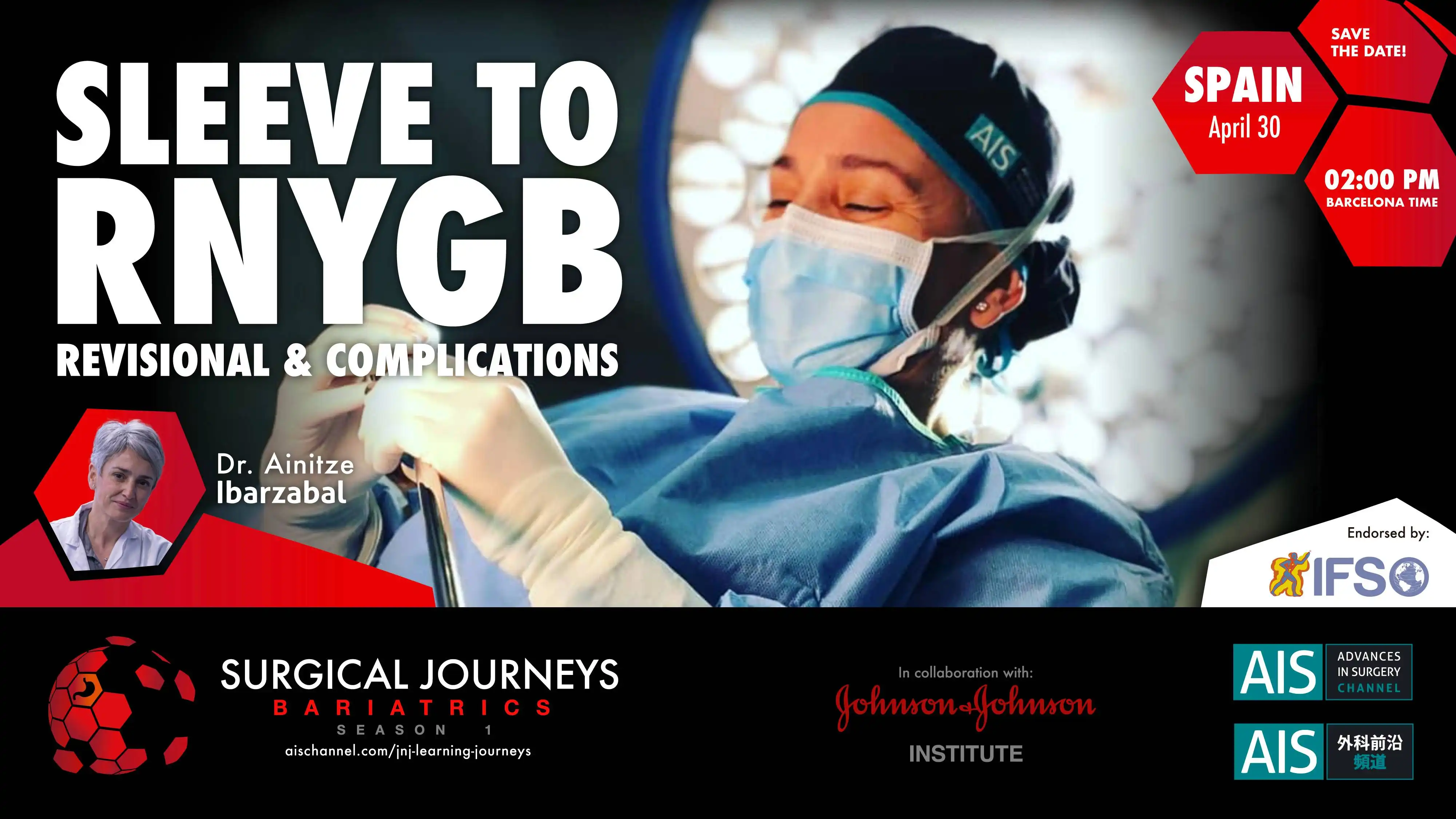
Dr. Ainitze Ibarzabal Olano and her team at Hospital Clínic, Barcelona perform a revisional RNYGB to a 55-year-old male patient who underwent a Sleeve Gastrectomy in 2015.
With Johnson & Johnson MedTech
Published
Apr 2021

Surgical Treatment of Type-2 Diabetes: what’s the current evidence? Diabetes affects about 387 million people worldwide. In the next 20 years, its prevalence is predicted to double, and more than half a billion people will be affected. Etiopathogenesis of type 2 diabetes and obesity In a subject at risk of having diabetes (obese patient or first-degree relative), the first thing that happens is insulin resistance. Most patients with diabetes are overweight or obese and suffer from increased visceral adiposity. There is ample evidence to prove that inflammation is directly related to insulin resistance. Both hyperplasia and hypertrophy of the adipocytes can contribute to the expansion of adipose tissue. This expansion can lead to a number of effects, including hypoxia, cell death of adipocytes, increased secretion of cytokines, and deregulation in fatty acid flows. Effect of surgery on type 2 diabetes Multiple research studies have been developed to try to clarify the physiopathological mechanisms by which diabetes and the glycemic profile improve after obesity surgery. Initially it was thought that these results were due to the restriction and/or malabsorption produced by the surgery. There is no doubt that weight loss has a crucial effect on resolution, but certain factors such as the fact that the improvement of glycemic metabolism after obesity surgery occurs even before weight loss made us think of other possible causes not related to weight loss that could also have an effect on this evolution. The anatomical alterations made in surgical procedures trigger certain physiological changes (hormonal, increased bile acids, changes in the microbiota and even changes in intestinal morphology) that may contribute to these results, although the main cause of the resolution of diabetes remains unknown. From bariatric to metabolic surgery The rising prevalence of diabetes that is being observed worldwide is related to the large number of overweight and obese subjects. The extent of the problem is significant, so different medical societies have been taking an interest in the treatment of diabetes from obesity and there are currently several published guidelines for the treatment of diabetes where surgical treatment has special prominence. Multiple studies have demonstrated the efficacy of surgery over conventional medical treatment, and these satisfactory results have led to an extension of the indications for obesity surgery to the so-called metabolic surgery, which would be defined as the one aimed at improving or curing poorly controlled diabetes with medical treatment in patients with grade I obesity or even in overweight patients.
Published
Jul 2020

Case A 75 year-old man with a medical history of atrial fibrillation and laparoscopic radical prostatectomy for prostate adenocarcinoma. He came to the Emergency Department due to melena and hemodynamic instability with a blood test which found a Hemoglobin level of 7.9 g/dL. And emergent upper endoscopy showed early gastric neoplasia (type IIa + IIc) with a biopsy compatible with gastric adenocarcinoma. A CT scan showed a tumor in the right kidney with no signs of locally advanced gastric cancer. Thus a minimally invasive subtotal gastrectomy with D2 lymphadenectomy was scheduled. Treatment Surgery started with a lymphadenectomy of the greater curvature, with dissection of the gastroepiploic artery and vein. (Later, dissection of the pylorus and postpyloric section with an EndoGIA was performed. Lymphadenectomy of the left gastric artery, celiac trunk, hepatic artery and splenic artery followed. D2 lymphadenectomy with preservation of the ganglionar stations 1 and 2 was performed. Once this was done, the vascularization of the gastric stump was assessed with 5mg of ICG inserted through a central catheter, and the decision to section the stomach in a well-perfused portion of the gastric stump was made, as this would be the site of the gastrojejunal anastomosis. A end-to-side anastomosis was created using an Orvil®. The mesenteric defect was then closed. Outcome The patient had an uneventful postoperative evolution and started oral intake on the first day after surgery. He was discharged on the 4th postoperative day. Pathology reported a T2N0 (0/18) gastric adenocarcinoma. Conclusions Even though leakage after a subtotal gastrectomy with gastrojejunal anastomosis is uncommon, when a leak occurs the consequences are devastating, both in the oncologic long-term as well as in terms of function, morbidity and mortality. The use of tools such as ICG, which provide a guide for safer anastomosis, are useful and may help to further reduce this dreadful complication.
Published
Dec 2019

Obesity is considered nowadays a pandemic and its incidence increases year after year. Multiple treatments have been proposed but current literature data suggest that surgery is the most effective of them. Studies such as STAMPEDE concluded that, at five years, bariatric surgery plus intensive medical therapy is more effective than intensive medical therapy alone in decreasing hyperglycemia in obese patients with uncontrolled type II diabetes. Mediterranean surveys reported in 2014 a 15.1% of patients with obesity among the population aged 18 to 74 years (15.2% men, 15.1% women). This health survey reflects a relationship between excess weight and social class of educational level. This is reflected by the fact that 7.3% of the population with university studies was obese compared with 22.9% of the population with primary education. In the case of women, this relationship was more intense, being those women without studies or with primary education four times more likely to present obesity than women with university studies. Laparoscopic surgery has become the gold standard approach for the surgical treatment of obesity, due to enhanced recovery. This easier recovery from surgery has popularized bariatric surgery, with increasing numbers of patients treated each year worldwide. Data from Catalonia reflect 10,872 patients with morbid obesity surgically treated between 2012 and 2016. These outcomes can be compared with those reported from the 2016 International Federation for the Surgery of Obesity and Metabolic Disorders (IFSO), which represent a Federation of 62 national societies. The total number of bariatric procedures performed in 2016 was 685,874, including both surgical (96%) and interventional (4%). The most common surgical procedure in primary indication was sleeve gastrectomy (53.6%), followed by Roux-en-Y gastric bypass (30.1%). As in Mediterranean registries, there was a significant fluctuation of the type of bariatric procedures over the time, being sleeve gastrectomy the most commonly performed surgical intervention after 2013. Mediterranean data on surgical outcomes report a length of hospital stay of 5 days (range 0-180) with 4.6% of the patients requiring Intensive Care Unit. It is clear that the number of bariatric procedures (both surgical and endoluminal) continues to increase. Moreover, since 2013, the most commonly performed surgical intervention is sleeve gastrectomy. Experience from pancreatic and esophageal surgery suggest that regionalizing patients in high volume centers may decrease complications, this has also been shown in metabolic surgery. In conclusion, obesity is a pandemic that affects nearly 1/6 of the population. Its incidence is higher among patients with low education, especially in women. Bariatric surgery associated with intensive medical therapy is the most effective treatment for obesity and its comorbidities such as hyperglycemia. The surgical procedures have been changing over the years, with an important increase of sleeve gastrectomy procedures after 2013 on the Mediterranean area, reflecting the global tendency showed by the IFSO survey. Bariatric surgery is safe, with a low rate of complications and mortality, and on Mediterranean patients is associated with a fast recovery (LOS < 5 days). The regionalization of bariatric and metabolic surgery in high experienced centers is desirable.
Published
Oct 2018

Clinical Case Bariatric surgery is more strongly recommended in obese patients with type 2 diabetes mellitus when diabetes is inadequately controlled despite optimal lifestyle and pharmacologic therapy, including insulin. With the increase of bariatric surgery procedures across the world, it is important to better understand the outcome of the disease, especially in surgical candidates experiencing advanced stages of T2D. However, data on the midterm effect of Roux-en-Y gastric bypass and sleeve gastrectomy in this group of patients is scant . We review a study that was conducted at Hospital Clinic (Barcelona) to evaluate the extent and duration of the hypoglycemic effect of bariatric surgery on patients with type 2 diabetes mellitus treated with insulin. Methods A prospective observational study (4.9 ± 1.9 years) was conducted on the results of TDM2 , the changes in hemoglobin A1C (HbA1c) and the therapy of diabetes in individuals with DM2 treated with insulin who underwent Roux-en-Y gastric bypass (24 patients) or sleeve gastrectomy (50 patients) . Study participants were selected from among the 344 patients with T2DM who underwent BS at Hospital Clinic between January 2005 and December 2013 . Selection criteria for the study included insulin therapy before surgery and postsurgical follow-up of at least 24 months at the time of this analysis. T2DM remission was defined as HbA1c < 6.5% and FPG < 126 mg/dL without hypoglycemic medication. T2DM relapse criteria for T2DM according to ADA after T2DM remission attained after bariatric surgery. Results Overall, remission was observed initially in 20 out of 74 patients (27%) . However, throughout follow-up T2D relapse was observed in 13 of 20 participants (65%) , resulting in a final proportion of 90.5% of the cohort presenting with T2DM at their last follow-up visit (67 of 74 patients). Sustained remission was associated with younger age, lower HbA1C, a tendency toward shorter duration of T2DM, and N-BB insulin therapy compared with patients with nonremitting diabetes but not with differences in %EWL over the observation period Initial reduction of HbA1C and high rates of insulin cessation were observed (HbA1c nadir 5.9% ± 0.9%, insulin cessation rate 66.2%). However, these were followed by progressive deterioration of HbA1c (HbA1c at last follow-up 7.4% ± 1.3%; P < .001) and need for insulin therapy reintroduction (rate of insulin cessation at last follow-up visit 54%; P=.04). In multivariate analysis , larger maximum percent excess weight loss and nonbasal bolus insulin therapy were identified as significant predictors of diabetes remission, insulin cessation, and durability of HbA1C <7% . Comparison of T2DM remission rates at 1, 2, and 3 years demonstrated a tendency toward higher remission rates after RYGB, even though comparison was significant only at 3 years. Likewise, RYGB patients presented with lower HbA1c levels at 24, 36, and 48 months after surgery despite % excess of weight loss not being significantly different between surgical groups. Finally, the Kaplan-Meir analysis demonstrated that the median time free of T2D was longer for RYGB patients than for SG patients (47.8 ± 14.6 and 28.8 ± 4.6 mo, respectively), albeit no statistically significant differences were found (P = 0.167). Conclusion In insulin-treated patients with T2DM, bariatric surgery is associated with a low likelihood of midterm diabetes remission. Overall, in this group of patients, the marked initial improvement in glycemic control and insulin independence are of limited durability . In addition, in this group of patients, the need for prandial insulin and lower postsurgical weight loss may hamper the beneficial effects of bariatric surgery on glycemic control.
Published
Mar 2018

Clinical Case Since the introduction of the minimally invasive approaches, the benefits of laparoscopic colorectal resections, such a complete exploration of the abdominal cavity, minimal surgical trauma, and favorable surgical results when compared to the open approach, have been enhanced. However, the difficulties of intra-operative localization small cancers and polyps at the time of surgery without tattoo have been highlighted, due to reduced tactile feedback during laparoscopy. The precise lesion location must be identified pre-operatively as failing to identify the lesion for resection can result in open conversion or removal of the wrong bowel segment. In this set-up, endoscopic India ink marking techniques during preoperative colonoscopy were implemented and this is current one of the preferred methods with approximately a 70 to 90% of successful intra-operative location. However, endoscopic documentation of the tattoo site with respect to the tumor can be inconsistent and at times misleading or difficult to interpret. According to the literature, the tattoo is visible and accurate in 60 to 90% of cases, visible but inaccurate in approximately 5 to 10% of cases and not visible in 15 to 20% of case. In up to 20% of patients, no tattoos were found and either intraoperative endoscopy and/or intraoperative specimen analysis was required to confirm that the lesion was within the resection specimen. In cases of location failure, a complete review of the full length of the bowel is necessary. Laparoscopically enhanced visualization may be able to compensate for inconsistent documentation of the tumor´s distance from the anal verge. Identifying difficult spots, such as the splenic flexure, is definitely feasible at this point thanks to the laparoscopic instrumentation. Helpful maneuvers to visualize the tattoo may be the release of omental attachments or adhesion, or lateral mobilization of the colon, which may be hiding the ink on its posterior side. If any of these resources are unsuccessful, intraoperative colonoscopy may be useful for accurate localization. Conclusions Preoperative endoscopic tattooing is a safe and effective technique for intraoperative localization of colorectal lesions, improving the operative results of laparoscopic colorectal resections.
Published
Aug 2017
Help your network discover Dr. Ainitze Ibarzabal's clinical expertise.